Argentina face punishment over World Cup victory celebrations against England

 Politics once again spills onto the football pitch (Photo: x.com/AFASeleccionEN)
Argentina's dramatic 2-1 victory over England in the 2026 World Cup semifinal ended in controversy off the pitch. Several Argentine players could now face disciplinary action from FIFA after displaying a banner with a political message, according to The Guardian.
Moments after the final whistle, while celebrating their stunning comeback and place in the World Cup final, Argentina midfielder Giovani Lo Celso and defenders Nicolás Otamendi and Lisandro Martínez unfurled a large banner on the field reading:
"Las Malvinas son Argentinas" ("The Malvinas Islands are Argentine").
According to media reports, the banner originally came from supporters in the stands before the players carried it onto the pitch. The gesture sparked outrage in the United Kingdom and quickly drew the attention of FIFA officials.
Under the International Football Association Board (IFAB) rules and FIFA's Disciplinary Code, players are strictly prohibited from displaying political, religious, or personal messages, slogans, or symbols during official matches or ceremonies. The semifinal had already been designated a high-risk fixture, and U.S. authorities had warned fans that such banners would not be permitted inside the stadium.
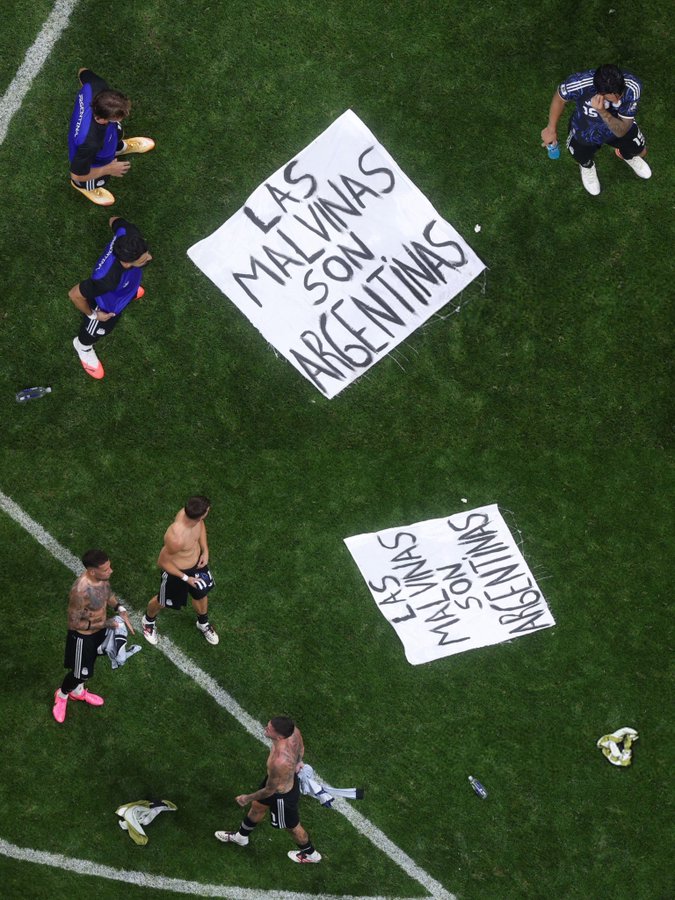
Controversial banner on the pitch (Photo: x.com/AFASeleccionEN)
Politicians react as coach distances himself
The incident quickly escalated beyond football. Even before the match, Argentina's Vice President Victoria Villarruel had fueled anticipation by calling the semifinal "an opportunity to put the occupiers in their place." After the final whistle, she openly praised the team's controversial gesture.
"They banned us from bringing this issue into the stadium, but they forgot that we carry it in our blood and in our hearts," Villarruel said.
The players also made little effort to hide their views. Asked about the banner, midfielder Leandro Paredes responded simply, "They will always be Argentine."
Head coach Lionel Scaloni, however, attempted to distance himself from the controversy, saying that sport and politics should not be mixed and describing the 1982 war as a tragic chapter in history.
What consequences could Argentina face?
FIFA is now awaiting official reports from match delegates and referees before assessing the incident.
If the governing body opens disciplinary proceedings and determines that the banner constituted a political message, the Argentine Football Association (AFA) and the players directly involved could face substantial fines or even suspensions.
The Falklands dispute explained
The sovereignty dispute over the Falkland Islands (known in Argentina as the Malvinas) has lasted for nearly two centuries, dating back to 1833, when Britain established control over the archipelago.
The conflict reached its most intense point in 1982, when Argentine forces landed on the islands, triggering the 74-day Falklands War. The conflict ended with Argentina's surrender and claimed the lives of more than 900 service members from both sides.
Today, the islands remain a British Overseas Territory, a status reaffirmed in a 2013 referendum, when more than 99% of residents voted to remain under British sovereignty. However, the United Nations continues to classify the issue as a territorial dispute and urges both countries to resolve it through peaceful bilateral negotiations. For many Argentines, the Malvinas remain a deeply emotional national cause.