Ancient Boyko and Hutsul Christmas magic from Carpathians

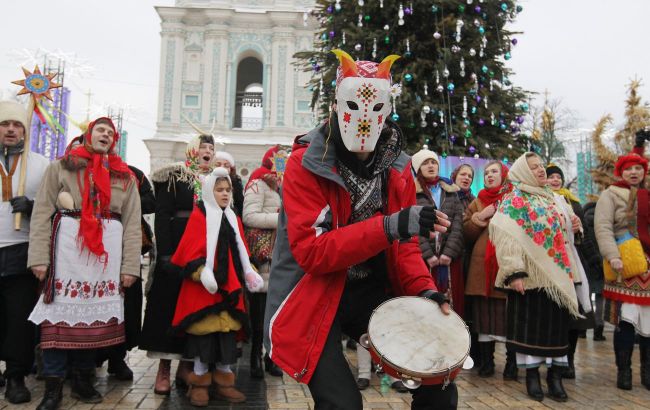 What ancient Christmas traditions and rituals existed in the Carpathians (photo: Getty Images)
For centuries, Christmas in Ukraine was not just a church holiday but also a complex system of family and ritual practices. Urbanization and Soviet prohibitions largely erased many of them from everyday life. However, in the mountain villages of Hutsulshchyna, Boikivshchyna, and Lemkivshchyna, many ancient Christmas customs have survived in an almost authentic form, from men's caroling communities to the rituals of the hospodar in a traditional grazhda household. How our ancestors celebrated Christmas many years ago, and which traditions have survived to this day
Christmas traditions in the mountains
Across Ukraine, the Christmas cycle begins with Christmas Eve: a meatless dinner of twelve dishes, with kutia and uzvar being mandatory. Their number is traditionally associated either with the twelve apostles or the months of the year.
The main symbol of the holiday is the didukh, a sheaf made from the first or the best ears of grain, which symbolizes the presence of ancestors in the home and a good harvest.
In the Carpathians, these common Ukrainian elements were complemented by local mountain specifics: trembitas, men's caroling communities, the hospodar's incantations, and a special attitude toward fire and livestock.
Thanks to their distance from large cities and Sovietization, these practices survived the 20th century almost without being interrupted.
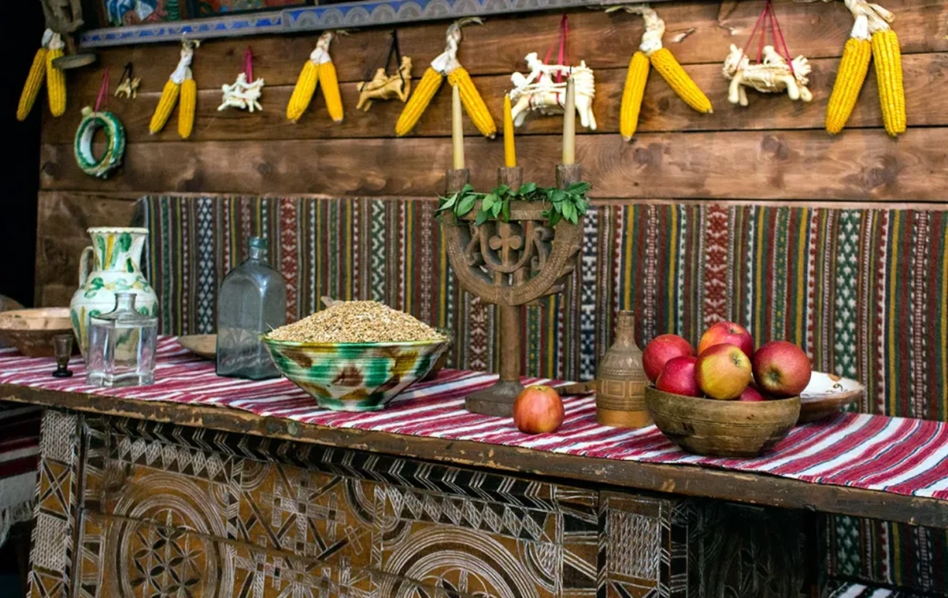 Exhibition "Hutsul Christmas" (photo: Photographs of Old Lviv)
Christmas Eve in a Hutsul grazhda
In mountain villages, preparations for Christmas begin long before the holiday: the house is thoroughly whitewashed, the floor is scrubbed, fresh straw is placed on the beds, and clothing is mended.
Hutsuls still emphasize that one must reach Christmas Eve "with a clean body and soul", meaning without quarrels, swearing, or alcohol, and it is customary not to eat until the first star appears.
In Boikivshchyna, a custom of binding the table with an iron chain "so that the cattle stay together and wild animals don't tear them apart in summer" was recorded, as well as placing hay under the tablecloth as a reminder of Christ's manger and the close connection between people and the highland pastures.
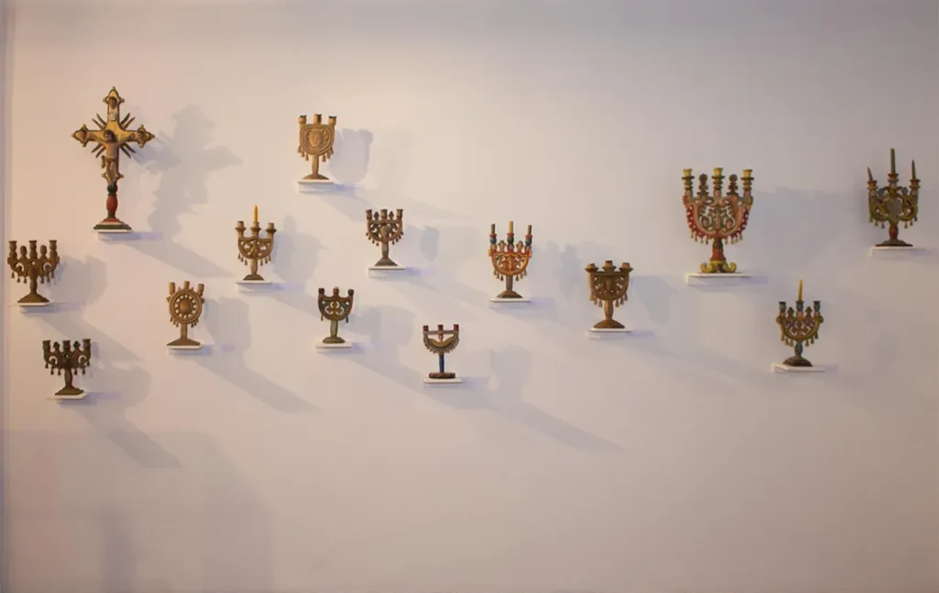 Exhibition "Hutsul Christmas" (photo: Photographs of Old Lviv)
Kutia and Christmas dinner for animals
Kutia is the main dish of Christmas Eve in all regions of Ukraine, but in the mountain villages, it has become a true ritual.
In Prykarpattia, they still know the old custom of throwing kutia at the ceiling: the hospodar or the eldest son tosses a spoonful of kutia toward the beam, and the number of grains that stick is considered a sign of the coming year's harvest and prosperity.
After dinner, part of the dishes, primarily kutia and bread, are taken to the stable and given to the livestock. It was believed that the hospodar shares the holiday with those who feed the family all year long, while also asking for protection from illness and misfortune in the coming season.
This "dinner" for the animals is also spread in other regions. However, in Carpathian villages, it is still often practiced, especially where traditional cattle herding survived.
Hutsul caroling
The most striking ritual, which has survived in nearly its original form only in certain villages of Verkhovyna district, is the Hutsul caroling. It is not just going from house to house singing. It is a complex system involving the entire community, the church, and even local self-governance.
In Kryvorivnia and nearby villages, caroling begins near the church after the Christmas Liturgy. The priest blesses the carolers, and the donations they collect are later directed toward restoring the church and supporting soldiers or the sick.
The key element is the parties or camps, which are men's groups of carolers from different hamlets. Each has its own clothing, repertoire, and route, and visiting all the homes may take from Christmas until Epiphany.
Joining the carolers is prestigious but also a responsibility, as boys are accepted into the group only after a dedication ritual and several years of apprenticeship.
Ethnographers also highlight the "caroling with axes" ritual preserved particularly in Kryvorivnia. Carolers walk through the village with carved axes and a wooden cross, singing ancient, drawn-out carols like "On Sunday Morning the Sun Rose," which combine Christian and archaic cosmogonic motifs.
All of this is accompanied by the Hutsul trembita, a multi-meter wooden horn whose sound signals the start of the holiday and gathers people to church or to meet the carolers.
Vertep, the goat, and 'living fire'
The Vertep (Christmas theatrical procession with shepherds, angels, kings, and other characters) is known in most regions of Ukraine.
However, in the Carpathians, it often remains an almost spontaneous folk performance, where the script is not fixed, and characters may react to current events, including the war or local news.
In Hutsulshchyna, the goat procession has also survived alongside the vertep, a masquerade walk featuring the character of the Goat, symbolizing fertility and life force. In some villages, this custom takes place specifically during the Christmas period, though in other regions it is more often tied to Malanka.
Another ancient layer of worldview felt in the Carpathian Christmas is the cult of fire.
Researchers of highland traditions describe the ritual of the "living fire": a fire lit in the pasturelands at the beginning of summer is considered sacred and is not extinguished with water. They let it burn out on its own.
The shepherds leave firewood and food near the stable for wandering travelers, and they do not lock the doors so that anyone can find shelter in winter.
Although this ritual is directly tied to the summer cycle, in the Christmas stories of elders, it constantly appears as a reminder: the fire in the stove and the candles on the table are a continuation of the same God's fire that protects the home and the community.
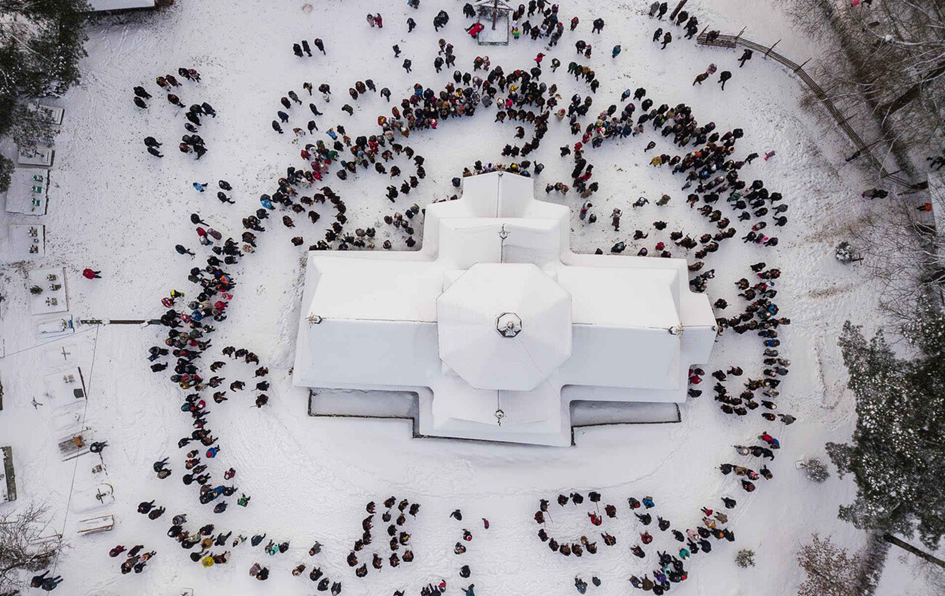 Caroling (or Koliada in Ukrainian) in Kryvorivnia (photo: Ukraїner)
Ancient rituals in the modern Carpathians
Despite the war, migration, and tourism, Carpathian Christmas traditions have not turned into folklore for tourists.
In the villages of Prykarpattia and Zakarpattia, customs, such as Christmas Eve dinner of 12 meatless dishes, a didukh, a dinner for the livestock, and a family prayer, are still preserved.
Hutsul caroling is already mentioned in research as an element of intangible cultural heritage alongside Ukrainian borshch and pysanka art, and local communities are working to protect and promote it.
For the rest of Ukraine, these stories are not only a tourist attraction but also a reminder that the ancient Christmas as it was in grandma's village is not a romantic myth but a living practice that still holds on in the Carpathian mountains and gives a sense of continuity to Ukrainian culture even in times of great upheaval.
Sources: Photographs of Old Lviv, Ukraїner, Izki, ethnographic essay "Customs of Our People" by O. Voropai.