10 dimensions may not exist: AI study at Large Hadron Collider challenges theory

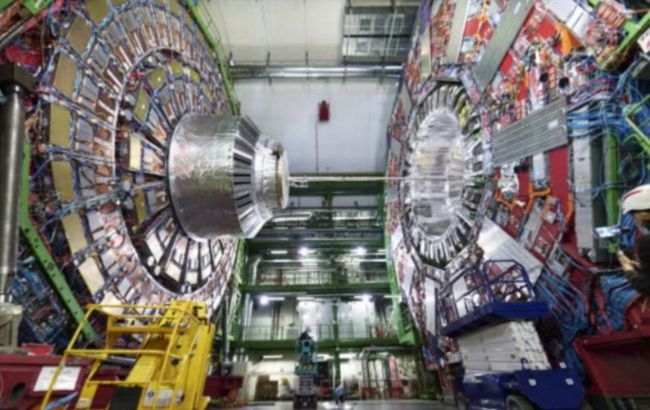 Scientists at the Large Hadron Collider seek answers about the origins of the universe (photo: CERN)
Physicists at the Large Hadron Collider searched for microscopic black holes, using a new machine-learning algorithm for the first time, according to a press release from the University of California, Santa Barbara (US).
How AI helps search for microscopic black holes
The laws of physics are divided into two main parts: one explains the behavior of massive objects in space (gravity and relativity), while the other describes the microscopic world (quantum physics).
To unify them, scientists look for phenomena where these two worlds intersect. Microscopic black holes are one such phenomenon.
Under certain conditions, when protons collide at extremely high speeds, space-time could theoretically become compressed, forming a tiny black hole. It would be harmless to Earth because it would exist for only a tiny fraction of a second before instantly decaying.
To search for traces of such decays in data collected from 2016 to 2018, scientists used AI. The new algorithm compared the energy and direction of motion of all particles simultaneously.
The method proved to be more accurate than previous approaches because it analyzes the overall picture of the collision as a single event.
What this means for string theory and other dimensions
During the study, scientists found no evidence of microscopic black holes being created. This suggests that they do not form at the collider's current energy levels.
The finding is highly significant for science. Physics includes many theories that predict the existence of parallel or hidden dimensions of space.
For example, the popular string theory predicts the existence of 10 dimensions. However, new experimental data suggest that if additional dimensions exist, there can be no more than two under the conditions studied.
Creating the smallest black hole without additional dimensions would require energy 1,000,000,000,000,000 times greater than what is available inside today's collider.
Mystery of matter's origins, future of experiments
In addition to black holes, physicists searched for special unstable particle states known as sphalerons.
They could help explain one of the biggest mysteries surrounding the origin of the universe: why matter did not completely annihilate with antimatter during the Big Bang, leaving the universe empty, but instead formed stars, planets and people.
Scientists have not detected sphalerons either, which allows them to rule out some incorrect assumptions.
The collider is currently shut down for a major upgrade. Once the equipment is upgraded, scientists will be able to conduct collisions with even greater precision and investigate how exactly the universe formed during the earliest stages of its existence.