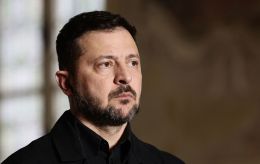
'We must drop illusion of making deal with Putin.' Interview with Ukrainian lawmaker Oleksandr Merezhko


 Oleksandr Merezhko (photo: facebook.com/oleksandr.merezhko.2025)
The ratification of the peace agreement in the Verkhovna Rada and the referendum, relations with US congressmen, Donald Trump, and European support are discussed in an interview with Oleksandr Merezhko, Chairman of the Verkhovna Rada's International Committee.
Key questions:
- Is ratification of the peace agreement in the Verkhovna Rada realistic?
- Are MPs involved in the peace talks?
- How does Ukraine work with US congressmen?
- What does Trump's activity from Venezuela to Greenland mean for Kyiv?
At the end of last year, President Volodymyr Zelenskyy presented a draft framework peace agreement. However, due to problematic issues, primarily the question of territory, he would prefer to put the deal to a nationwide referendum. Another option is to ratify such an agreement in the Verkhovna Rada.
However, there are questions about both options, as the Verkhovna Rada cannot ratify international treaties that contradict the Constitution, according to Oleksandr Merezhko, chairman of the Verkhovna Rada Committee on Foreign Policy and a professor of international law.
"As a theoretical idea, of course, it can be discussed, but when you start to analyze the necessary prerequisites for this, you realize that it is not yet very clear whether it makes sense at all," Merezhko emphasizes.
Therefore, the President of Ukraine will still need to explain what exactly he wants from the people's deputies. At the same time, Merezhko insists that the people's deputies will not shirk responsibility if the agreement is brought to parliament.
However, this prospect remains very distant because, as before, Putin does not want peace. But, according to the MP, Trump already understands the real intentions of Putin.
Equally important, the US President has begun to lose his psychological barriers to putting pressure on Putin and other members of the so-called coalition of evil.
Since the beginning of the year, the US, on Donald Trump's orders, has carried out an operation to capture Nicolás Maduro in Venezuela, while Washington has sharply escalated its rhetoric on Iran amid mass protests and has also begun detaining Russian tankers. At the same time, his rhetoric on Greenland is creating new challenges for Europe and Ukraine.
US activity around the world
— What does Trump's turbulent activity, from Venezuela to Iran and Russia, mean for Ukraine?
— There are pros and cons here. Because if we look at each case or each of Trump's actions separately, we see that there are things here that can be useful for us. I am referring primarily to the situation surrounding Venezuela.
There is a cross-party group (in the Rada – ed.) called Free Venezuela, of which I am co-chair. This means that we maintain contact with the democratic opposition, in particular with those parliamentarians who won the elections that were stolen by Maduro.
We all understand that Maduro is Putin's ally. This is important for us because it weakens this so-called coalition of evil that is essentially waging war against Ukraine. I always emphasize, in my communications with our counterparts and partners, that it is wrong to perceive Russian aggression as merely a war between one country and another.
We are fighting an entire coalition of authoritarian regimes, which, incidentally, includes Venezuela. Therefore, this is a defeat for this aggressive coalition.
The fact is that we do not know how events will unfold. I am a professor of international law, not just a politician, and therefore I try to look at foreign policy from the point of view of objective international legal analysis. And here there may be certain difficulties. Because, again, for me, Russian aggression against Ukraine is also a war against international law.
It is in our interests to support the international legal order and international law, and to show a certain degree of principle. I do not believe in double standards. It is dangerous. We do not know how events will unfold in Venezuela now, but it is very important that they unfold, first, in line with international law and, second, in line with democracy.
— What about Greenland and Denmark?
— My position here is unequivocal because, first of all, Denmark, I want to emphasize, is one of our greatest friends. If we analyze it in terms of gross domestic product per capita, we see that it is one of the leaders in assisting Ukraine.
Denmark has always supported Ukraine's territorial integrity. And we must also support their territorial integrity. You know, I believe that the United States as a country, as a people, is an ally and a friend. But it is normal for even friends to have different points of view.
— Actually, that's my next question. The weakening of unity between NATO members on different sides of the Atlantic – how could this be dangerous for Ukraine?
— It is very dangerous. I believe in transatlantic solidarity, and one of its elements is the NATO defense alliance. It must be strengthened.
There is a certain danger because we do not know how events will unfold. We must fight together with our European partners and convince them that it is in the interests of the United States to preserve the world order that was created after World War II, with their active participation. This includes institutions such as the UN, the International Monetary Fund, and, above all, NATO. This is because NATO's strength depends on trust in it.
If we observe negative trends within NATO—when internal solidarity is weakened rather than strengthened—this is dangerous. It undermines trust in NATO and its capabilities.
We need to convince President Trump of this. By the way, I see different people with different views in his circle. I hope there are many who understand the importance of NATO for the United States.
Because it is a huge plus for them. And for the world as well, and for the security of Europe and Ukraine. Therefore, we must work hard here to convince them.
— Nevertheless, to conclude the topic of Greenland, let's take the worst-case scenario, when a conflict between the United States and Europe could begin. In that case, whose side should Ukraine take?
— I don't believe such a conflict will happen. After all, I did a little research and read a lot before Trump became president for the second time. I collected a library of books about Trump and read his books, trying to understand what kind of person he is.
His style is not that of a diplomat, but of a businessman. Some people perceive this as a slightly aggressive style of negotiating deals. He himself writes about this that he deliberately raises the bar, sets it very high, and then starts negotiations.
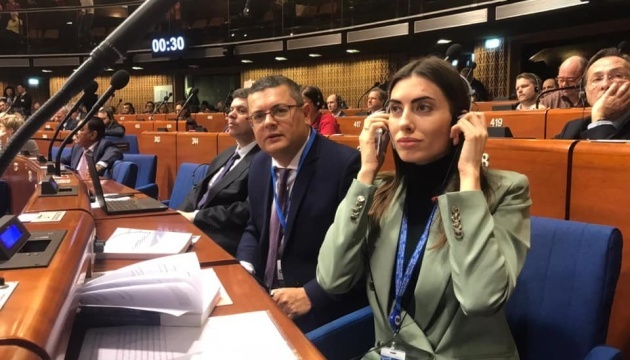
Oleksandr Merezhko at the Parliamentary Assembly of the Council of Europe (photo: facebook.com/oleksandr.merezhko.2025)
These statements, thank God, do not cross the red lines of international law, at least not yet. The issue of Greenland can be understood in a security and geopolitical sense, because it is an important issue for the security of the United States. And Trump is open about this. He would not want Greenland to fall under the influence of Russia or China.
But the question is how to achieve this. I am convinced that this must be done within the framework of international law, without violating the territorial integrity of Greenland.
I think that, more likely, some kind of compromise will be found that will not affect or destroy the international legal order in the region. But this also means that each state must have a clear position.
Peace talks: risks and opportunities
— What does Trump's growing determination mean in the context of our peace talks, particularly in the context of pressure on Putin?
— This is a rather complicated situation because, again, it could turn out to be positive, or it could turn out to be very negative. But this creates opportunities for us.
It means that we need to work hard with President Trump, and direct contact with our President—summits—is very helpful in this regard. We need to maintain such contact constantly and systematically.
On the one hand, Trump is in a hurry. He likes quick victories and sees himself as a peacemaker. This is reflected in his inauguration speech. But if a politician is in a hurry to resolve a conflict, it may be at the expense of the weaker side. And that is the danger.
Therefore, we need to be very wise, which is what our diplomacy is doing, communicating and explaining to Trump, relying on those people in his administration who understand the danger of such a quick peace at the expense of Ukraine. That this is not peace, it is appeasement of the aggressor. And this does not solve the problem, but creates the conditions for new aggression. And some people understand this.
I think Trump has already realized this. There are signs of this, and I could refer here to an interview in Vanity Fair magazine with his chief of staff, Susan Wiles.
Trump realizes that Putin is not interested in annexing part of Ukraine's territory. Putin is trying to subjugate and destroy the statehood of Ukraine as a whole. The question is how he will respond to this. And here a lot depends on our European partners. We are working in unison here.
Parliamentary diplomacy and work with US Congress
— Senator Lindsey Graham recently said that Trump has given the green light to a vote in Congress on a well-known bill that would impose 500% trade tariffs on Russia. I would like to ask you how actively we are currently working with US congressmen?
— We are working. By the way, a trip with a broad representation is planned for the end of this month to Congress. I am going on this trip, and there will also be representatives of the opposition. That is, on our part, the trip will be multi-party. Our friends from the Baltic states, as well as from other European countries, are actively participating.
This is such an important format, when not only representatives of Ukraine come, but also of Lithuania, Poland, and so on—it makes a huge impression on congressmen. This is not the first time, and we are using all the opportunities of parliamentary diplomacy and communication with both parties.
We continue to have the support of both parties. In fact, the majority. Even the Republicans – the majority support Ukraine. The situation is changing slightly in a positive direction.
If, after the elections (the US presidential elections, ed.), let's say, not all Republicans could speak out in support of Ukraine, although deep down it was clear that they supported it, now we are seeing very positive developments.
Incidentally, we have not given up on Ukraine becoming a member of NATO. I continue to talk about this constantly, and when people tell me that it is not on the table, I say, no, we continue to insist. For us, this is the only real guarantee of our security and even our very survival as a country. No matter what anyone says on this subject, we will continue.
— Still, if we talk about the foreseeable future, what can we realistically achieve through communication with Congress? After all, at least until November, when the midterm elections to Congress will take place in the United States, Trump will remain in full power.
— Not complete power, in the sense that there is a system of checks and balances. And I would like to point out that the latest poll results are very encouraging. They show that American society supports us, meaning that it is still a democratic country where the voice of society matters.
Whoever wins the congressional elections is of no fundamental importance to us: Republican or Democrat. The main thing is that this person supports Ukraine.
Of course, we must continue to work with Trump, and we must also work actively with the MAGA movement (Trump's most loyal supporters, the acronym comes from the slogan Make America Great Again – ed.). Because Trump cannot ignore his voters, who actually brought him to power. But, again, if you don't communicate, you can't convince them. And when you communicate, there is a chance.
And one more thing. Politics in America is not just about Washington. It's individual states. And you have to travel, communicate with representatives of different communities and religions in each state, and meet with local authorities, because it's a federal state. And the states have enormous influence there.
I had a very interesting conversation recently. At the end of last year, a delegation of American experts from think tanks arrived who were not entirely on Ukraine's side, to put it mildly.
It was a very difficult conversation, but still, when you present your arguments, they have to agree. You just have to prove that it is in your interest to support us. Putin is waging war not only against Ukraine, but he is also waging war against the United States as the leader of the rules-based international order and as the leader of the West. Putin's goal is to destroy NATO, to sow chaos. So, ultimately, this is a war by Russia and Putin against the United States.
Why is it important to support Ukraine? Because Ukraine is defending the global democratic order that the United States once created.
Verkhovna Rada and peace talks
— Returning to the peace talks, President Zelenskyy has stated that there are currently two options for a framework peace agreement. These are either ratification in the Verkhovna Rada or a nationwide referendum. What do you think about both options?
— I think that this is very, very far off, and it is a bit of a pipe dream at the moment. It is not even on the horizon.
In general, the very idea of a peace treaty was Putin's idea. He managed to convince some of Trump's entourage that, first, as Putin calls it, the so-called root causes must be resolved.
This is completely illogical and contrary to international law. President Trump must be brought back to his original plan—an unconditional ceasefire. Logically, the first step should be to cease fire, establish a stable ceasefire and a regime of silence, and only then begin negotiations.
.jpg) "Any international agreement must not violate the Constitution of Ukraine."
"Any international agreement must not violate the Constitution of Ukraine."
But if we think about it theoretically, first of all, we do not know what form it will take – legal or political. I am referring, for example, to the Minsk agreements. They did not require ratification because they were not an international treaty. It was a political agreement that had political force, not legal binding force.
We do not yet know what form it might take in principle. This is because a political agreement, even one of an international nature, does not require the consent of parliament, i.e., ratification by the Verkhovna Rada.
Most importantly, any international treaty, in order to be ratified, must not violate the Constitution of Ukraine.
— What about a referendum?
— I can't imagine that. I don't see any point in holding a referendum at this stage. As for the subject of the referendum, it is not yet clear what the subject could be the subject of a referendum.
Some territorial changes? This is impossible from the point of view of the Constitution, which prohibits changes that violate territorial integrity.
— President Zelenskyy said that he would like to put the entire framework agreement to a referendum.
— Again, this does not make sense because it is a matter for ratification by parliament. And parliament can only ratify it if it does not violate the Constitution, including the principle of territorial integrity.
I may be wrong here, but as an international lawyer, I don't see the point of holding such a referendum. Not to mention that it is impossible to hold a referendum during martial law, during a war.
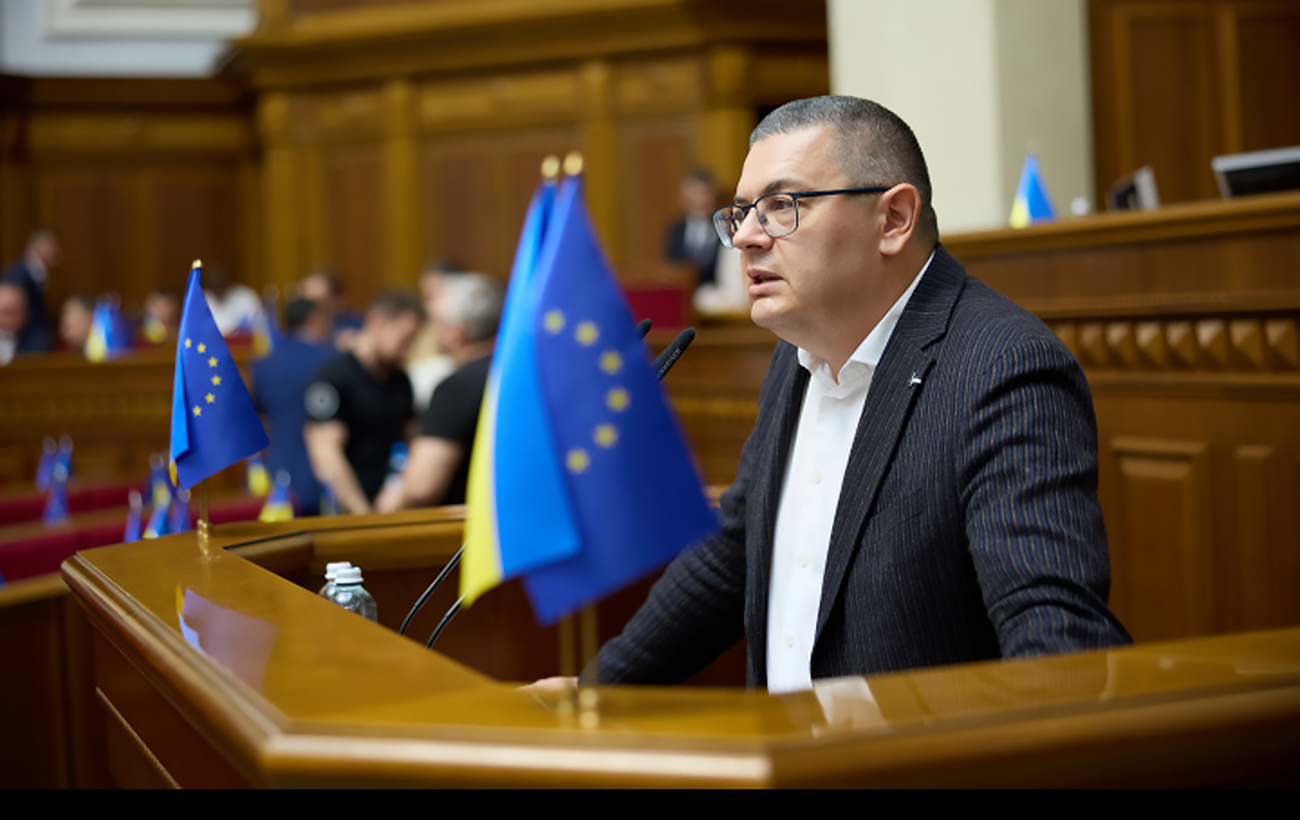 Photo: Oleksandr Merezhko in the Verkhovna Rada (photo: Getty Images)
As a theoretical idea, of course, this can be discussed, but when you start analyzing the necessary prerequisites for this, you realize that it is not yet very clear whether it makes sense at all.
— Various sources in the Verkhovna Rada tell RBC Ukraine that it is unlikely that the necessary votes would be obtained if such an agreement contained painful compromises, particularly regarding territories. In general, deputies would prefer to shift this responsibility to the people. To what extent is this true?
— This is not the case because, again, it still needs to be ratified in parliament if it is an international treaty and not a political agreement, which, in principle, does not require ratification.
You know, I believe that politicians can make mistakes, and that is normal. Everyone makes mistakes, and we learn from them. But there is one thing a politician has no right to do, and that is to shirk responsibility.
When you press the button, you vote as a representative of the people. And that is your personal position. And people appreciate that. They can forgive mistakes. But when a person shirks responsibility, I think that is wrong. That is not a real politician.
Therefore, I am confident that deputies will not shirk responsibility.
— Are deputies currently involved in the negotiation process in any way?
— The leader of the Servant of the People faction, Davyd Arakhamia, participated in the negotiations in Paris. He even communicated with Witkoff.
There is no legal need to involve the Rada (in the negotiations, ed.), because foreign policy issues are the prerogative of the President. This includes conducting negotiations. He decides who is included in the delegation.
And if it is an international treaty, it meets certain criteria and the Constitution, and there is also a law on international treaties of Ukraine, then it is a matter of whether or not to grant consent by parliament.
Security guarantees for Ukraine
— Among all the negotiation tracks, perhaps the greatest progress we have made is on security guarantees for Ukraine from the United States. How might this look from a legal point of view, so that we do not repeat the situation with the Budapest Memorandum?
— Here I can only express my very subjective point of view. I have researched this issue not only as an international lawyer, but also by reading a great deal of literature on what security guarantees actually are.
For me, this is even a political and psychological issue. In other words, the answer depends on Putin. In other words, what in his mind could deter him from a new act of aggression? And I know one thing for sure.
Ukraine's membership in NATO will deter him. We see that he does not dare to attack the Baltic countries, for example.
Therefore, for me, this is the only guarantee. In general, why is Putin afraid of NATO? Because it has the nuclear umbrella of the United States. The main deterrent is the presence of nuclear weapons. That was the case during the Cold War, and it is still the case today. That is why I am proceeding from this, and for me, this is the main guarantee of security. I have no confidence in anything else.
 "Ukraine's membership in NATO will deter Putin. This is the only genuine security guarantee."
We need to proceed from the worst-case scenario. Imagine that there is some kind of agreement that has been accepted, and so on. There is a ceasefire, even some kind of demilitarized zone. I'm not sure if this is technically possible, but let's imagine it.
Then, Putin builds up his forces and attacks anyway. It's not even a question of if, it's a question of when. Will what they offer us be enough to deter Putin? I don't have an answer to that question today.
There is talk of the NATO Article 5 model. But, again, Article 5 is part of NATO. And behind this article stands the entire mechanism of this defense alliance. If you separate this article, I'm not sure it will work.
But there are other interesting models. For example, the US-Japan and US-South Korea security agreements. I looked at the text of the agreement with Japan. Incidentally, it also has Article 5. It is formulated in a similar way to NATO's Article 5, but it is slightly different.
If, for example, Trump agrees to a full-fledged international treaty stating that an attack by Russia on Ukraine will be considered an attack on the United States, then perhaps it is worth considering such a guarantee. This is important. But again, for me, these are not 100% reliable guarantees, like NATO.
That is why we continue to insist (on membership in the Alliance – ed.). We are told that it is impossible, and so on. But we should not create limitations for ourselves.
What were we told? F-16 fighter jets – impossible too. We were told many times before that it was impossible. But we managed to convince our partners.
Therefore, I am sure that the same will happen with Ukraine's membership in NATO.
Strong positions in Europe
— We are also negotiating with Europe. And here it is more about the political context. Over the past year, which was actually a difficult election year, it seems that no new friends of Putin have appeared in power in European countries. Except for Czechia, but there are nuances there. How strong is our position in Europe now?
— They are very strong. Fortunately, we have strong support from European leaders. Here, I include the United Kingdom, which is not a member of the EU, but is a leader in Europe.
In Germany, the current federal chancellor, who has taken a very decisive position, openly says that Germany is in conflict with Russia. In other words, they understand that Russia is already waging a hybrid war against Europe, and that this is a matter of their security.
Ukraine is now Europe's first line of defense. And if we fail, there will be huge problems in Europe. Understanding all this danger, they are determined to support Ukraine. Because it is in their national and security interests.
— What challenges do you see this year in the context of our relations with Europe?
I will start by saying that the biggest challenge is for us ourselves. As long as we hold out, we cannot be defeated. The main thing is not to listen to anyone who wants us to break down and agree to some shameful compromises.
As long as we remain true to our principles in our collective consciousness, we cannot be defeated. The worst thing that can happen is for us to give up in our own minds. This must not happen under any circumstances.
The winner is the one who goes all the way. Therefore, we must be focused only on victory. The return of territories may take some time, but under no circumstances do we have the right to give up.
In Europe, too, there are already calls for having a dialogue with Putin.
There is no one to talk to there. Because when you talk, victory over Russia is postponed. The summit in Alaska did just that. Putin is not a rational person who is really ready for any compromise, as Europeans think. Therefore, the greatest danger is resuming communication with the Kremlin leader.
We must get rid of any illusions that something can be agreed with Putin.