'Ukraine has the advantage': British ambassador Neil Crompton on the war trajectory shift


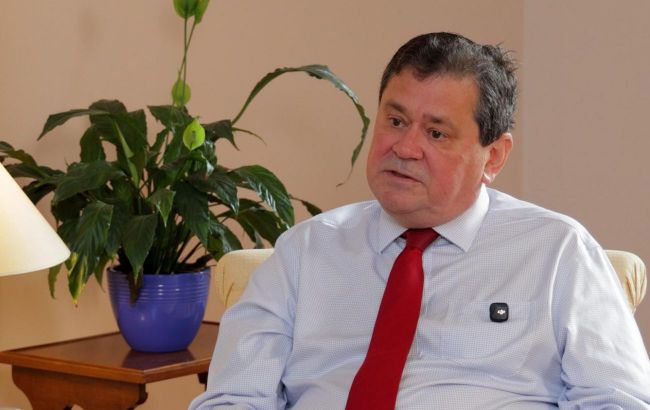 Photo: Neil Crompton, British Ambassador to Ukraine (RBC-Ukraine)
Neil Crompton, British Ambassador to Ukraine, on continuity under a new prime minister, why he thinks momentum has shifted on the battlefield, and the search for an opening to negotiate.
Andy Burnham has been prime minister for barely three weeks, having taken over from Keir Starmer in July after a Labour leadership contest that reshuffled much of the cabinet. In Kyiv, the question hanging over the change was whether it would mean any drift in Britain's support for Ukraine. Neil Crompton, who arrived as ambassador at the end of last October, argues it won't. In a conversation that ranged from battlefield casualty counts to the fate of Roman Abramovich's frozen Chelsea FC proceeds, he laid out why he believes Russia's position — on the ground and around it — is eroding, even as the war grinds on. The interview has been condensed and edited for clarity.
Government reshuffled - policy unchanged
Britain has a new prime minister and a new cabinet, though from the same governing party. Mr. Crompton said the message from Downing Street has been continuity, not change, especially where Ukraine is concerned. Mr. Burnham's first call to a foreign leader after Mr. Trump, he noted, was to Volodymyr Zelenskyy, and the first foreign leader received in London was Mr. Zelenskyy himself, a visit Mr. Crompton attended in person.
He said the PM's message to the Ukrainian president was blunt: "There will be no change in policy, we are absolutely committed to supporting Ukraine."
Beyond that meeting, the working relationships have already been rebuilt: the new defense secretary, Wes Streeting, has spoken with Ukraine's acting defense minister, Yevhenii Khmara, and the new foreign secretary, Ed Miliband, has both met and spoken by phone with his Ukrainian counterpart, Andrii Sybiha. Mr. Crompton predicted the same broad support would hold across the political system and the British public.
As for concerns that Mr. Burnham, a career politician better known for domestic issues like housing and the National Health Service, might pay Ukraine less attention than his predecessor, Mr. Crompton was skeptical.
"In my personal recollection, all prime ministers are primarily focused on domestic policy. That's kind of two-thirds of their job description," he said. "But then they find that when they enter office, they have to become more involved in foreign policy."
He also pointed to a marker of continuity below the political level: Mr. Burnham kept Jonathan Powell, Mr. Starmer's national security adviser, in place — a figure he called "an important voice on issues like Ukraine and issues in the Middle East."
"So I think the same amount of attention will be given to Ukraine and foreign policy as before," he said.
The 3% question
Mr. Streeting recently declined to guarantee that Britain would hit defense spending equal to 3% of gross domestic product by 2030, a hedge that stirred some unease about whether joint UK-Ukraine defense projects might lose momentum. Mr. Crompton dismissed the worry.
"I don't think so," he said. "I mean, there is a commitment to get to 3% of GDP spending on defense. The only debate is over when we get there."
He described a long and complicated process to agree on Britain's defense investment plan — one he said is now settled, even if, as he put it, "there's sort of still little bits of funding that need to be found for that."
 With a new defense secretary and a new chancellor in place, he read Mr. Streeting's caution as a reluctance to promise what hadn't yet been fully worked through internally, not as backing away.
"So the direction of travel is clear," he said.
King's visit to Kyiv
Mr. Zelenskyy has invited Mr. Burnham to visit Ukraine.
"Well, we hope so," Mr. Crompton said. "I think President Zelenskyy certainly invited the Prime Minister to visit. He's only been in office for three weeks, so he has to work out his priorities. But I think the intention is to visit as early as possible."
Asked whether King Charles III might one day visit as well, Mr. Crompton demurred: "Well, I think you have to ask the King. The King has visited Ukraine before, many years ago when he was the Prince of Wales. So he does take a keen interest." He added: "I don't know how many meetings he's had with President Zelenskyy. My guess is it's more than he's had with any other foreign leader. So he cares about the subject."
Mr. Zelenskyy has said publicly, after a past London visit, that he extended an invitation of his own.
'The trajectory of the war has changed'
Asked who currently holds the initiative on the battlefield, Mr. Crompton gave an extended answer.
"I think from my reading, which is shared by my colleagues in London, in the last few months — let's say since the end of the winter, which is obviously a very difficult period — it feels like the trajectory of the war has changed," he said. He broke that down into three parts.
First, he said, "in the east, in the Donetsk region, the war of attrition continues. But I think Ukraine is inflicting extraordinary numbers of casualties on the Russian forces. So I read yesterday, the chiefs of staff said they killed or seriously wounded 42,700 Russian soldiers in July alone."
That figure was up from about 35,000 in April and May, he said, and a somewhat lower count in June, when thicker foliage made it harder to track movement. For comparison, he noted that Soviet losses over the entire Afghan war are put at around 15,000 killed.
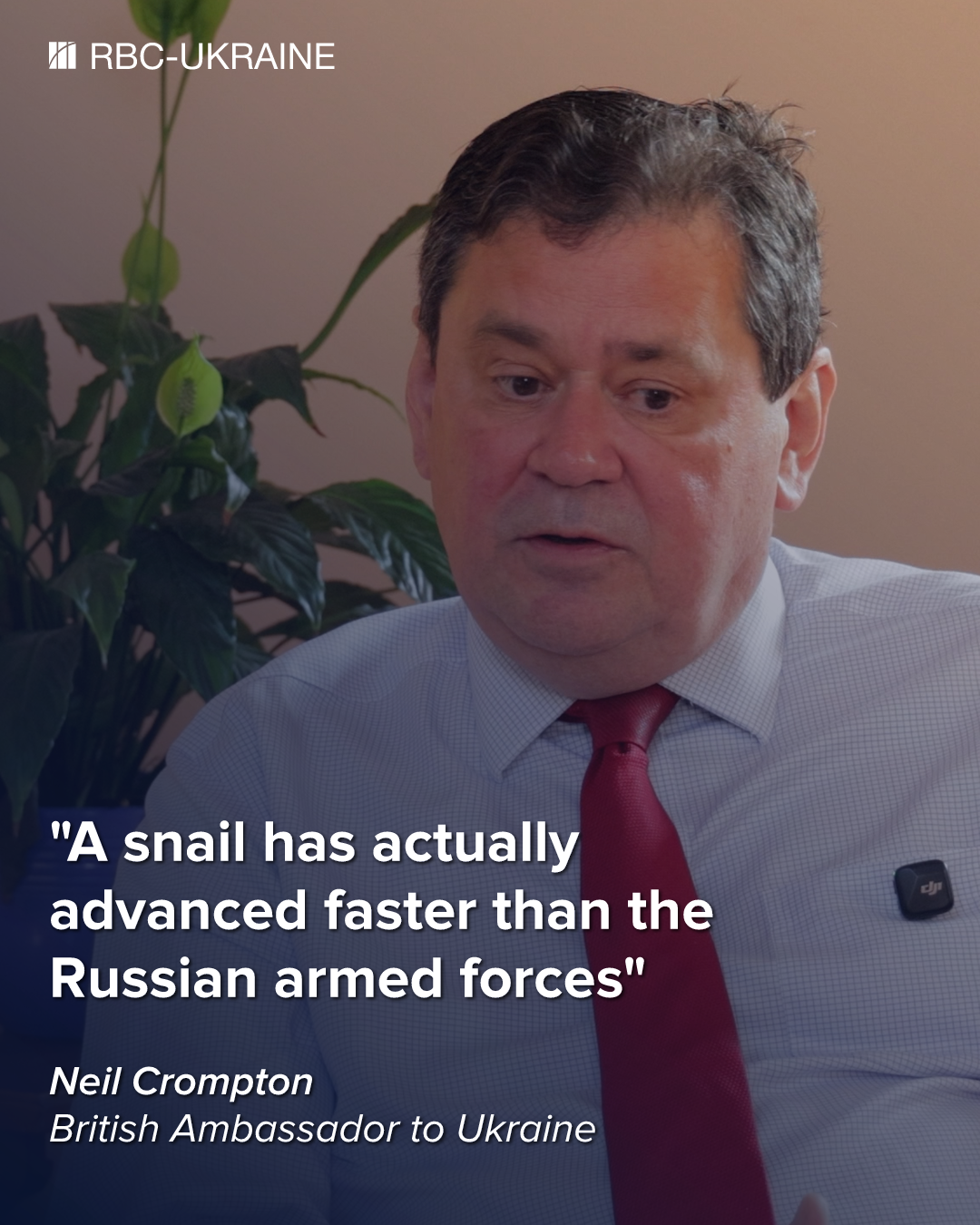
"President Putin is very good at claiming he is advancing very quickly," he said, "but our former chief of defence staff once said that a snail has actually advanced faster than Russian armed forces. And this is coming at a huge cost."
Second, and more significant in his view, has been the growing reach of Ukraine's strikes inside Russian-held territory and Russia itself.
"President Putin has had to declare a state of emergency" in Crimea, he said. "Russian holidaymakers are not going to Crimea. People are having to move out. It's causing real damage to the military supply lines." Crimea, he added, is "the 'jewel in the crown' of the war" for Russia, and therefore "politically difficult for Moscow." Ukraine has also had real success, he said, in "stopping shipping through the Sea of Azov and the Strait of Kerch."
Third is the deepening campaign of long-range strikes on Russian territory.
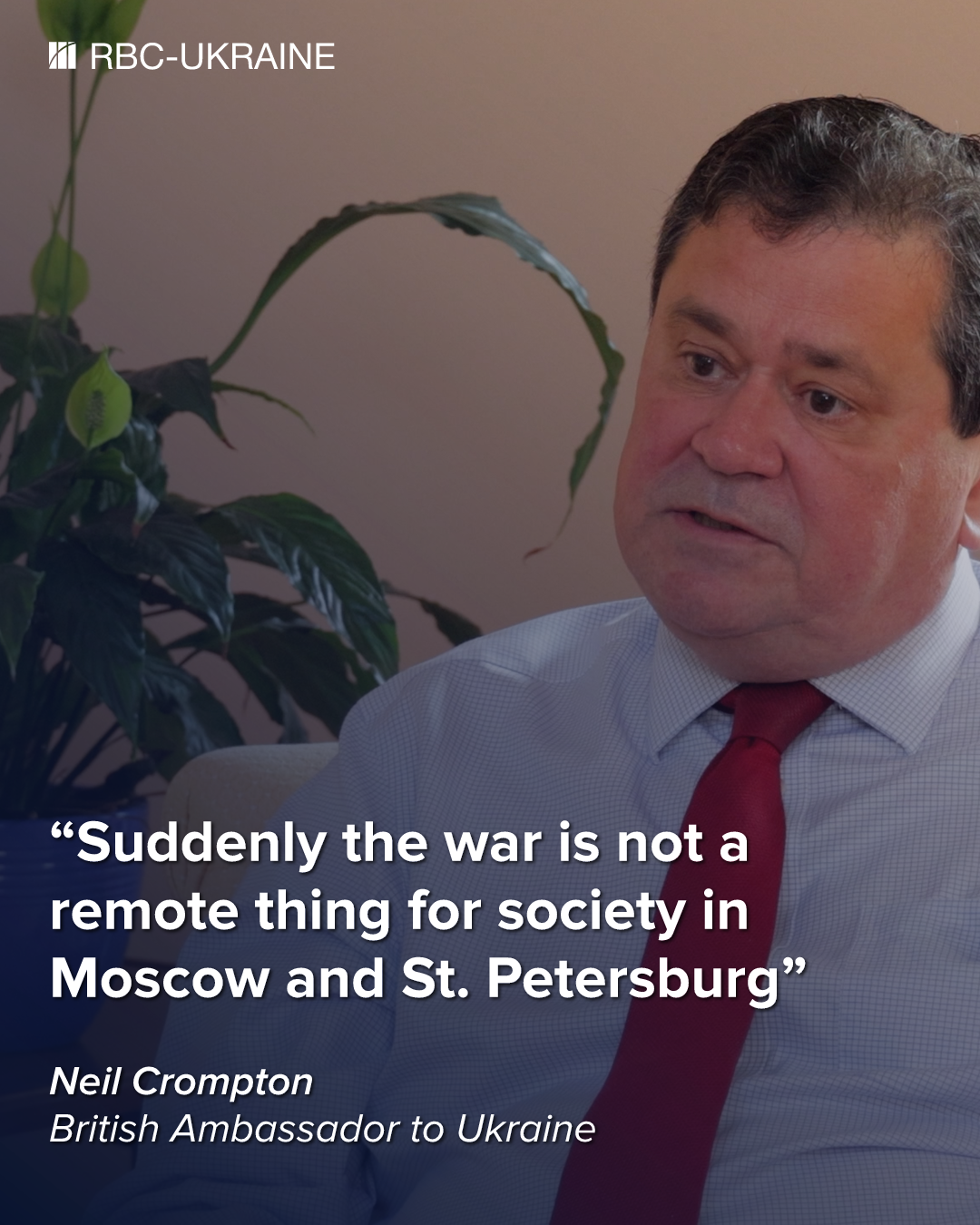
"He says Ukraine doesn't want to target Russian civilians, but Russian civilians need to feel the political effects of the war," Mr. Crompton said of Mr. Zelenskyy's framing, pointing to Mr. Putin's decision to let the Victory Day parade in Moscow go forward under heavy security and to the mood at the St. Petersburg International Economic Forum as evidence the war no longer feels remote to Russian elites.
Strikes on refineries and the shadow fleet of tankers evading sanctions are also hurting the economy, he said.
"We know it hurts the Russian economy because Russians are talking about it at an ordinary level. We've seen petrol queues in Moscow and elsewhere." In a sense, he added, Russians are now feeling "a little bit of what you've been feeling for the last four years."
He was careful to note the picture isn't one-sided: Ukraine faces a real shortage of Patriot interceptors, and its own cities remain under sustained attack — "the war in the cities is not one way." But he contrasted the mood now with when he arrived last October.
"When I first arrived in October, Putin pushed the narrative that Ukraine was losing, defeat was inevitable, so why bother," he said. "And now, every time I open a Foreign Affairs or one of these international magazines, they talk about Ukraine having the advantage. So I think that's how we see it." "But I think it feels like the momentum at the moment is with Ukraine," he added.
Zooming out further, Mr. Crompton argued Russia's broader strategic position has also weakened. "If you sit in Moscow and you look at developments in the last two or three years — NATO is suddenly a lot bigger," he said, noting Sweden and Finland's accession and sharply rising European defense budgets. The alliance's Ankara summit, he added, produced a two-year commitment to fund Ukraine's defense budget — "not a short-term thing." Mr. Putin, in his assessment, "is losing a degree of credibility in the international community," even as he avoids admitting the war isn't going as planned.
Making the case for talks
Asked whether time favors Ukraine, Mr. Crompton was direct.
"Yes, I think so," he said. "I would say, I think for now, there's some momentum with you. Well, you're a big country, but you're up against a very big country. But I think the Ukrainian strategy is right — that you have to increase pressure on Russia in order to get them to negotiate seriously, to demonstrate that they cannot take the whole of Donbas, as they talk about doing."
"Diplomats, we use the phrase 'strategic patience,'" he said. "Sadly, it's a war of attrition on the battlefield, and I think it's also sort of a competition between the two military-industrial complexes."
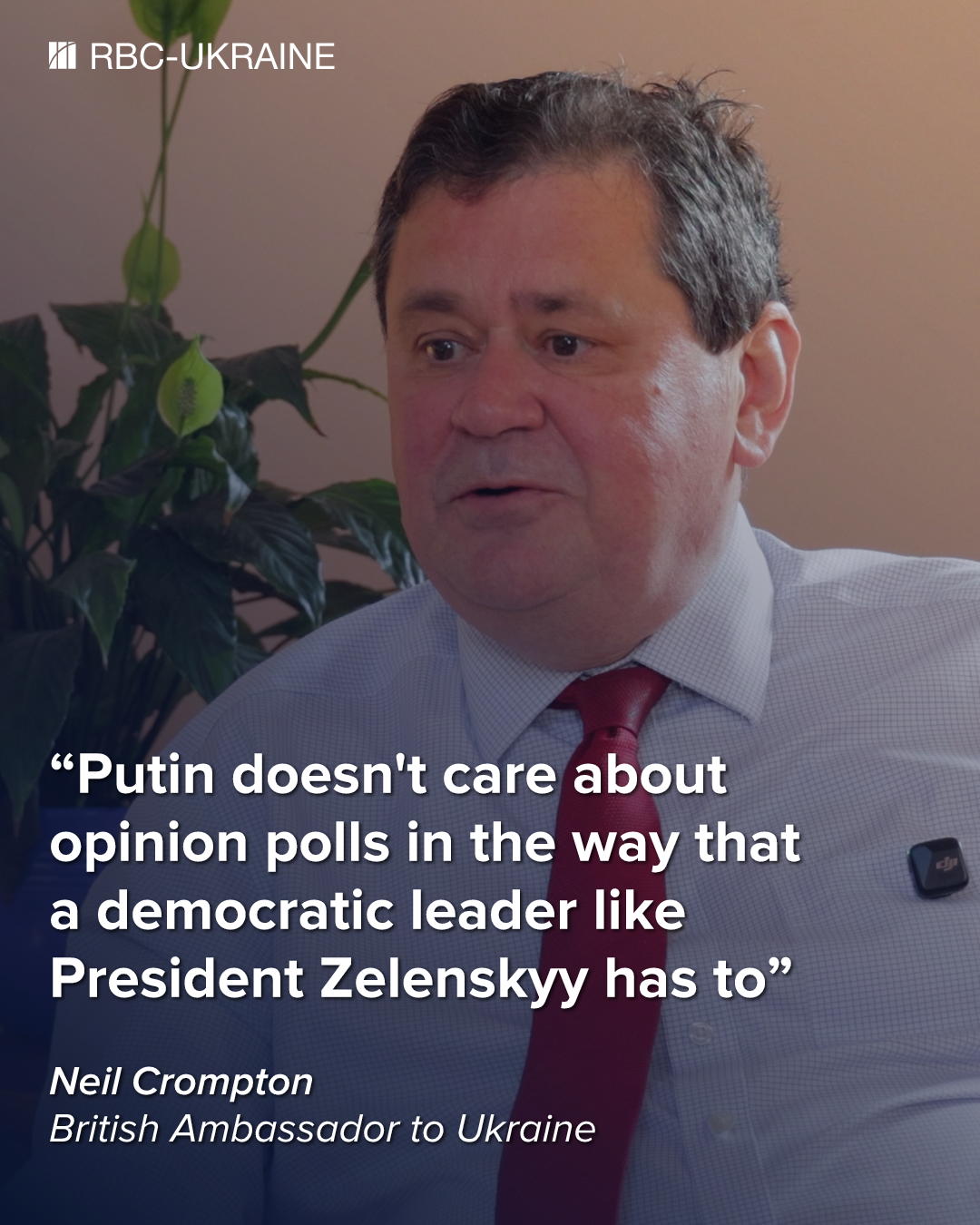
He pointed to the rapid growth of Ukraine's defense industry: "The Ukrainian defence-industrial sector has made astonishing advances in the last year, both in the type of weaponry, innovation and costs, but also the numbers. I think you're going to make 10 million drones this year" — a genuine edge, he said, tied to the freedom of a democratic system to innovate quickly. He said there's no sign yet that Mr. Putin wants to change course, but pointed to growing anxiety inside Russia. "Mothers are worried that their sons may be mobilised," he said. "Putin is not elected, so he doesn't care about opinion polls in the way that a democratic leader ... has to. But you have to start somewhere."
He added that comments from President Trump about shifting battlefield dynamics could also become a factor. "As a diplomat, I'm paid to always see openings," he said, "but we must also be realistic. And I think that's your strategy — is to try for negotiations, but make sure you will increase military pressure. And I think you've been very effective in that this year."
NATO's nerves: Poland, the Baltics and red lines question
On the string of Russian drone and airspace incursions into Poland, Romania and the Baltic states, Mr. Crompton was measured.
"We agree with your analysis that there's a series of incidents," he said. "I mean, it's not just this year, but over many years. People use different phrases — hybrid warfare, cyber attacks, the like."
NATO countries, he said, have been investing in hardening their defenses "whether it be in the intelligence space or the cyber space through to the military," while working out collective responses to what he called Russian "pokes." "I think in Ankara, NATO described Russia as a long-term threat to security of Europe," he said, likening the alliance's calibrated response to "a cat and mouse game" in which Russia probes and NATO adjusts. He argued that both Ukraine's battlefield successes and NATO's own buildup are, over time, weakening Russia's hand.
"Well, I know there's lots of discussions going on in Brussels at the moment in the NATO headquarters, working out how best to respond," he said of the aftermath of the Poland incident. "Putin will, I'm sure, test in another area, and NATO will have to respond."
On the risk of a direct Russian move against a Baltic NATO member, he said: "My personal sense is that NATO resolve to defend each other's states is strong, and that would be a miscalculation by Russia. But we clearly need to not be naive, and we need to both prepare for but also deter contingencies like that. So I think there's a good, coherent NATO plan aimed at doing that."
Asked whether British troops stationed in Estonia would be authorized to respond immediately to aggression, without waiting on alliance-level consultations, he called the question hypothetical but said their purpose is both to reassure Estonia and to deter Russia, with an expectation they would "act in light of the circumstances at the time."
Kyiv's case for a seat at NATO's table
Mr. Crompton was asked about recent remarks by Ukraine's Ambassador to Britain, Valerii Zaluzhnyi, who said he had heard for 12 years that Ukraine would join NATO, that it never happened, and that NATO's own standards were outdated compared with what Ukraine has learned in the war. Mr. Crompton called NATO an important partner and reiterated that Britain supports Ukrainian membership, though no alliance-wide consensus exists.
"I think NATO is an important partner of Ukraine," Mr. Crompton said. "There has been a long history over the possibility of Ukraine joining NATO. The UK position is that we would like Ukraine to join, but there is no consensus on that within NATO as a bloc." He drew two lessons from the debate. First, any durable peace will require a credible Western security guarantee. "Everybody recognized that for a peace agreement to be durable, Ukrainians need to believe that they will not be attacked again," he said, citing the lessons of Minsk.
He pointed to NATO Secretary General Mark Rutte's articulation of that guarantee, delivered in a speech to Ukraine's parliament: "I think the first element of any security guarantee is strong Ukrainian Armed Forces and industry supported financially for a long time by Europe and others. I take it as read that that will happen. You've got the largest and most experienced armed force in Europe, and the political commitment from Europe is clear." The second strand, he said, is "some European boots on the ground and planes in the air," discussed through the coalition of the willing, followed by a US "backstop." No formal negotiations are underway, he said, but any eventual deal will need to include such guarantees.
Second, he suggested the old framework — Ukraine striving to meet NATO standards — has essentially inverted: "everyone in NATO recognizes there are many lessons we can learn from Ukraine," he said, and he hopes that dynamic strengthens both military ties and the growing links between Western and Ukrainian defense companies eager to absorb lessons from the battlefield and from Ukrainian engineers' capacity to innovate on a timeline the West hasn't matched in years.
Missile gap
On Ukraine's shortage of ballistic-missile defense — an area where the United States has made no fresh commitments — Mr. Crompton said Britain wants to help but faces practical limits: it has no Patriot batteries of its own, with most of its air-defense assets deployed on ships in the North Sea and not easily transferable, though Britain has contributed some shorter-range systems and considers itself skilled at shooting down drones.
The core problem, he said, is a global shortage of PAC-3 interceptor missiles, made worse by demand from the recent war involving Iran, with production not yet scaled to meet demand. He said Mr. Zelenskyy raised the issue directly during his London visit, and that Britain intends to lobby allies who hold PAC-3 stockpiles or production licenses "so that you're not naked against this," even if it cannot supply the missiles itself. "It's a little bit personal to me," he said. "I hear these things too often."
Ukraine's defense industry, and Britain's bet on it
Mr. Crompton described a British appetite to invest more directly in Ukraine's drone industry, citing an early-stage partnership between a British company and Ukraine's Octopus drone program aimed at improving speed and efficacy, though not yet at scale.
He said cross-border projects routinely run into export-licensing and legislative hurdles in both London and Kyiv, but that progress is being made — pointing to the recent unveiling of a system called Stone Cloak, meant to improve drone accuracy, which he hopes will be among the "catalytic projects that we can scale up" alongside a growing number of interested British firms. With Britain's defense investment plan now settled and its budget picture clearer, he said appetite for such projects is real.
He framed the goal as building durable supply chains among allied countries — a lesson, he said, reinforced by shocks from the pandemic, the war in Ukraine and the more recent conflict involving Iran — with manufacturing split between the two countries.
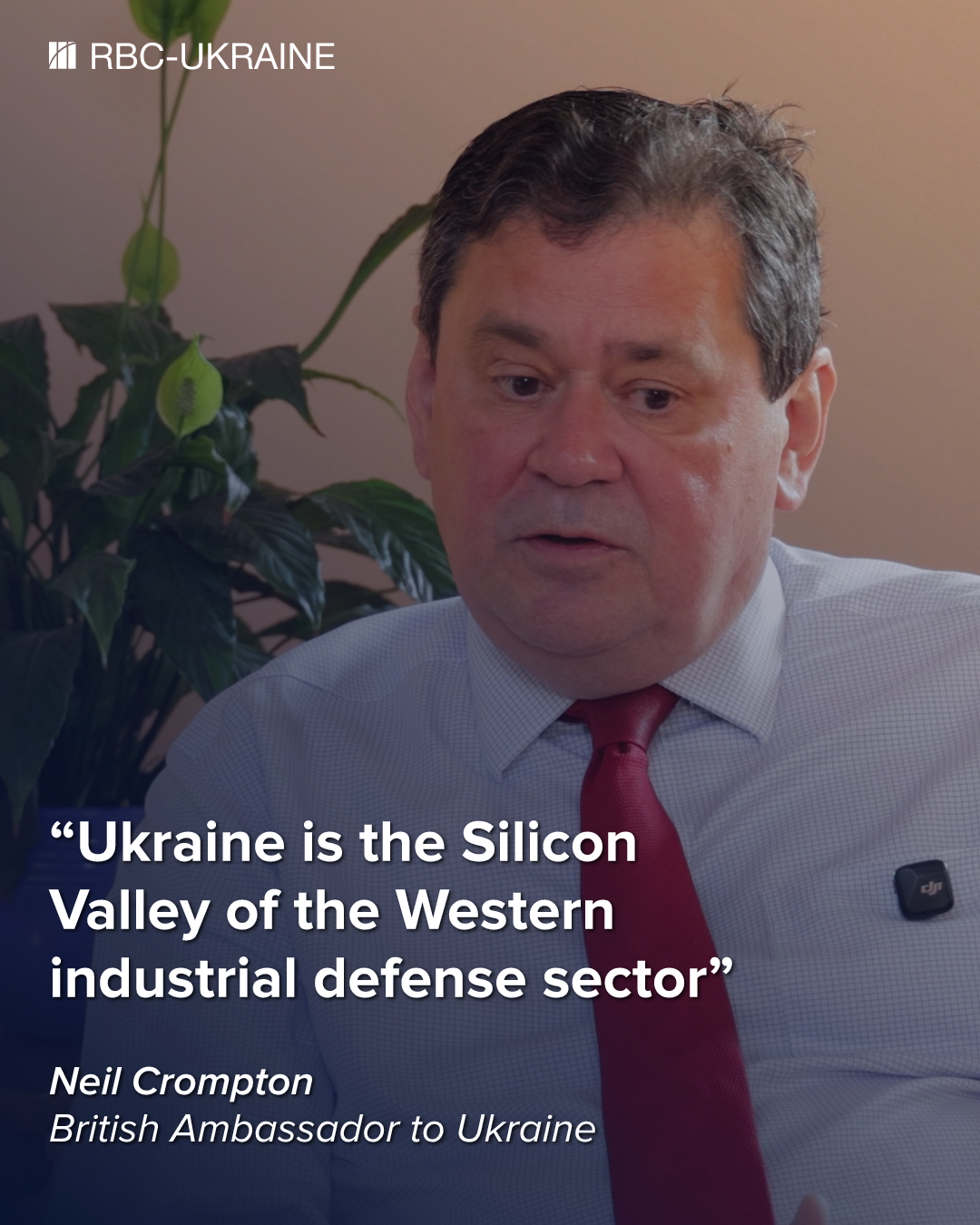
"You can't afford weapons systems to be taken from the front line," he said, "but there should be a sweet spot where we can meet everybody's needs." The war involving Iran, in particular, he added, underscored how much the West has to learn from what he called "the Silicon Valley of the Western industrial defense sector."
That shift in posture — from Ukraine as an aid recipient to Ukraine as a security contributor — struck Mr. Crompton as significant in its own right. He noted the irony that Western militaries, who in theory could field the kind of total air superiority the coalition enjoyed in the Iran war, are now the ones asking to learn from Ukraine's improvisation under far harder constraints. He pointed to language in the NATO Ankara summit's final communiqué explicitly crediting Ukraine's contribution to Euro-Atlantic security as an important marker of that shift.
Frozen fortunes: Oligarch money and the Chelsea case
London's long-standing reputation as a haven for Russian money, Mr. Crompton said, has changed substantially since sanctions tightened after 2014 and especially after the 2022 invasion; most of the oligarchs once based there, he said, have since relocated elsewhere or returned to Russia, though Britain continues to keep an eye on the sector — "we don't want that in our system," he said.
On frozen Russian sovereign assets, he said Britain — like other Western governments — has agreed to direct the profits generated from those frozen funds toward supporting Ukraine militarily, while the underlying assets themselves remain a matter under review, pending the war's outcome.
Separately, he addressed the yearslong legal impasse over the roughly £2.5 billion in proceeds from Roman Abramovich's forced sale of Chelsea Football Club, which was meant to be directed toward humanitarian causes in Ukraine under an agreement reached after the 2022 sanctions. Mr. Abramovich has since challenged the arrangement in court, and the case remains unresolved.
Mr. Crompton said the government views the current moment as likely the last real chance to reach agreement, but couldn't offer a timeline.
"Anything in the courts," he said, "tends to take a little bit longer than any of us would like."