Russia's Oreshnik missile threat explained: Intimidation or real danger?


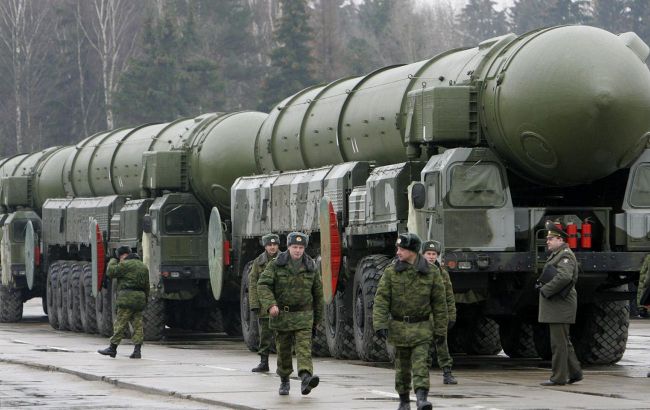 Photo: Russia intimidates the world with nuclear weapons (Russian media)
Russia is increasingly launching daytime ballistic missile strikes on rear cities in Ukraine. In recent days, Lviv and Kyiv have come under attack, and today air raid alerts sounded across the country due to the threat of the Oreshnik missile.
In a comment to RBC-Ukraine, military expert Ivan Stupak explained the logic behind Russia’s tactics, how dangerous the Oreshnik missile really is, how many such missiles Russia has, and what system could intercept them.
Read also: Belarus prepares base for Oreshnik missile system: Satellite images
Key points:
-
Russia uses ballistic missiles to strike “hot” targets quickly.
-
Oreshnik, without a nuclear warhead, is more about intimidation.
-
In a non-nuclear configuration, Oreshnik would create craters comparable to 36 artillery shell impacts.
-
Patriot systems are not designed to intercept missiles of Oreshnik’s class; the US THAAD system would be required.
Why Russia launches ballistic attacks on Ukraine during the day
Stupak explained why Russians use ballistic missiles to strike rear cities in Ukraine, specifically during daylight hours.
He emphasizes that ballistic missiles are extremely fast: they arrive within just a few minutes and are used when there is precise, “hot” intelligence about a target or cargo that needs to be destroyed immediately.
Because of their speed, the occupiers do not wait until evening or for cruise missile launches.
“Let’s imagine that somewhere on the outskirts of Lviv a shipment arrived from the western border. It will be here for another two hours and then it will disperse somewhere. So as soon as the information is received, a strike is immediately carried out. That’s the logic,” the interlocutor explained.
Oreshnik attack. What's known about this missile
Oreshnik is a Russian intermediate-range ballistic missile (IRBM) that Moscow presented as its “latest weapon” at the end of 2024.
According to open-source data, it was developed on the basis of the RS-26 Rubezh system and is capable of reaching hypersonic speeds (over 12,000 km/h). It is equipped with six warheads, each carrying submunitions.
According to Ukraine’s Foreign Intelligence Service, as of the end of January 2026, Russia has no more than 3–4 such missiles in service. It is also known that only a small number are produced each year.
Is Oreshnik really as terrifying as the Kremlin claims?
Stupak notes that when “Oreshnik” is not equipped with a nuclear warhead, it separates into six blocks with six parts each — 36 in total.
“That already shows it’s not that serious. When Oreshnik carries no nuclear charge, these are essentially blanks. It’s more about intimidation,” Stupak said.
The expert explains that the effect of such blocks is similar to conventional artillery shells.
“When it hit Dnipro, I saw research on the craters. Do you know what they look like? Craters from ordinary artillery shells. So you can consider it as 36 artillery shots,” Stupak added.
According to him, there was information suggesting the enemy could use conventional explosives in such missiles. However, there is a nuance.
There is a theory that due to the enormous speed and the heating of the blocks upon reentry into the atmosphere, it is difficult to place conventional explosives inside — they could detonate prematurely.
“Of course, if a nuclear charge arrives, then it’s over for everyone. But for now, thank God, there isn’t one,” Stupak said.
Can Ukraine intercept such missiles?
Although Patriot air defense systems are capable of intercepting ballistic missiles, including the Kinzhal, they cannot cope with the Oreshnik.
“Patriot cannot shoot down Oreshnik. There is an American system called THAAD. It costs $3 billion, and we don’t have that kind of money,” the interlocutor concluded.
Quick Q&A
Why does Russia attack with ballistic missiles during the day?
Ballistic strikes are needed to quickly hit a specific target while it is still “on site.”
How dangerous is Oreshnik?
If it carries no nuclear warhead, it is essentially about intimidation.
Can Ukrainian air defenses shoot down such missiles?
No. Even Patriot cannot handle it; THAAD could, but it is prohibitively expensive for Ukraine.
Can the blocks of ‘Oreshnik’ contain explosives?
Theoretically possible, but due to heating during flight, it is risky.
Previously, today, air raid alerts were declared across Ukraine due to the threat of an intermediate-range ballistic missile. The alert lasted 25 minutes, and the launch of an Oreshnik was not confirmed.