New army chief, battle for Donetsk and winter threat: What's happening on Ukraine's front


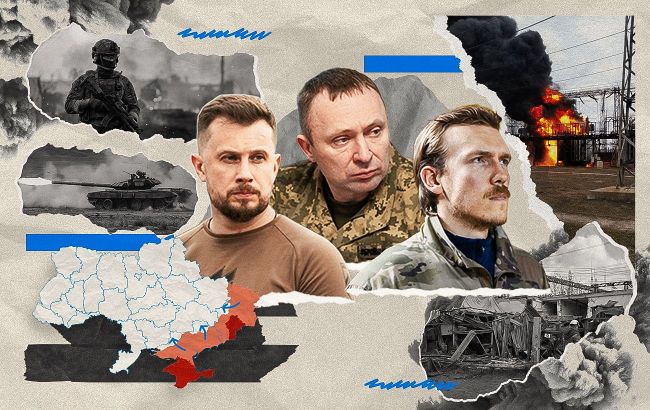 Russia is stepping up pressure and changes by Ukraine's new army chief Mykhailo Drapatyi (collage by RBC-Ukraine)
The appointment of Mykhailo Drapatyi did not trigger a sweeping personnel revolution in the Armed Forces of Ukraine, but approaches to personnel decisions, front-line command, and the future of assault regiments are changing. Meanwhile, Russia is once again stepping up pressure along the Pokrovsk-Dobropillia axis and expanding its capabilities for strikes against Ukraine's rear areas.
The new commander-in-chief's first decisions, the situation in key sectors of the front, and the main risks facing Ukraine in the coming months are examined in RBC-Ukraine's article.
Key points:
-
Drapatyi's first decisions. There has been no sweeping personnel purge since the change of commander-in-chief, but sources describe broader opportunities for officers to advance in rank and a somewhat different command style.
-
The Joint Rapid Response Forces have not yet been formed. The plan to create the Joint Rapid Response Forces has not been abandoned. However, according to RBC-Ukraine, Mykhailo Drapatyi and Dmytro Voloshyn have different views on how the force should be structured, meaning it will likely be led by someone else. For now, assault regiments are being placed under the operational command of individual corps.
-
The Donetsk region is being divided between two groups of forces. Andrii Biletskyi's Center grouping is expected to cover the sector from Lyman to Kostiantynivka, while Denys Prokopenko's Azov grouping will oversee the Dobropillia-Pokrovsk sector.
-
Operation Vivaldi. Biletskyi said the offensive operation in the Lyman sector disrupted the northern part of Russia's plan to encircle the Kramatorsk urban area. RBC-Ukraine sources say the actual advance by the Armed Forces of Ukraine is greater than has been publicly reported.
-
Winter could prove the toughest test. Sources see little chance of a lasting ceasefire covering energy infrastructure and expect Russia to expand its aerial strike capabilities. According to RBC-Ukraine, Russia plans to produce up to 2,000 Dan-T systems by the end of this year and up to 14,000 next year.
The change in leadership of the Armed Forces of Ukraine came at a time when the Ukrainian military must simultaneously hold back Russian pressure in the Donetsk region, respond to threats in other sectors of the front, and prepare for another winter under Russian attacks.
Against this backdrop, personnel and organizational changes are already underway within the Armed Forces of Ukraine, although it is still too early to assess their scale and consequences. Some decisions concern the command structure, while others involve troop management and the future of assault units.
At the same time, the situation across the front remains uneven. Ukrainian forces have stabilized the situation or advanced in some sectors, while in others Russia is increasing pressure or seeking new opportunities to launch offensive operations. Some RBC-Ukraine sources believe that the greatest challenge in the coming months may not be the front itself, but a potential new campaign of Russian strikes.
Drapatyi's first decisions
According to RBC-Ukraine sources, Mykhailo Drapatyi's appointment as commander-in-chief did not trigger a sweeping personnel "revolution" in the military. He did not carry out a large-scale removal of commanders and staff officers who had served under Oleksandr Syrskyi.
At the same time, targeted changes are taking place within the senior command. Artem Martynenko, one of the architects of DELTA (Ukraine's digital battlefield management system), was appointed deputy commander-in-chief of the Armed Forces of Ukraine with responsibility for digital transformation and innovation. Brigadier General Serhii Sobko has also become an acting deputy commander-in-chief.
RBC-Ukraine sources point less to the scale of the reshuffle than to Drapatyi's approach to personnel decisions. According to them, he has begun more actively promoting people from lower levels of the military hierarchy into senior command positions, significantly expanding opportunities for upward career advancement.
Not all RBC-Ukraine sources within the Armed Forces view this approach equally positively. Some believe it allows highly capable specialists to advance more quickly without rigidly tying promotions to their formal military education, rank, age, or length of service.
Others see risks in this approach. A traditional military career involves gradually progressing through several levels, from commanding lower-level units to serving on staffs and holding senior command positions. At each stage, an officer gains not only a higher rank but also experience managing increasingly large formations, planning operations, and working within the military command system.
RBC-Ukraine sources also point to a difference in command style. According to them, under Syrskyi, much of the direct work involving the front was concentrated in the hands of the commander-in-chief himself.
"A significant part of the work of Chief of the General Staff Hnatov was focused on the international track — meetings, negotiations and various forms of cooperation with partners. Syrskyi himself, meanwhile, practically lived at the front: he constantly traveled between different sectors, visited units, personally became involved in difficult situations and tried to keep a very large number of issues under control, right down to the lower levels. Put simply, if a gap appeared somewhere, he would go there himself and help close it," one RBC-Ukraine source said.
According to the source, this model gave Syrskyi a highly detailed understanding of the situation on the front, but at the same time may have diverted some of his attention from strategic-level issues, including the problems surrounding the assault regiments.
"He had a plan for the war, but to a large extent it remained in his head. Drapatyi is working differently so far. He also visits the front and sees what is happening, but for now he is giving commanders on the ground more room to demonstrate results themselves — both those who were already in their positions and those he appoints," the source said.
The source suggested that this approach could leave the new commander-in-chief more time to focus on systemic issues, including changes to the command structure, the future of the assault forces and the development of his own strategy for conducting the war.
"To understand what kind of commander-in-chief Drapatyi will be and to assess his first steps, we need at least three months," the source concluded.
One of the systemic issues the new commander-in-chief will have to address in the near future is the future of the assault regiments and the creation of the Joint Rapid Response Forces.
In July, Volodymyr Zelenskyy signed a decree establishing the new structure within the Armed Forces of Ukraine and said that Brigadier General Dmytro Voloshyn would oversee its formation. The Joint Rapid Response Forces were intended to combine assault units with unmanned systems, artillery and other capabilities to respond rapidly in the most difficult sectors of the front. Their creation was also intended to address problems that had accumulated around individual assault regiments.
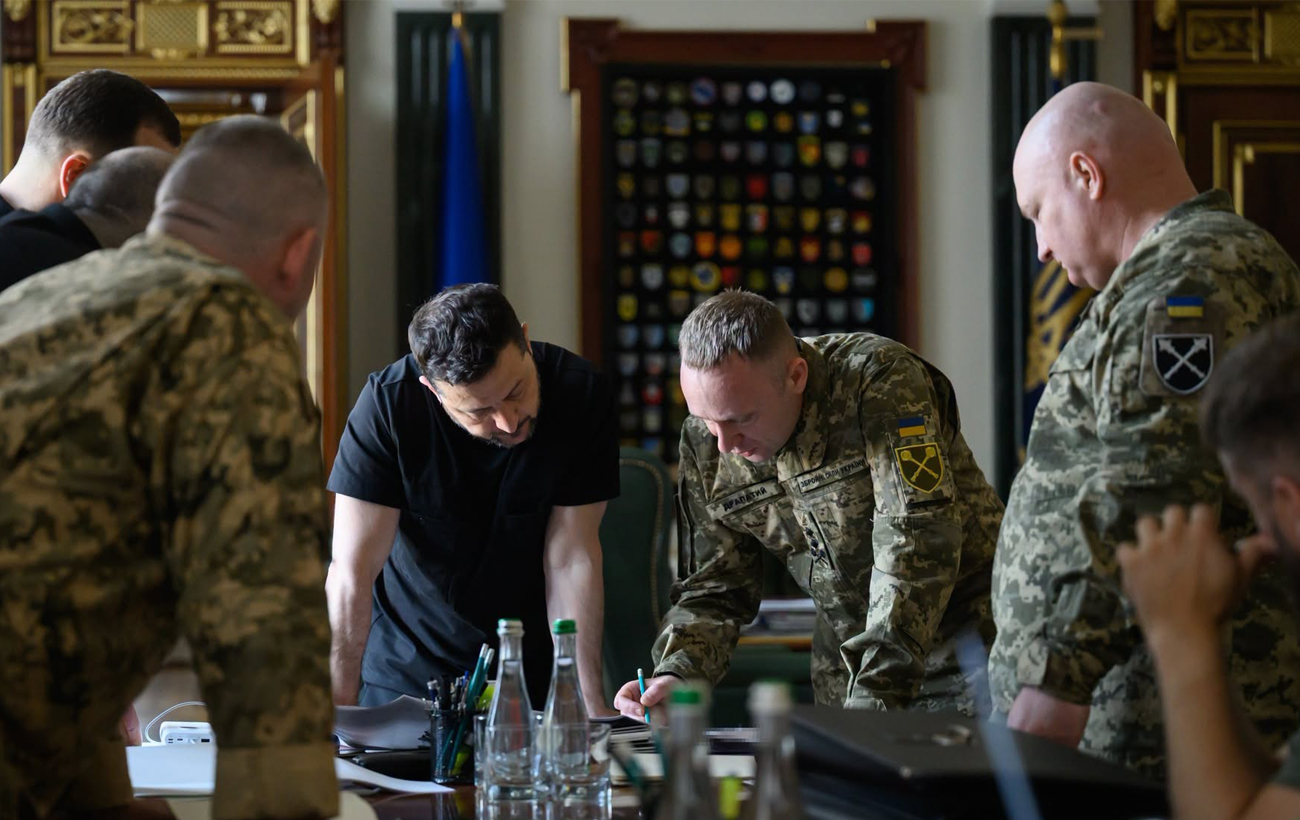 Volodymyr Zelenskyy and Mykhailo Drapatyi during a meeting (photo: Volodymyr Zelenskyy/Facebook)
According to several informed RBC-Ukraine sources, the plan to create the Joint Rapid Response Forces has not been abandoned, but Drapatyi and Voloshyn have different views on what the structure should look like and how it should be employed. As a result, RBC-Ukraine understands that Voloshyn has returned to command the 8th Air Assault Forces Corps, while a new candidate to lead the formation of the Joint Rapid Response Forces has not yet been selected.
Until the issue is resolved, assault regiments are effectively being placed under the operational command of corps operating in the most difficult sectors of the front. For example, the 425th Skelia Regiment is operating alongside the 1st Azov Corps, the 225th Regiment with the 7th Air Assault Forces Corps, and, according to RBC-Ukraine, the 33rd Regiment with the 3rd Corps.
This does not mean that these regiments are being formally incorporated into the respective corps. They remain separate military units but carry out missions within the corps’ area of operations under the command of its leadership.
How front-line command is being reorganized in the Donetsk region
Following the change of commander-in-chief, the system for managing Ukrainian forces in the Donetsk region is also being reorganized. The East Grouping of Forces, previously commanded by Major General Viktor Nikoliuk, is effectively being divided into two new groupings: Center, which will also take over certain sectors from the Joint Forces Command area of responsibility, and Azov. The first is led by Andrii Biletskyi and the second by Denys Prokopenko. Nikoliuk, meanwhile, is returning to his permanent position as commander of Operational Command East (a regional military command responsible for forces in eastern Ukraine).
In practice, this creates another level of operational command above the corps. The corps themselves will continue to hold their respective sectors of the front and conduct combat operations, while the grouping commands will coordinate their activities across broader areas and work with the General Staff of the Armed Forces of Ukraine.
According to RBC-Ukraine, the 3rd, 11th and 19th Army Corps are expected to come under the command of the Center grouping. Its area of responsibility will stretch from the Lyman sector through Sloviansk and Kramatorsk to Kostiantynivka.
Biletskyi is effectively taking command of an area where one of the major battles for the Donetsk region could unfold. This is where the approaches to Lyman, Sloviansk, Kramatorsk and Kostiantynivka converge, forming the last major belt of cities that Russia is seeking to gradually envelop from several directions.
Lyman remains important for an advance toward Sloviansk from the north, while Kostiantynivka is important for putting pressure on the urban area from the south. This sector is therefore likely to remain one of the key objectives of the Russian offensive.
For Biletskyi, this means not only commanding on a larger scale but also assuming significantly greater responsibility. Formally, each corps will continue to hold its own sector and conduct combat operations independently. In the public perception, however, both successes and setbacks across the Center grouping's area of responsibility will inevitably also be associated with its commander.
According to RBC-Ukraine, Biletskyi was also offered another senior position — commander of the Ground Forces of the Armed Forces of Ukraine. The role involves a much broader range of responsibilities than directly managing combat operations at the front, including training and staffing the forces. Under the current system, the Ground Forces Command also exercises overall supervision of the Territorial Recruitment and Social Support Centers (the military offices responsible for mobilization, military registration and recruitment).
However, several RBC-Ukraine sources said Biletskyi declined the offer. Brigadier General Sviatoslav Zaiets, who previously commanded the 20th Army Corps, was appointed commander of the Ground Forces instead.
Two pincers around the Donetsk region
After Biletskyi's appointment to his new position was announced, he spoke publicly for the first time about Operation Vivaldi, an offensive being conducted by the 3rd Army Corps in the Lyman sector. The corps reported that during the first and second phases of the operation in the northern Donetsk region, Ukraine regained control of 125 square kilometers, including 50 square kilometers that were directly liberated from Russian forces.
According to RBC-Ukraine, preparations for the operation began in March this year, while active operations continued throughout the summer. For a long time, details were deliberately kept out of the public domain as Ukrainian forces gradually advanced toward designated positions under conditions of operational secrecy. RBC-Ukraine sources say the actual advance is already significantly greater than what has been publicly reported.
These actions are complicating Russia's plans for further advances in the Donetsk region. RBC-Ukraine sources say Russian forces are seeking to form two "pincers" around the main Ukrainian strongholds of Sloviansk and Kramatorsk to avoid attacking them head-on. The northern pincer would advance through Lyman toward Barvinkove, while the southern one would move through Dobropillia in the same direction. The two were intended to converge there, creating the threat of a broad encirclement of the Kramatorsk-Kostiantynivka urban area. According to Biletskyi, the northern part of this plan has so far been disrupted.
Farther south within the Center grouping's area of responsibility are the 11th and 19th Army Corps, both of which have recently undergone changes in command. Colonel Emil Ishkulov took command of the 11th Army Corps, which holds the Sloviansk-Kramatorsk sector, replacing Oleksii Maistrenko.
The 19th Army Corps, responsible for the Kostiantynivka sector, is now commanded by Brigadier General Valerii Skred. He previously served as chief of staff of the 7th Air Assault Forces Corps, while Ishkulov served there as deputy commander. This means that two corps within Biletskyi's area of responsibility are now led by officers who already have experience working within the same command structure. RBC-Ukraine sources view the leadership changes in both corps positively and expect them to make coordination within the new grouping easier.
At the same time, some sources identify Kostiantynivka as the most vulnerable point in this sector through the end of the year.
"It is unlikely that the Russians will reach Sloviansk by the end of the year. They may reach Kramatorsk, but the city is so heavily fortified that our forces could hold out there for months. At the moment, Kostiantynivka appears to face the greatest threat through the end of this year," one RBC-Ukraine source said.
According to RBC-Ukraine sources, the situation in Kostiantynivka itself was stabilized around a month ago. Ukrainian forces cleared out some of the Russian groups that had infiltrated the city. RBC-Ukraine sources credit General Nikoliuk with playing a significant role in stabilizing the situation there. Russian forces, however, have not abandoned their offensive in this sector. The 19th Army Corps says that after prolonged frontal assaults, Russian forces are increasingly trying to bypass Ukrainian positions from the flanks.
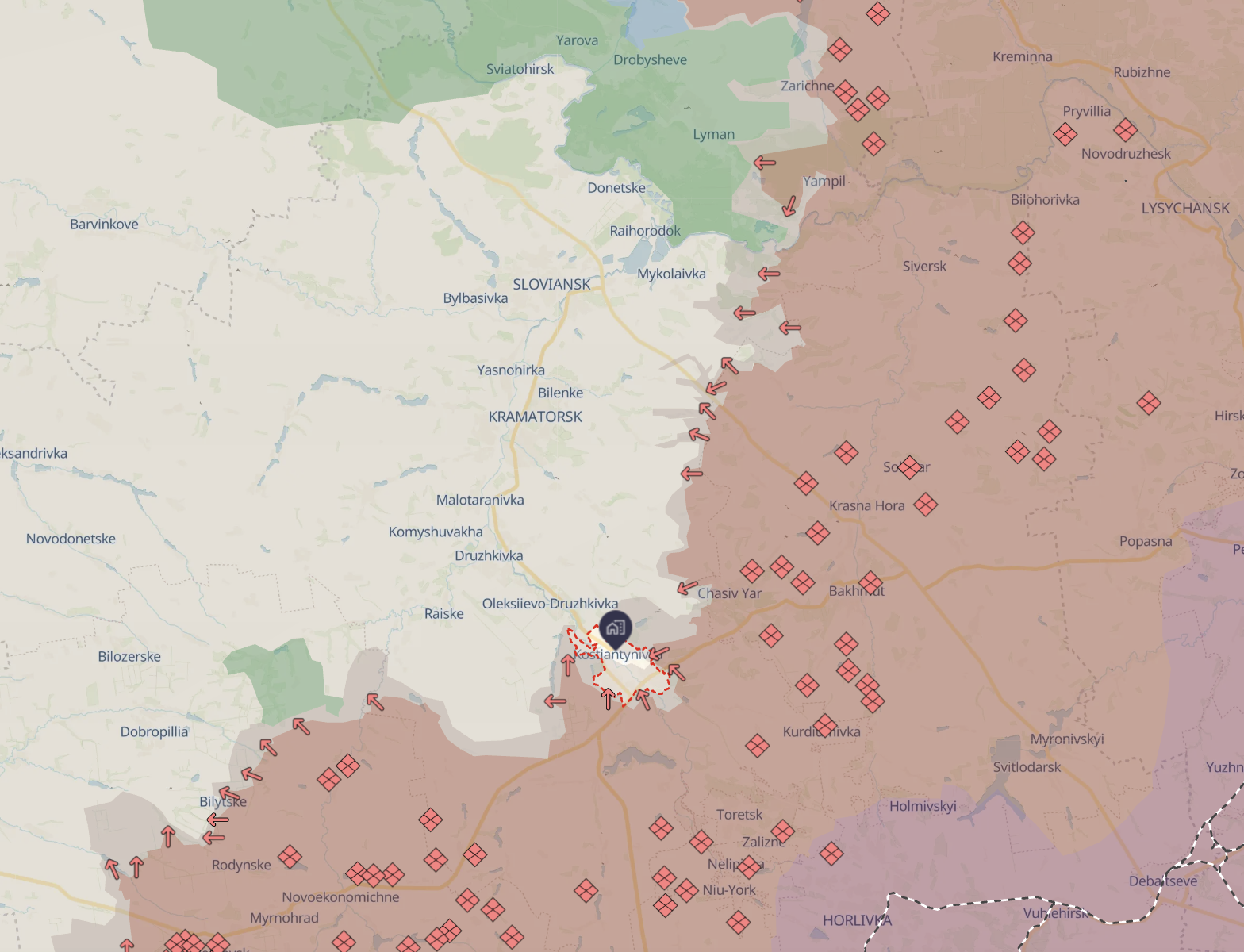 Photo: DeepState map
Farther south begins the area of responsibility of the Azov grouping. According to RBC-Ukraine sources, it will include the 1st Azov Corps of the National Guard of Ukraine (a military formation within Ukraine's National Guard) and the 9th Army Corps under the command of Oleksandr Tarnavskyi. The former operates in the Dobropillia sector, while the 9th Army Corps has moved into the Pokrovsk sector, previously held by the 7th Rapid Response Corps of the Air Assault Forces. Denys Prokopenko took command of the new grouping on September 13.
RBC-Ukraine sources once again describe the Pokrovsk-Dobropillia sector as one of the main centers of Russian military activity.
"At the beginning of the year, the fighting was most intense in the Pokrovsk sector. It then shifted to the Kostiantynivka sector, followed by the Sloviansk sector, where things are relatively quiet now. The peak of the fighting is now shifting back to the Pokrovsk-Dobropillia sector," one RBC-Ukraine source said.
Another RBC-Ukraine source shares this assessment. According to the source, Russia's focus is once again shifting toward the Pokrovsk-Dobropillia sector because this is where Russian forces are trying to develop the southern part of their plan to encircle the Kramatorsk urban area — extending the southern "pincer" toward the northern one.
In other words, while Biletskyi assesses that the northern "pincer" has been significantly weakened, Russian forces in the south continue looking for ways to extend the second one farther west.
Beyond the Donetsk region: Other risks along the front
Farther south, at the junction of the Donetsk, Dnipropetrovsk and Zaporizhzhia regions, Ukrainian troops from the Air Assault Forces are conducting another offensive operation in the Oleksandrivka sector. Its results have previously been reported: President Volodymyr Zelenskyy said that 26 settlements had been liberated. According to RBC-Ukraine, Ukrainian forces have advanced further since then.
At the same time, the command of the 7th Rapid Response Corps of the Air Assault Forces has been redeployed to reinforce the Huliaipole sector, where Russian forces have recently made advances. The corps is commanded by Brigadier General Yevhen Lasiichuk, whom RBC-Ukraine sources describe as a strong battlefield commander.
According to RBC-Ukraine sources, the Huliaipole sector is currently one of Russia's key areas of focus in southern Ukraine and one of the areas where Russian forces are being concentrated. It can cautiously be said that the Russian advance there has been halted for now, but sources expect the fighting in this sector could peak in November and December.
Another area where sources see a risk of escalation is the Orikhiv sector in the Zaporizhzhia region. The core of the Ukrainian defenses there is held by the 17th Army Corps, which until recently was responsible for the entire front line within the Zaporizhzhia region.
According to RBC-Ukraine sources, the situation around Orikhiv has recently shown signs of escalating, with Russian forces seeking to increase pressure on Ukrainian defenses. Ukrainian military officials have also publicly reported large numbers of Russian assault groups, the intensive use of guided aerial bombs and drones, and attempts by Russian troops to infiltrate Ukrainian positions.
Another area of activity is northern Kharkiv and Sumy regions. In communities along the border, Russian troops are attempting to cross the state border in small groups and identify weak points in Ukraine's defenses.
RBC-Ukraine sources also do not rule out the possibility that Russia could intensify activity in the Chernihiv region through similar localized operations by small groups and infiltration attempts along the state border. At least in the near term, however, they see neither the prospect of a major offensive operation nor signs that Russia is preparing a large-scale breakthrough in this sector. No signs of Russia forming an offensive force near either the Chernihiv or Kyiv regions have been detected.
If Moscow were to decide to launch another ground operation directly toward Kyiv, Belarus would remain the most obvious staging ground. RBC-Ukraine sources, however, are skeptical that the Belarusian military itself would directly participate in such an operation.
In their view, a more realistic scenario — if it were to materialize at all — would involve Russia redeploying its own troops to Belarus and then launching an offensive from Belarusian territory. RBC-Ukraine sources see no signs of practical preparations for such a scenario through at least the end of this year.
Is the greatest risk behind the front lines?
Despite all the risks on the battlefield, most of the RBC-Ukraine sources interviewed in military and political circles say the greatest challenge in the coming months may not be a potential Russian breakthrough in any particular sector, but what could happen behind the front lines. The main concern is the coming winter and the possibility of a new wave of Russian aerial attacks.
RBC-Ukraine sources see little chance of a lasting ceasefire covering energy infrastructure, which Donald Trump has already rushed to announce, let alone a broader ceasefire. Kyiv has publicly said it is prepared to discuss a mutual halt to strikes on energy and critical infrastructure, but only if Russia demonstrates a genuine and long-term willingness to abide by such an agreement. No formal agreement is currently in place.
If no agreement is reached, Ukraine will most likely continue striking Russian oil refining facilities, while Moscow could once again launch a large-scale campaign against Ukraine's energy infrastructure.
For Ukraine, giving up strikes on oil refineries would also represent a major compromise. Along with facilities belonging to Russia's military-industrial complex, bases and launch sites for attack drones, and ballistic missile launchers, oil refineries are currently among the priority targets of Ukraine's long-range strike operations, according to one source.
Strikes on Russian oil refining facilities have become a significant means of putting pressure on Russia's fuel sector and economy. Recent attacks have already forced some major Russian oil refineries to suspend operations and deepened fuel shortages.
The cost of continuing this exchange of strikes, however, is especially high during winter. Russian attacks on the electricity system directly affect the basic living conditions of millions of people, including electricity, heating, water, communications, businesses and transportation. Several RBC-Ukraine sources say they still do not know whether Vladimir Putin is prepared to give up such attacks at all.
Strikes on the energy system also inevitably have secondary effects on military logistics and supplies, which, like the rest of the country, depend on energy, transportation and fuel.
Ukraine is entering this period with an acute shortage of interceptor missiles, particularly those capable of countering ballistic missiles. Stocks of Patriot Advanced Capability-3 interceptor missiles remain critically limited, while Russia is simultaneously expanding the range and number of weapons in its strike arsenal.
Alongside expanding its ballistic missile capabilities, Russia is increasingly relying on jet-powered drones. They have been used systematically since late August, including against Kyiv and the surrounding region. Jet-powered drones currently account for an average of around 50 to 60 percent of the drones used in an attack, while sources say Russia plans to increase that share to 80 percent by November.
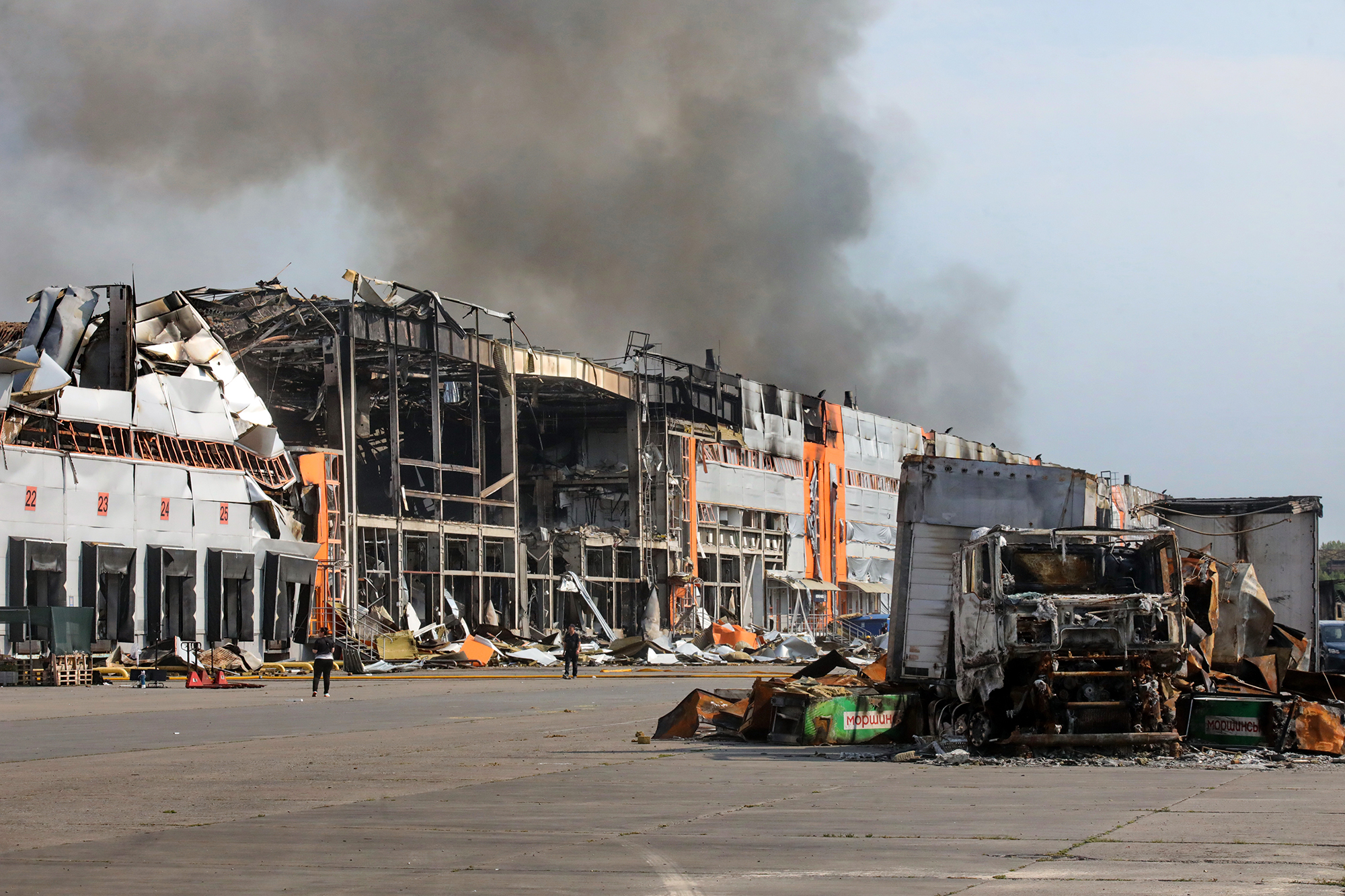 Aftermath of a Russian strike on a warehouse in the Kyiv region (photo: Getty Images)
Russian strikes are also increasingly targeting facilities connected to people's everyday needs, including logistics infrastructure, warehouses, and facilities involved in the production and distribution of food, medicines and other essential goods. In recent days, Ukrainian authorities have also specifically identified railways and networks of fuel stations as targets receiving particular attention from Russian forces.
Ukraine is trying to develop countermeasures. Successful interceptions of jet-powered Shahed drones using new interceptor systems have already been publicly reported during testing.
One RBC-Ukraine source says Ukrainian jet-powered drones already used for long-range strikes could also provide a promising foundation. Some models have performed well as interceptors after being adapted for the role. The main question now is how quickly these systems can be made cheaper and their production scaled up.
Sources see another potential threat in new weapons such as the S8000 Banderol and Dan-T. They are paying particular attention to the latter. According to the Russian manufacturer, the Dan-T can be launched from aircraft or helicopters, is powered by a jet engine, can travel hundreds of kilometers at high speed, and can autonomously navigate toward its target after launch. Rostec (Russia's state-owned defense and technology corporation) also claims that the system has a special flight mode designed to make it more difficult for air defense systems to detect and intercept.
RBC-Ukraine sources, however, see the greatest risk in the potential scale at which the Dan-T could be deployed. The combination of high speed, long range, and the possibility of launching thousands of such weapons would place another burden on Ukraine's air defenses alongside Shahed drones, cruise missiles, and ballistic missiles. According to RBC-Ukraine, Russian plans call for the production of up to 2,000 Dan-T systems by the end of this year and up to 14,000 next year.
RBC-Ukraine sources also do not rule out the possibility that Russia could launch another wave of mobilization and add hundreds of thousands of people to its military. This would create additional pressure along the front, although one source believes that winter itself will be Ukraine's most difficult test in the coming months.
"Russia will most likely carry out another wave of mobilization and recruit around 300,000 people. It will be difficult for us, but we have to hold our territory, contain them, and we will inflict even greater losses on them. Our biggest challenge is this winter. If we make it through this winter, we will keep fighting in 2027," the RBC-Ukraine source said.