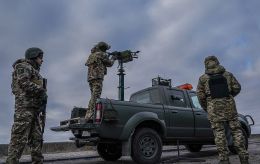
New Black Sea flashpoint? Russia ramps up sea drone production to strike Ukraine


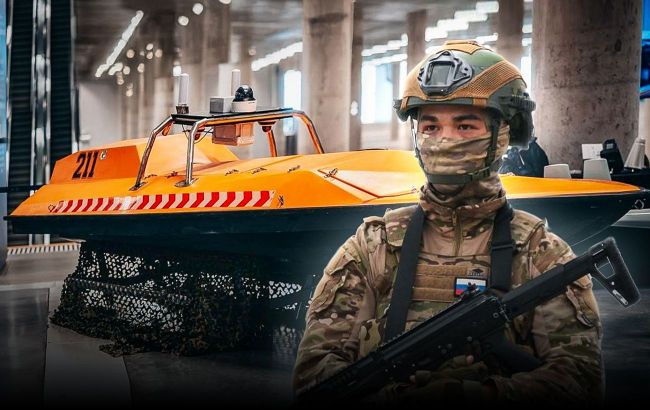 Russia stockpiling sea drones for war against Ukraine (photo: RBC-Ukraine collage)
The struggle for control of the sea in the war with Russia is entering a new phase. Russians are copying Ukraine's experience in the use of sea drones and are preparing for mass deployment.
What threat Russian sea drones may pose not only to Ukraine but also potentially to NATO countries, and what is known about Russian developments, is analyzed in the RBC-Ukraine article.
Read also: Ukraine destroys Russian Ка-27 'submarine hunter' helicopter in Crimea
Key points:
- On Kremlin strategy: Russia views sea drones as part of a plan to pressure Ukrainian shipping and to impose a de facto blockade of the Black Sea.
- On intelligence assessment: The Main Intelligence Directorate of the Ministry of Defense of Ukraine records a growing threat and a likely transition of some drones to mass use.
- On potential targets: Ukrainian ports, logistics, and shipping remain in the risk zone.
- On the role of sea drones in war: Experts believe that for Russia, this is still a tool ''for the future.''
- On long-term risk: Russia is systematically developing the naval unmanned direction as an investment in future scenarios of war at sea.
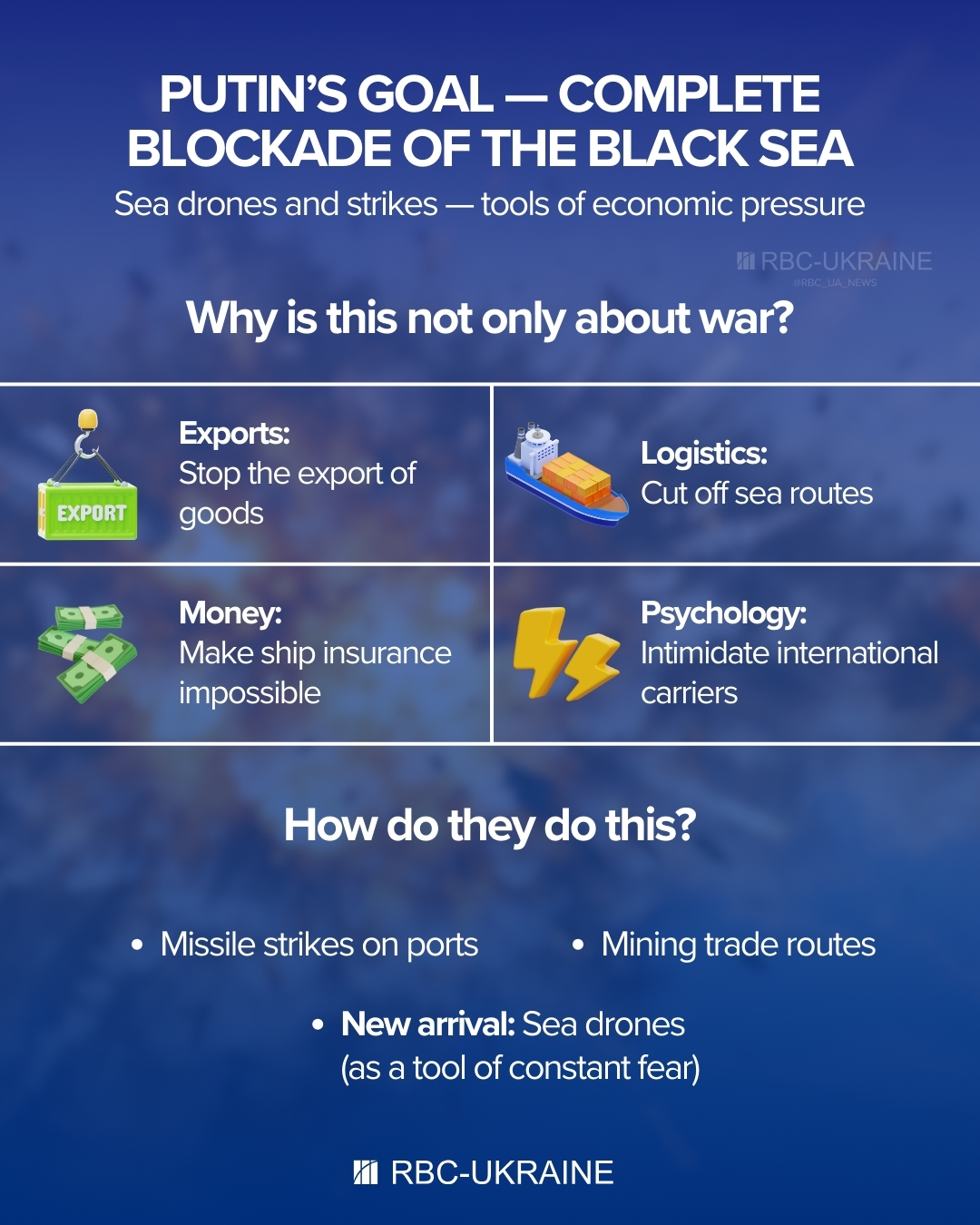 Russia wants to push Ukraine out of the Black Sea (Infographic by RBC-Ukraine)
Russian forces have increased pressure on Ukrainian port infrastructure and ships in the Black Sea. Moscow carries out regular strikes on key economic and logistics facilities. In particular, missile attacks are directed at the ports of Odesa, Chornomorsk, and Izmail, and the enemy is trying to affect the operation of Ukrainian maritime infrastructure.
In these conditions, the technological threat from Russia is also growing: the enemy has announced the development of a new naval unmanned carrier boat called Skorlupa. This drone is allegedly capable not only of operating at sea but also of carrying first-person-view drones for possible attacks toward Odesa and Mykolaiv — distances that fall within the declared technical parameters of these systems.
These developments — from strikes on ports to the emergence of new naval unmanned surface vehicles — call into question the security of Ukraine's critically important maritime corridors and draw special attention to the development and use of unmanned systems at sea.
Kremlin's objective: Blockade of the Black Sea
The development of Russian naval unmanned systems fits into the broader Kremlin strategy regarding the Black Sea. According to sources in military and political circles, Russian President Vladimir Putin has tasked officials with ensuring a de facto blockade of the Black Sea and pressure on Ukrainian shipping as one of the key elements of the war against Ukraine.
''For the Kremlin, control over the Black Sea is not only about military presence. It is about economy, logistics, exports, insurance, and psychological pressure on international partners of Ukraine,'' one of the publication's interlocutors explains.
This refers to an instrument of influence on Ukrainian exports, international trade routes, shipowners, and insurance companies. That is why Russia is seeking different ways to influence the situation in the waters — from missile strikes and mining to the development of naval unmanned systems.
In this logic, sea drones are viewed as one of the potential tools for implementing this objective, even if, for now, they do not produce the desired effect.
Military intelligence assessment: Threat growing
Main Intelligence Directorate of the Ministry of Defense of Ukraine confirms that Russia is actively working on the development of naval unmanned systems, although for now, this direction remains largely experimental.
In a comment, the Main Intelligence Directorate states that the threat level from Russian naval unmanned systems is assessed as steadily increasing.
Over the past year, Russia has moved from conceptual design to the stage of active testing and attempts at serial production. At the same time, most projects are currently at stages of development or experimental combat operation.
According to intelligence data, only isolated cases of test or episodic use of Russian surface and underwater unmanned systems have been recorded, including types called Skat and Triton.
 There is currently no systematic or effective use of these systems achieving a significant combat effect. However, it is precisely Triton that may be prepared for attacks on civilian shipping and the port infrastructure of Ukraine.
''At the same time, existing production plans (in particular up to 40 units of systems of Skat type per month) indicate the intention of the adversary to shift to tactics of mass use,'' military intelligence reported.
Particular attention is also drawn to the development of an autonomous underwater vehicle called Prosvet-1, which is being created to counter Ukrainian underwater unmanned systems. This indicates attempts by Russia to build a layered underwater defense.
Among the most likely scenarios for use of this system are protection of fleet basing points, patrolling coastal waters, use as communication relays, and potential attempts to influence the shipping and port infrastructure of Ukraine.
Delayed start and copying Ukrainian technologies
Russia is indeed moving toward the development of naval unmanned systems, but is doing so with significant delay, sources say.
''They operated for a long time under traditional fleet doctrine: ships, submarines, aviation. Only when it became clear that these tools did not deliver the desired result did they begin looking for an alternative in drones,'' explains a source from the military environment.
The problem lies not so much in the availability of hulls or explosives as in the absence of an established system of use. The concept of a simple kamikaze sea drone existing as a standalone strike asset has, in fact, already lost relevance.
Modern unmanned warfare requires more complex multi-layered solutions — with reconnaissance, stable communication, relay capability, and integration into the overall strike system. These elements remain the weakest point of Russian developments. And these are precisely the elements Russia is trying to copy from Ukrainian drones.
Spokesman of Naval Forces of Ukraine Dmytro Pletenchuk said in a comment that Russian developments in the field of sea drones largely represent an attempt to reproduce the Ukrainian approach that proved effective in the fight against Russia's Black Sea Fleet.
''They are not copying a specific drone. They are copying logic: fast platform, low visibility, modularity, attempt to integrate into larger system,'' he explained.
According to him, Russians have problems with access to components, as well as difficulties with communication and navigation. Without this, the sea drone turns into a poorly controlled and ineffective tool.
Why sea drones have not become main Russian weapon
Despite demonstrations of new boats and developments, the Kremlin currently has no grounds to make naval unmanned systems the main instrument of pressure on Ukraine.
Defense Express expert Oleh Katkov points out that Russia already has much more effective and proven tools — aerial drones and missiles that are used massively and systematically.
''They have missiles. They have Shaheds that operate regularly and against a wide range of targets. Why complicate the scheme and bring in a sea drone if the effect from it is much smaller?'' he explains.
According to Katkov, Ukraine has few large maritime targets. Ukrainian fleet does not operate in large ship formations in the open sea, and most operations are asymmetric in nature. Hunting single targets with sea drones is a complex operation with minimal results.
 In addition, a sea drone must be physically delivered to the area of use, provided with communication, navigation, and coordination with intelligence. This makes the operation significantly more complex and expensive than the launch of an aerial unmanned vehicle.
Therefore, according to assessments of interlocutors, Russian sea drones are currently more a line of work ''for the future'' than an instrument capable of significantly changing the situation right now.
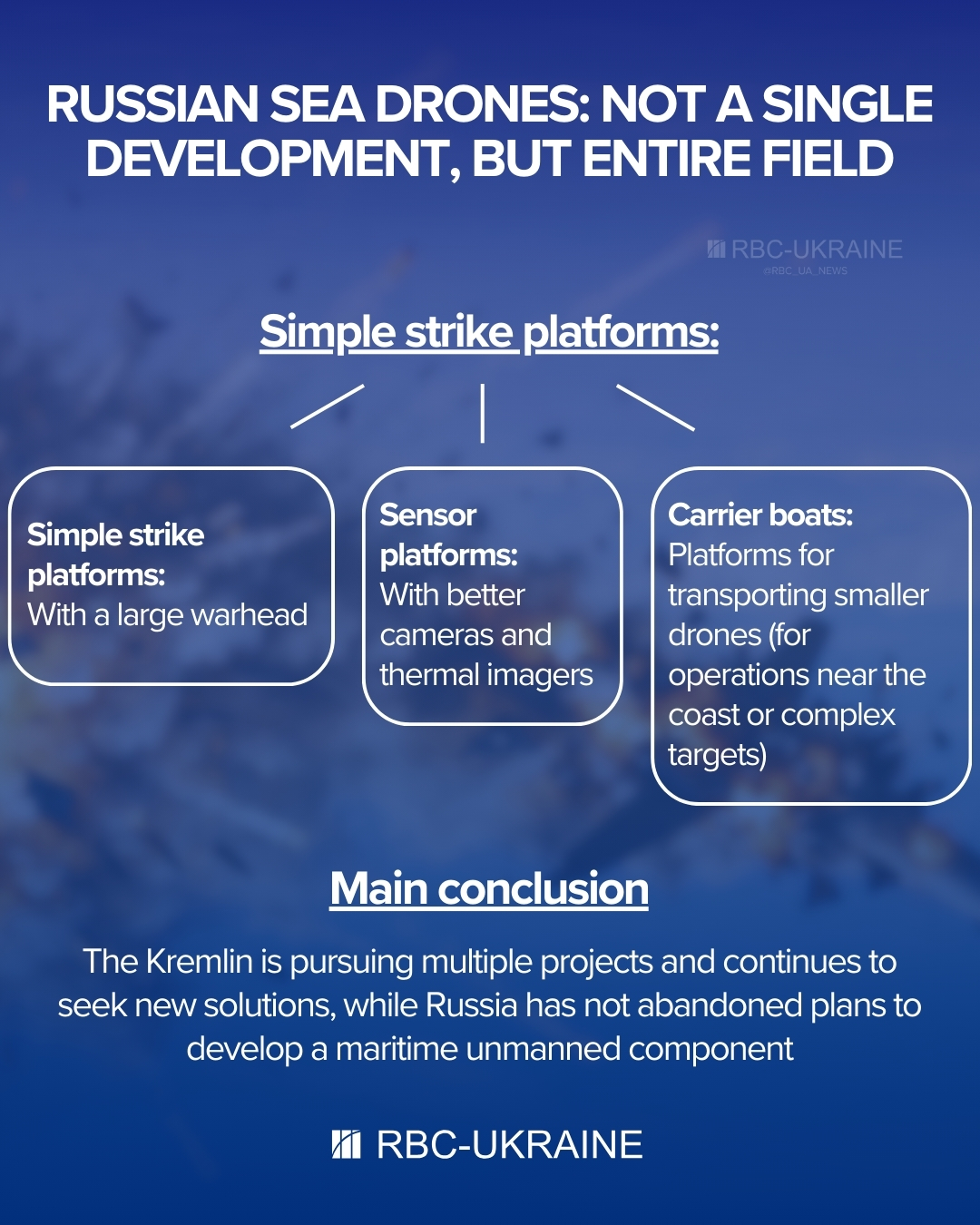
What Russia already has: Not a single development, but an entire direction
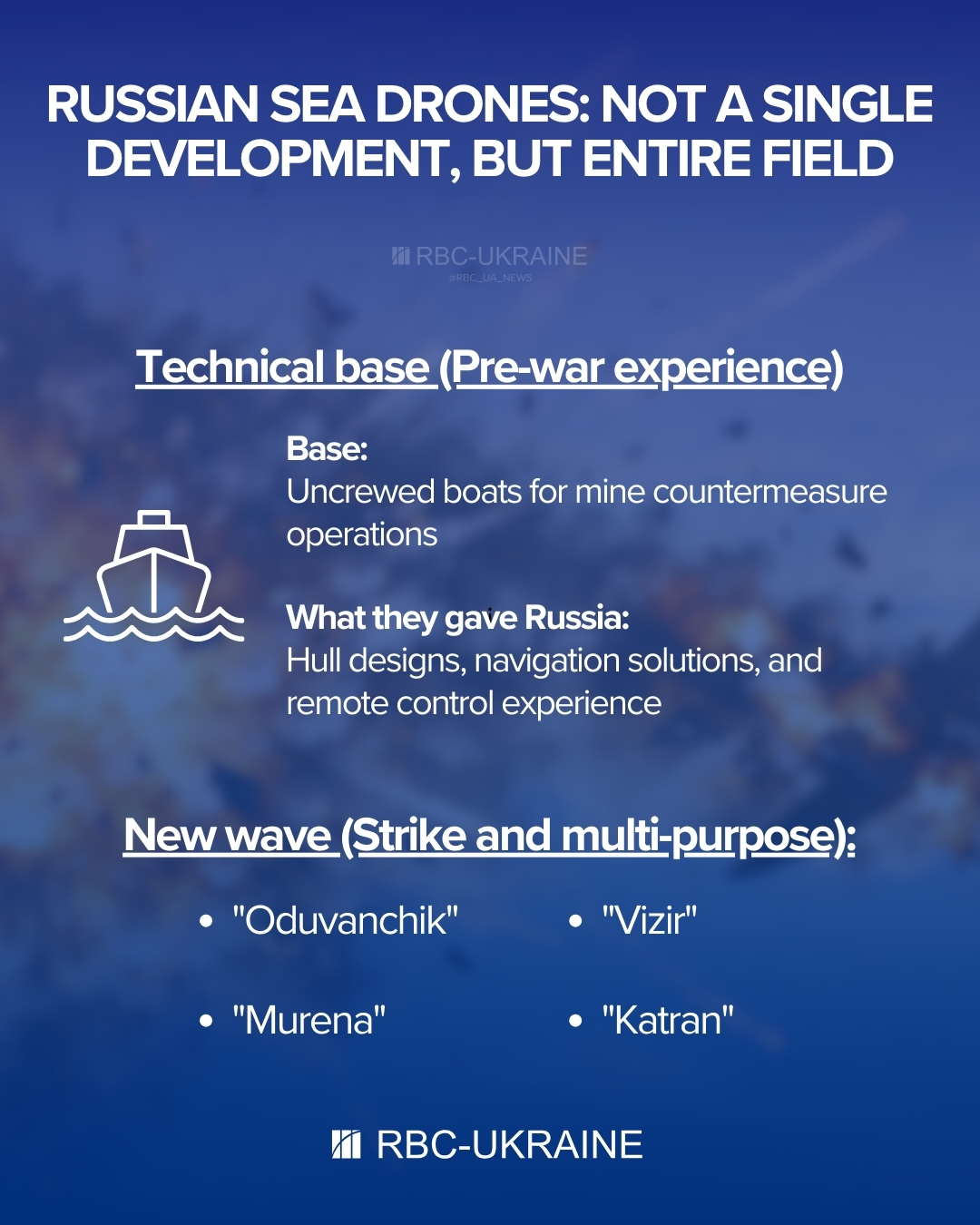
Despite all limitations, Russia is not curtailing work on naval unmanned systems and is trying to form several platforms at once for different tasks. Some developments originate from prewar programs — these are uncrewed boats that were used for mine countermeasure operations. They are not strike systems, but they gave Russia a technical base: hulls, navigation solutions, and experience of remote control.
The new wave consists of strike and multipurpose uncrewed boats that Russia is trying to adapt for different possible uses. In open sources, names such as Oduvanchik, Murena, Vizir, and Katran regularly appear.
This is not about isolated experiments. Russia is simultaneously testing several concepts: simple strike platforms with large warheads, platforms with improved sensor capabilities (cameras, thermal imagers), as well as ideas of carrier boats for smaller drones that can operate closer to shore or near complex targets.
The fact that the Kremlin has not stopped at one project but is searching for different solutions shows that Russia has not abandoned the idea of creating a naval unmanned component, even if, for now, it does not yet work as desired.
What threat exists today for Ukraine and the world
Russian naval unmanned systems are not yet an instrument capable of turning the situation in the Black Sea. Most such platforms are at the testing stage or limited operation, but this transitional phase itself creates a key risk: the field is developing systematically and does not appear temporary.
Moreover, according to sources, the adversary is accumulating these means. For now, Ukrainian ports, logistics, shipping, and military platforms remain in a zone of potential risk. This is not about large-scale operations but about the gradual buildup of instruments of influence.
Danger is also posed by the logic of combined use. Sea unmanned system by itself may not be decisive, but in combination with aerial drones, intelligence, or missile strikes, it becomes part of a multi-layered attack.
A separate dimension of risk is the potential threat to the vessels of other states. Expansion of the Russian arsenal of naval unmanned systems means these systems may be used not only against Ukrainian targets but also in wider maritime areas, including international shipping routes.
This includes scenarios of demonstrative pressure or attempts to control waters, as well as the use of unmanned systems to cover own actions or repel pursuit. Under conditions of high tension, this creates additional risks of incidents involving civilian or foreign vessels and increases the importance of maritime security far beyond the Ukrainian theater of war.
''In strategic dimension, development of naval unmanned systems is viewed by Russia as a component of long-term military policy aimed at asymmetric confrontation with states possessing technologically advanced sea forces,'' the Main Intelligence Directorate stated, adding that the Ukrainian side continues to monitor their production for further neutralization.
***
The main point is that Russia views naval unmanned direction as a long-term investment in war. Technological and organizational limitations currently restrain these plans, but the development trend is steady, which is a reason for Ukraine and the world to prepare for a new threat.