Behind the scenes: Why Zelenskyy removed defense minister Mykhailo Fedorov, and who could benefit


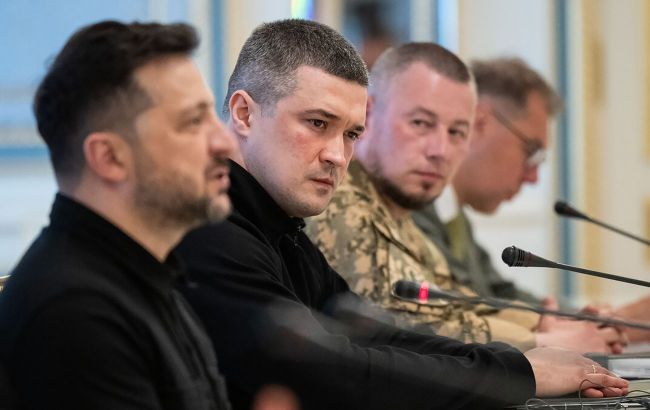 Mykhailo Fedorov (photo: facebook.com/zelenskyy.official)
The biggest question surrounding President Volodymyr Zelenskyy's government reshuffle has now been answered: Mykhailo Fedorov will no longer serve as Ukraine's defense minister in the new Cabinet of Ministers.
Why did Zelenskyy decide to remove one of his key ministers, and how has the decision reshaped the balance of power within his inner circle?
Key points:
-
Official reasons for the dismissal: President Volodymyr Zelenskyy said Fedorov was removed because of his conflict with Commander-in-Chief Oleksandr Syrskyi and because the Defense Ministry was purchasing weapons against the wishes of the military.
-
Unofficial theories and behind-the-scenes speculation: Among the unofficial explanations are a struggle over the Defense Ministry's budget, Fedorov's rivalry with David Arakhamia, and an alleged attempt by Bankova (a metonym for the Office of the President of Ukraine, named after the street where it is located) to neutralize a potential political rival.
-
Parliament and Arakhamia gain influence: Against the backdrop of the government reshuffle and the weakening of the Presidential Office following Andriy Yermak's departure, parliament succeeded in pushing through its preferred candidates, while David Arakhamia significantly expanded his influence.
-
A victory for the generals: Ihor Klymenko was nominated to head the Defense Ministry, a move widely seen as the final victory of the "old generals" in their long-running confrontation with Fedorov's team.
"It is wrong when people on the same team communicate only 'through me' instead of speaking directly to each other," President Volodymyr Zelenskyy told members of the Servant of the People party (the ruling parliamentary faction) on the evening of July 15 while explaining the reasons for Defense Minister Mykhailo Fedorov's dismissal.
The second reason cited by the president was the procurement of weapons, including artillery shells, which, according to Zelenskyy, Fedorov's ministry purchased despite the military's objections.
Lawmakers, unsurprisingly, reacted to the news in different ways. For some, such as Danylo Hetmantsev, Chairman of the Verkhovna Rada Committee on Finance, Tax and Customs Policy, who has been at odds with Fedorov and his team since Fedorov headed the Ministry of Digital Transformation, it was a major victory.
"But many lawmakers, of course, went home with a heavy heart because of Fedorov," one member of the presidential faction told RBC-Ukraine.
Some members of the Servant of the People party even found the courage to express their dissatisfaction on social media.
Why Fedorov was removed: The main theories
Since Sunday afternoon, when Zelenskyy announced a government reshuffle, the biggest question had been whether Fedorov would keep his position. That became even more uncertain after multiple sources, including RBC-Ukraine, confirmed that his future in office was far from guaranteed.
Behind the scenes, numerous theories circulated about what was happening. One was that Fedorov was never actually going to be removed and that the president simply wanted to remind one of his most promising ministers that no one on the team is indispensable. After all, Fedorov had served in the Cabinet since the autumn of 2019, beginning with Oleksiy Honcharuk's government.
Fedorov's fate was not finally decided until the evening of July 15, during Zelenskyy's meeting with the Servant of the People parliamentary faction. Overall, the government reshuffle unfolded with far fewer media leaks than usual.
However, informed sources interviewed by the media outlet believe that the decision on Fedorov had actually been made earlier that day, not during the final meeting before the faction gathering, but at a series of consultations and closed-door meetings.
One of those discussions was a morning meeting on personnel appointments attended by a small group of officials, including Danylo Hetmantsev.
Another theory, widely discussed both behind the scenes and publicly, is that the president decided to remove a potential political rival before he could become one. Supporters of this viewpoint point to Fedorov's relatively clean public image and his reputation for acting independently.
"Come on, he's not Zaluzhnyi (Valerii Zaluzhnyi, Ukraine's former commander-in-chief, who remains one of the country's most popular public figures - ed.), who was polling at 30 percent. Mykhailo's numbers are ten times lower," a source within the ruling party said, dismissing that theory.
The source went on to explain that during last year's "card protests" (demonstrations against the government's proposed changes to the military service exemption system), protest organizers had expected Fedorov to publicly side with them. Instead, he chose not to do so, raising the issue of the resignation of Andriy Yermak (the former head of Ukraine's Presidential Office) only behind closed doors.
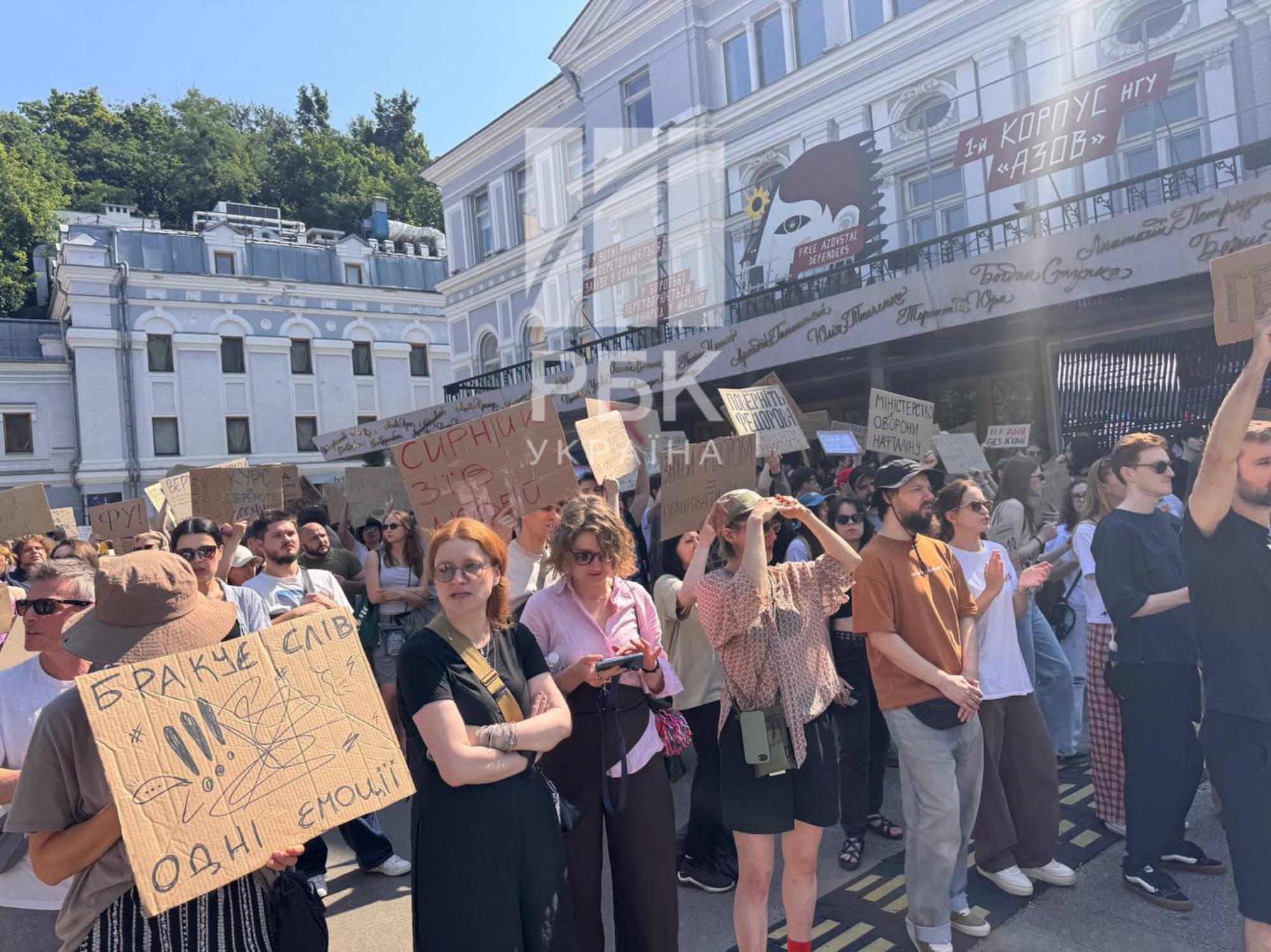 Protest in Kyiv over Fedorov's dismissal (photo: RBC-Ukraine)
The source then went on to describe what he called conspiracy theories. According to this account, a potential "anti-corruption party" inside and outside parliament commissioned opinion polls that allegedly showed Fedorov was the only figure capable of making such a political project successful. As a result, several media outlets supposedly began deliberately boosting Fedorov's public profile to provoke a sharp reaction from Zelenskyy, trigger a split between the two, and push Fedorov into the opposition.
The source stresses that this is pure speculation. But, as with any conspiracy theory, once you start believing it, individual events begin to appear as though they fit together into a logical chain.
For now, however, one key element is still missing: an actual break between Fedorov and the president's team. According to sources familiar with the discussions, the former minister is expected to remain part of that team for the time being, with a decision on his future expected next week.
Another, far more straightforward explanation for the dismissal is a struggle over access to the enormous financial resources controlled by the Defense Ministry. After becoming minister, Fedorov began changing the rules of the game in the defense procurement market, something that inevitably upset many influential stakeholders.
At the same time, members of Zelenskyy's team say that even if someone ultimately benefits from another shift in the weapons procurement system, that alone would not have been enough to trigger such a major political decision as replacing the defense minister.
Finally, another theory suggests that the developments bear the imprint of David Arakhamia, head of the Servant of the People parliamentary faction, whose influence has grown significantly in recent months.
RBC-Ukraine previously described in detail the relationships among key figures in the president's entourage following Andriy Yermak's departure. The rivalry between Fedorov and Arakhamia was one of the most visible.
Although both people close to the minister and officials at Bankova insisted at the time that nothing unusual was happening, stories like this rarely emerge without some basis.
How parliament and Arakhamia gained influence
After announcing the upcoming government reshuffle, Zelenskyy left for France for two days. As a result, discussions over Cabinet appointments took place throughout the beginning of the week without the president being physically present.
That even prompted jokes that Ukraine was finally beginning to operate according to its Constitution, which defines the country as a parliamentary-presidential republic. However, RBC-Ukraine's sources in parliament insist there was more than a grain of truth in that joke. They say parliament played a much larger role in this reshuffle than it had in previous ones.
For example, Zelenskyy reportedly met two future ministers — Oleksandr Kravchenko, nominated to head the Ministry of Economy, and Andrii Butenko, nominated for the Ministry of Education — only during the Servant of the People faction meeting on the evening of July 15.
"Yermak would never have allowed that kind of independence," a source close to the president told the media outlet with irony.
Kravchenko was personally invited into the government by incoming Prime Minister Serhii Koretskyi, who wanted a trusted ally overseeing a key portfolio. Butenko, meanwhile, emerged as a compromise candidate backed by several influential figures in the education sector, despite opposition from the Office of the President. Deputy Head of the Presidential Office Olena Kovalska had instead supported Mykola Trofymenko for the position.
In this case, however, parliament succeeded in pushing through its preferred candidate. And as parliament's influence grows, so does the influence of its informal leader, David Arakhamia, who played an active role in the behind-the-scenes negotiations.
According to the media outlet's sources, Arakhamia not only succeeded in forcing the politically unfriendly Fedorov out of the Cabinet but also secured another ministerial appointment. Vitalii Kim, the head of the Mykolaiv Regional Military Administration and Arakhamia's fellow native of Mykolaiv, is unexpectedly set to become the minister for veterans affairs.
In addition, two members of the Servant of the People party are moving into the Cabinet: Vitaliy Bezgin will head the restored Ministry for Development of Communities and Territories of Ukraine, while Denys Maslov is expected to become minister of justice. According to lawmakers, these promotions have been well received within the parliamentary faction, demonstrating that political advancement remains possible under the current system.
As sources within the Servant of the People faction told RBC-Ukraine, these appointments have at least partially softened the disappointment caused by Fedorov's departure.
The new Cabinet is expected to be approved by parliament, although not without some difficulties. The most challenging vote is expected to be the appointment of Ihor Klymenko as defense minister, which is scheduled to take place at the very end of the process.
Among other concerns, lawmakers are skeptical that the new minister will be able to bring order to Ukraine's mobilization system, largely because they believe the problem cannot be fully resolved in principle.
Notably, Fedorov's first proposal after becoming defense minister envisioned shifting the main burden of mobilization onto the police, an institution overseen by Klymenko during his tenure as interior minister. However, Zelenskyy personally rejected that plan. Fedorov then ran out of time to present a new concept before his dismissal.
Despite his high-profile removal, the last remaining minister from Zelenskyy's original Cabinet is unlikely to leave on a confrontational note. While supporters gathered outside Kyiv's Ivan Franko National Academic Drama Theater to protest his dismissal, Fedorov himself was preparing a briefing on his work, showing no sign of escalating tensions.
Much stronger reactions came from people close to Fedorov, including volunteers and military figures. Among them were his former adviser Serhii Sternenko and Pavlo Yelizarov, deputy commander of the Air Force, who announced on Thursday morning that he was resigning and leaving the Armed Forces of Ukraine.
The current parliament, meanwhile, is seen as unlikely to stage an open rebellion. Quietly sabotaging votes is considered a far more typical form of resistance. Even so, the appointments are still expected to receive enough votes, with the Servant of the People party likely to be backed by several parliamentary groups and possibly even some opposition lawmakers.
According to lawmakers who spoke with RBC-Ukraine, Zelenskyy also said during his opening remarks at the faction meeting that he could eventually dismiss Commander-in-Chief Oleksandr Syrskyi as well, when the time is right.
For now, though, the more than six-month battle between Fedorov's "new team" and the "old generals" appears to have ended with a decisive victory for the generals.