Zelenskyy's office uncovers new US, Chinese and Belarusian components in Russian missiles

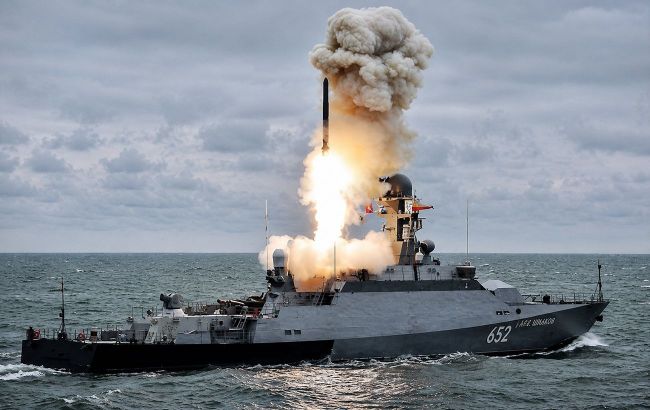 Photo: Russia is launching a Kalibr missile (Russian media)
Recent examinations of the debris from a cluster-warhead Iskander-M missile and an Oreshnik missile, used in Russia's May 24 strike near Bila Tserkva, confirmed the presence of new components.
"For example, in the cluster-warhead Iskander-M, we identified components made in the United States, Taiwan, Switzerland, Japan, China, and Belarus. Some of these electronic parts were manufactured in 2024 and 2025," Vlasiuk said.
He stressed that the findings show modern technologies continue to reach Russia's military-industrial complex despite international sanctions.
The role of Belarus
At the same time, Moscow is expanding weapons production by relying on Russian and Belarusian-made components. According to the analysis, every identified part in the examined Oreshnik missile was manufactured exclusively by Russian and Belarusian factories.
"The role of Belarusian manufacturers is particularly notable, especially Integral and the Transistor plant, whose products are regularly found in modern Russian missiles," the presidential commissioner said.
More than half of the components identified in the Oreshnik missile were manufactured in 2023-2024, while some parts were dated 2025.
The cluster-warhead Iskander-M also contained a significant number of components produced in 2024-2025, including parts manufactured in Belarus.
"This indicates that Russia is not relying on old stockpiles but continues to produce missiles using newly manufactured electronic components," Vlasiuk emphasized.
Earlier, questions had already been raised over whether the Oreshnik missile contained foreign-made components. Vlasiuk previously suggested that, unlike other Russian missiles, the version used in the May 24 strike might not include any foreign parts.