No launches, no satellites: Ukraine’s alternative path to space research

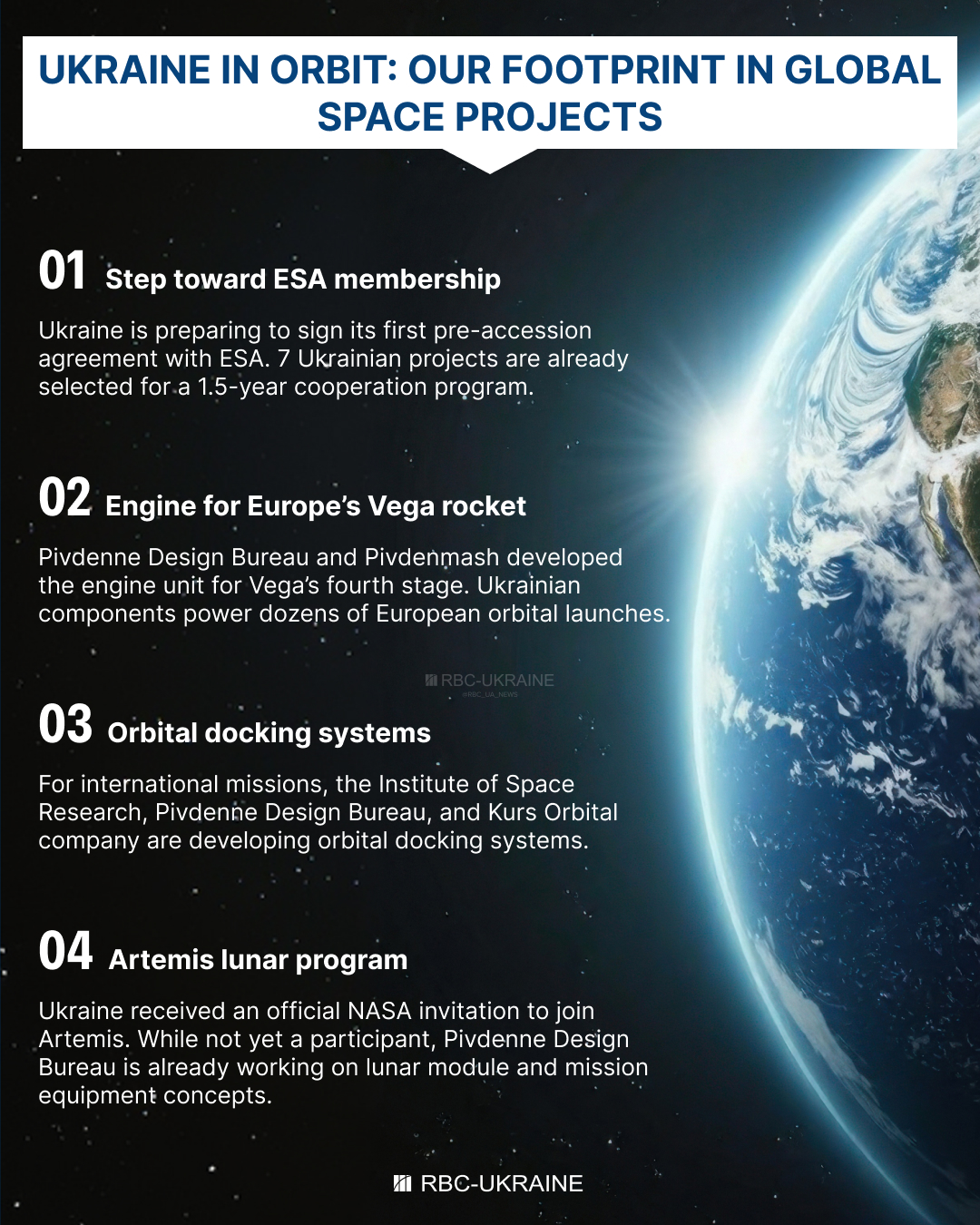
 Ukraine is involved in a number of international space programs (infographic: RBC-Ukraine)
Ukraine continues to be an active participant in global space research, despite not having its own satellites in orbit. Ukrainian scientists have learned to effectively overcome technical limitations through international cooperation and modern technologies, according to chief researcher and former director of the Institute of Space Research of the NAS of Ukraine, Oleh Fedorov.
Key points:
- Space data sharing: Ukraine uses free satellite data from the European Sentinel constellation and NASA grants for environmental and scientific monitoring.
- Artificial intelligence in orbit: The limited optical resolution of satellites is compensated with AI and the concept of Earth Intelligence, which helps predict land degradation and crop yields.
- Antarctic platform: Through the Akademik Vernadsky station, Ukrainian physicists and geophysicists study magnetic phenomena, cosmic particles, and near-polar space environments.
Free satellite data sources
Modern space research allows countries to avoid spending billions on independent launches by using global data-sharing systems.
“Modern space activity allows the use of free data. We use data from the European Sentinel constellation. These satellites are not very high-resolution, but they are sufficient for environmental monitoring,” Fedorov noted.
In addition to European spacecraft, Ukrainian specialists also receive financial and technical support from the United States. In particular, small NASA grants provide access to unique scientific data.
 AI in orbit: the Earth Intelligence concept
To solve complex tasks — for example, predicting land degradation in Ukraine or accurately modelling crop yields — scientists must combine data of completely different types.
“As we see it, artificial intelligence is essential here, for identifying patterns and processing large volumes of information from different sources: satellite imagery, radar data, different ranges and formats. What matters to us is the result, and without such technologies, it is practically impossible,” researchers note.
Today, the global space industry is shifting toward the concept of Earth Intelligence. This is a new level of analysis, where AI instantly processes satellite streams and delivers ready-made insights.
The main trend of modern space science is no longer just owning raw data, but instantly predicting risks, detecting hidden threats, and analysing situations in real time.
Antarctic radar for studying the Universe
Another unique window into space for Ukraine is the polar station Akademik Vernadsky. The South Pole is an irreplaceable natural platform for observing near-Earth space.
“The Antarctic region is important for studying magnetic phenomena, processes near the pole, and precipitation of charged particles. That is why systematic observations are conducted there. Specialists from our laboratory process data for the National Antarctic Center. This includes not only satellite data but also geophysical information,” experts explain.
These studies are an example of large-scale internal cooperation. Scientists from different fields — biologists, physicists, and geophysicists from the Main Astronomical Observatory and the Radio Astronomy Institute of the NAS of Ukraine — participate in processing Antarctic data.
Recently, the director of the Ukrainian company Stetman, Dmytro Stetsenko, said the company is working on creating its own satellite constellation in low Earth orbit. A test satellite is planned to be launched in October 2026.
Earlier, we reported that the head of the parliamentary subcommittee on state security, Fedir Venislavskyi, stated that Ukraine needs space forces and its own satellite constellation.