How Israel's elections could shape next war with Iran: Interview with Deputy Ambassador Mila Tzur


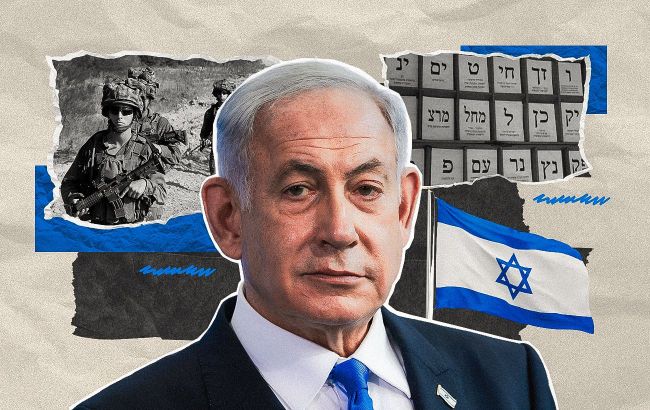 Israeli elections (RBC-Ukraine collage)
The results of Israel's elections are in, but neither the bloc led by incumbent Prime Minister Benjamin Netanyahu nor the opposition Zionist parties managed to secure the required majority. A lengthy and difficult coalition-building process lies ahead, with another snap election potentially on the horizon.
In an interview with RBC-Ukraine, Israel's Deputy Ambassador to Ukraine, Mila Tzur, discussed the election results, possible vote-buying by Türkiye and Qatar, prospects for a new campaign against Iran, relations with Ukraine, and a possible visit by Volodymyr Zelenskyy to Israel.
Key points:
-
How Israel differs from Ukraine: Israel has experienced extended pauses in hostilities, and displaced people have returned home. In Ukraine, the war has been continuous, and displacement has been on a much larger scale. This makes it possible to hold elections in Israel, but not in Ukraine.
-
Foreign interference in the election: An investigation into the alleged use of foreign money to bribe Arab voters is a concern for the authorities, but it will not affect the election results.
-
Security and Iran: Any operation against Iran depends on security considerations, not the election outcome. A weakened Iran would benefit Ukraine because of Tehran's support for Russia.
-
Ties with Ukraine: Relations between the two countries are growing stronger. Israel is providing assistance with shelters and energy, but does not plan to act as a mediator in peace negotiations.
– Israel is sometimes cited as an example for Ukraine: it also faces constant external threats and active military conflicts, yet the country still holds elections. How valid are these parallels? And if Ukraine ultimately has to hold elections before a lasting peace is achieved, can we adopt any of your experience?
– I can understand the comparison because, as you said, it's, in some way, a similar situation of an active conflict. But I think it's an important distinction about the intensity of the conflict. In Israel, it's usually very intense for a short time, and then long periods of, let's say, calmer times. Even now, we're still technically in some sort of war with Iran and others, you know, but currently, there is a possibility for the elections to be held normally because it's calm. There are no daily alarms or alerts or anything.
Read also: Political deadlock or a new war? Four scenarios for Israel and the risks for Ukraine
So I think it's quite different in that sense. Also, currently in Israel, the situation of the displacement that happened at the beginning of the war, immediately after October 7th in 2023, but today most of the civilian population has been able to return to their homes, save for small communities from the Gaza border that are still displaced but they were taken care of by the Election committee in a separate special way with their ability to vote.
But in a general sense, most people have been able to return to their communities and their homes. This is different here in Ukraine, where so many people are displaced and, of course, there is no possibility to hold elections in the front lines or any occupied territories.
– Based on the results of the election in Israel, it is clear that forming a new coalition will be difficult and could take time. Does this carry any risks for the country and the overall situation in the region?
– I think instability everywhere is always a little bit of a risk. But we have sort of a stable transition of power situation. As long as the new government is not able to be assembled, the current interim Prime Minister and government will continue to manage the daily affairs of the country, which they have been doing.
So from that perspective, there is no sort of threat of larger instability or anything like this. This is also not unusual for Israel to have these overdrawn coalition negotiations. So it's not something that is unusual or that we need to learn how to deal with. Also, hopefully we won't have to do it again, but having multiple election cycles is also not something new.
– This is basically what my next question is about: how would you assess the likelihood that your country will be drawn into yet another cycle of these snap elections as it was several years ago?
– I think everybody's hoping to avoid the situation because, at the very least, it is costly for the economy because, in Israel, we have a day off for the election, to encourage people to go vote, you get a day off. Also, it creates longer instability. However, again, as you said, it's something that has happened before, and actually in the end it led to a fairly stable government that managed to even complete its term.
– Despite this attack on October 7 in 2023, which is an insane challenge for any government.
– Yeah, so you could imagine that something like this, so shocking and so difficult, could have caused an election to happen, but this government managed to fulfill its term, which in Israel is also something that happens not very often.
So even if we do go to another election, maybe it will again lead to an even more stable government.
– How can you explain such high voter turnout among Arab citizens? Israel's Central Election Commission instructed the Shin Bet to investigate potential voter bribery, with media naming Qatar and Türkiye as possibly involved. How could these allegations impact the international situation in the region and the election results overall if voter bribery is proven?
– So this is a developing situation, and so of course, we don't have any final answers. It's something that is very concerning in Israel. We take very big pride in our democracy, in our fair and safe elections that have been for all these years: despite all the disagreements, the ability to still come together and respect each other's vote and each other's opinion.
In this situation, as I'm understanding now, the details are concealed because of the investigation. There is some suspicion that maybe foreign money was used to encourage voters to go and vote in a specific way, which is of course not allowed and is a criminal offense.
And of course it raises a lot of concern because you don't want another country to be involved in your country's democratic process in such a way, if you're giving people money or encouraging them with rewards to vote in a certain way.
So right now we're waiting for the security services to do their job and investigate. As I understand it, there are also some people who have been arrested during the day of the election for trying to hand out money to people, which of course is also illegal. I don't think that this specific allegation will influence the results.
– Like the distribution of mandates?
– Yeah, but everything has to be determined by the election committee, which is headed by a judge.
– Right after the elections, incumbent Prime Minister Benjamin Netanyahu stated that there is now a "unique opportunity" to address the Iranian threat. The possibility of another campaign following the US Congressional elections is also widely discussed in the United States. Is it accurate to say that after all these elections, the likelihood of a new operation will increase?
– It's hard to say because, again, it has to do with a lot of information that is not known to the public. So it's hard to estimate. Since the beginning of this conflict, it's been a bit of a game of posturing from both sides, and you never know when different leaders say something in a threatening way, but it ends up being nothing.
I don't believe that the elections themselves are going to influence whether or not there will be another action in Iran. I think the majority of the parties that have gotten large representation in the parliament and the various representatives mostly understand that issues of national security come before any disagreements or squabbles in the political sense, so I think everyone will put the national security concerns ahead of everything.
– Both inside Israel and among foreign observers, many claim that the decision to launch a new operation against Iran could be driven purely by political factors. To what extent is this true?
– I believe that statements like this are also part of the political game. When you say statements like this, it can change the way that people perceive different politicians. Even the media is a player in the political game. So you should also be wary of such statements when they come, accusing this side or that side of doing or not doing something because of the election.
I believe that the big majority of our Parliament members put the issues of national security always ahead.
– What could the consequences be for the entire region and for Ukraine specifically if another escalation still happens, as our conflicts are so interconnected? I mean the risk that attention to the Russo-Ukrainian war will decrease once again, while the shortage of air defense systems – specifically Patriot missiles, which Ukraine also urgently needs – will worsen. And oil prices will go up, which clearly benefits our enemy – Russia.
– As you said, we have some certain common enemies or common interests even in these two different wars. Of course, it's Ukraine's best interest to stop Iran from its meddling and the campaign of terror in various countries, including its support and upholding of Russia in this matter.
Hopefully, we will be able to achieve our goals, in any future campaign or even the current American economic campaign, and to stop the Iranian regime from having the ability to support and uphold their various proxies, to support and uphold their partners in weapons and technology and so on.
There's also the conflict with the Houthis in Saudi Arabia. The Houthis are of course an Iranian proxy. This is again a way that they're trying to influence. Of course, Hezbollah. So, I think it's everyone's best interest – not just Israel's, not even just Ukraine's – but globally, to stop this regime from acting in this way and supporting all these terrorist organizations and all of the violence.
They are supporting with training, supporting with weapons, supporting with money. The money is not going to their citizens. They don't have electricity. They don't have fuel. They don't have medicine. They don't have schools because their money is going instead to some proxies.
– Should we expect changes in relations between Israel and Ukraine following these elections?
– The relations have been improving, I would say, in recent times, we've had some ministers visiting from both countries. Recently, Minister Elkin has been to Ukraine, Minister Kachka went to Israel.
Read also: US and Israel prepare weeklong bombing campaign against Iran – Axios
So we've seen quite a tightening of relations, we've seen some statements from either side on certain subjects, and I hope that this trend will continue, that Israel will continue to be able to support Ukraine in subjects related to dealing with trauma. We're now working on a program to donate some shelters to Sumy and later to other regions in Ukraine.
So, I hope we can continue to support Ukraine also with energy as we've done in the last winter. It's really important to us to support Ukraine in Ukraine's time of need.
– You mentioned a number of top-level visits, but what about bilateral visits by our president Zelenskyy or the Israeli Prime Minister, be it Benjamin Netanyahu or somebody else? Are they discussed, or may they happen in the future?
– We would love to see it. But as you understand, right now we have an acting prime minister. But I hope that after the election or after a new government is sworn in, some reciprocal visits can be arranged. It would be very wonderful to see it. I think it can boost this continued strengthening of relations between our countries
– Could Israel resume its role as a mediator in negotiations on ending the Russo-Ukrainian war, which have recently seen renewed activity, in the foreseeable future?
– I think that, of course, Israel is always ready, to our ability, to assist in any sort of peace talks because we are people that value peace and put the value of life above everything else.
But I think that this involvement is probably not really wanted or requested by either side. I think there's a situation like too many cooks in one kitchen.
There are so many other assisting countries that I'm sure all want to achieve the best for both sides, and to stop the violence, and to stop the war. But you can get into a situation where it's already too much involvement and too many offers, and it's becoming messy.
So I think it's better to let the process that is already taking place run its course. There is the process being led by the US, and we would love to see them come to some sort of achievement.