Why car battery terminals corrode and how to clean them: A simple guide for drivers

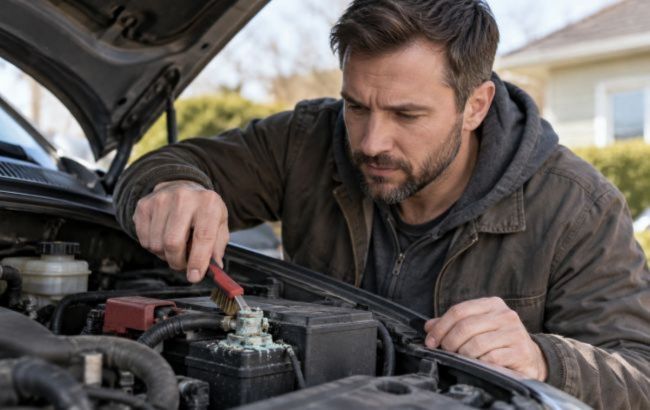 White or greenish deposits on battery contacts can significantly affect engine starting (photo: Styler)
White, blue, or greenish deposits sometimes appear on car battery terminals. This is not just a sign of corrosion. The main danger is that the buildup can interfere with electrical contact and make the car harder to start. However, you can fix the problem at home without visiting a repair shop.
RBC-Ukraine explains why battery terminals corrode and how to clean them.
Why car battery terminals corrode
White, blue, or greenish deposits around battery contacts can signal corrosion. It occurs when chemical reactions involve metal, electrolyte vapors, and gases released while the battery is operating.
As Interstate Batteries explains, hydrogen and electrolyte vapors can settle on metal contacts and form deposits. Their color depends on the metal used to make the terminals and clamps.
Corrosion can worsen for several reasons:
-
Damage to the battery casing. Cracks or leaks can allow electrolyte to reach the contacts.
-
Charging problems. A faulty alternator or voltage regulator can cause the battery to overcharge.
-
High temperatures. Heat accelerates battery wear and can increase evaporation.
-
Poor contact. Loose clamps can also contribute to battery connection problems.
Why deposits on battery contacts are dangerous
Corrosion weakens the electrical connection between the battery and the car's wiring. As a result, current flows less efficiently, making it harder to start the engine.
Drivers may notice the following signs:
-
The starter turns the engine over slowly
-
The car is difficult to start or will not start at all
-
Headlights and other electrical components work erratically.
These symptoms may indicate not only dirty contacts but also a discharged or worn-out battery. Therefore, after cleaning the terminals, we recommend checking the battery's condition, especially if starting problems persist.
How to clean battery terminals
You will need baking soda, water, a small brush, a clean cloth, protective gloves, and safety glasses. You can also use a special brush designed for cleaning battery contacts.
Before starting, turn off the engine and ignition, and let the engine compartment cool. Work in a well-ventilated area. Do not smoke, use open flames, or allow sparks: hydrogen gas, which can explode, may be released while the battery is operating.
Clean the contacts in the following order:
-
Disconnect the terminals. Remove the negative terminal first, followed by the positive one. Do not try to force the clamps off the contacts.
-
Prepare the solution. Mix baking soda with a small amount of water to form a paste.
-
Remove the deposits. Apply the mixture to the affected areas with a brush and gently clean the contacts and the inside of the clamps.
-
Remove the baking soda residue. Wipe the surfaces with a damp cloth. Do not allow water to enter the battery or its ventilation openings.
-
Dry the contacts. Make sure all surfaces are completely dry before reconnecting the battery.
-
Reconnect the battery. Attach the positive terminal first, followed by the negative one.
Note that Interstate Batteries recommends applying the solution only to the affected areas rather than pouring it over the battery.
If your car has a start-stop system or complex electronics, check the manufacturer's instructions before disconnecting the battery. Some models require a special procedure, and you may need to adjust additional settings after reconnecting.
How to prevent battery terminals from corroding again
After cleaning, you can apply a special protective product for battery terminals to their outer surfaces. It helps slow down corrosion. However, do not apply it between the metal contact surfaces: the clamp must fit tightly against the battery post.
Also, inspect the battery regularly and make sure the clamps are securely fastened. If deposits reappear quickly, the battery casing is damaged, or the car continues to have trouble starting, you should have it checked at a repair shop.
In that case, a mechanic will check the battery's condition, the alternator, and the charging voltage. Cleaning the contacts alone will not fix the problem if the corrosion is caused by a fault in the charging system.