US revamps giant cannon to test hypersonic weapons

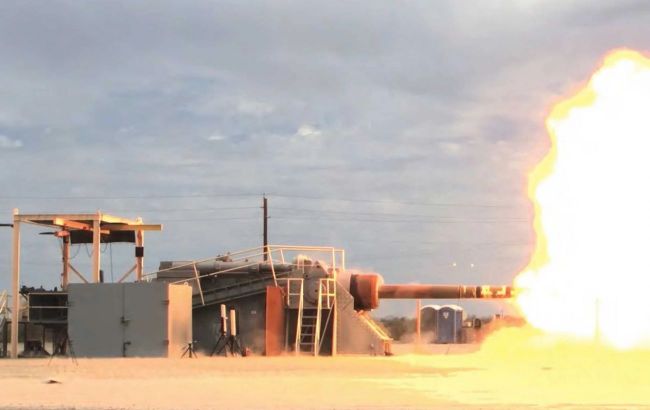 Photo: Testing a hypersonic warhead from a cannon (US Army)
The US Army conducted its first full-scale test of a hypersonic warhead by firing it from a large-caliber cannon at the Yuma Proving Ground in Arizona. This method allows the warhead's vulnerability and performance to be tested during a strike on a target without having to use an entire missile for each test, according to Army Recognition.
Long-range artillery gun was modified for warhead testing
On July 30, 2026, the first full-scale test of a hypersonic warhead launched from a cannon system took place at the Yuma Proving Ground in Arizona. The test was conducted jointly by specialists from the proving ground, the DEVCOM Armaments Center, and the Lawrence Livermore National Laboratory.
The Heavy Artillery Test System (HATS) was used for the launch—a stationary installation based on the canceled Strategic Long Range Cannon (SLRC) program, which had once envisioned the development of a mobile cannon capable of striking targets at ranges exceeding 1,600 km.
This testing method allows the warhead to be accelerated to the required velocity without using a rocket engine, which significantly reduces the cost and speeds up testing.
A cannon shot does not simulate the operation of a cruise engine, hypersonic flight, or missile maneuvering. Instead, it allows researchers to focus exclusively on what happens at the moment of impact with the target: whether the warhead's structure holds up, whether the detonator fires, and whether the payload remains intact.
Why military needs separate cannon-firing test method
The main advantage of the cannon-firing method is cost and speed. A full-scale flight test of a hypersonic missile requires a launch vehicle, engines, guidance systems, and test range support, and costs millions of dollars per launch, whereas the cannon method allows for significantly more firings within the same budget.
To protect the warhead during a hard launch, engineers developed a special protective launch package (Integrated Launch Package) featuring a launch tray and an electronic safety and actuation device that protect the structure, the detonator, and telemetry sensors from stresses exceeding those experienced by the warhead during a conventional missile launch.
Full-scale flight tests of missiles remain necessary to verify engine performance, guidance, and maneuvering; however, the gun-launch method allows these expensive and complex tests to be separated from the significantly cheaper verification of the warhead's pure destructive capability.
According to the developers' plan, this should accelerate the development of new hypersonic munitions and provide engineers with more data to calibrate computer models.
Germany and the United Kingdom are secretly developing a new DPS missile, and among the options being considered is a hypersonic version capable of speeds at least five times the speed of sound.
The US is expanding production of Patriot and THAAD interceptor missiles, signing a contract with Lockheed Martin and Northrop Grumman worth over $3 billion—amid declining stockpiles due to Russia's war against Ukraine and the conflict in the Middle East.