US Central Command rejects Iranian claims of blocking the Strait of Hormuz

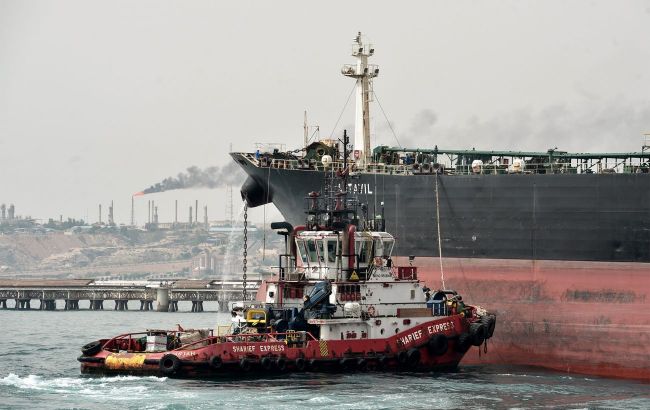 Photo: Iran may move toward full closure of the Strait of Hormuz (Getty Images)
According to US military officials, Iran has not yet closed the Strait of Hormuz, as its vessels are neither mining the waterway nor conducting continuous patrols there, Fox News journalist Jennifer Griffin stated.
Read also: Iran claimed ability to build 11 nuclear bombs, Trump's envoy Witkoff says
"CENTCOM says Strait of Hormuz not closed despite IRGC pronouncement. Iran is not patrolling the strait, and no sign yet of it mining the strait," Griffin stated.
She also emphasized that about 80% of Iran’s oil exports go to China. Blocking oil and gas logistics through the strait would harm both Iran and its key ally.
Where the Strait of Hormuz is located
The Strait of Hormuz is situated in the southeastern Middle East, between Iran to the north and Oman and the United Arab Emirates to the south. It connects the Persian Gulf to the Gulf of Oman and, further, to the Arabian Sea and the Indian Ocean.
The strait stretches 195 kilometers (121 miles) in length, and its width varies between 55 and 95 kilometers (34 to 59 miles). It has an average depth of 27.5 meters, with a maximum depth of 229 meters.
Among the main ports located near the strait are Bandar Abbas (Iran) and Khasab (Oman).
The strait is divided into two shipping lanes approximately 2.5 kilometers wide each, separated by a 5-kilometer buffer zone.
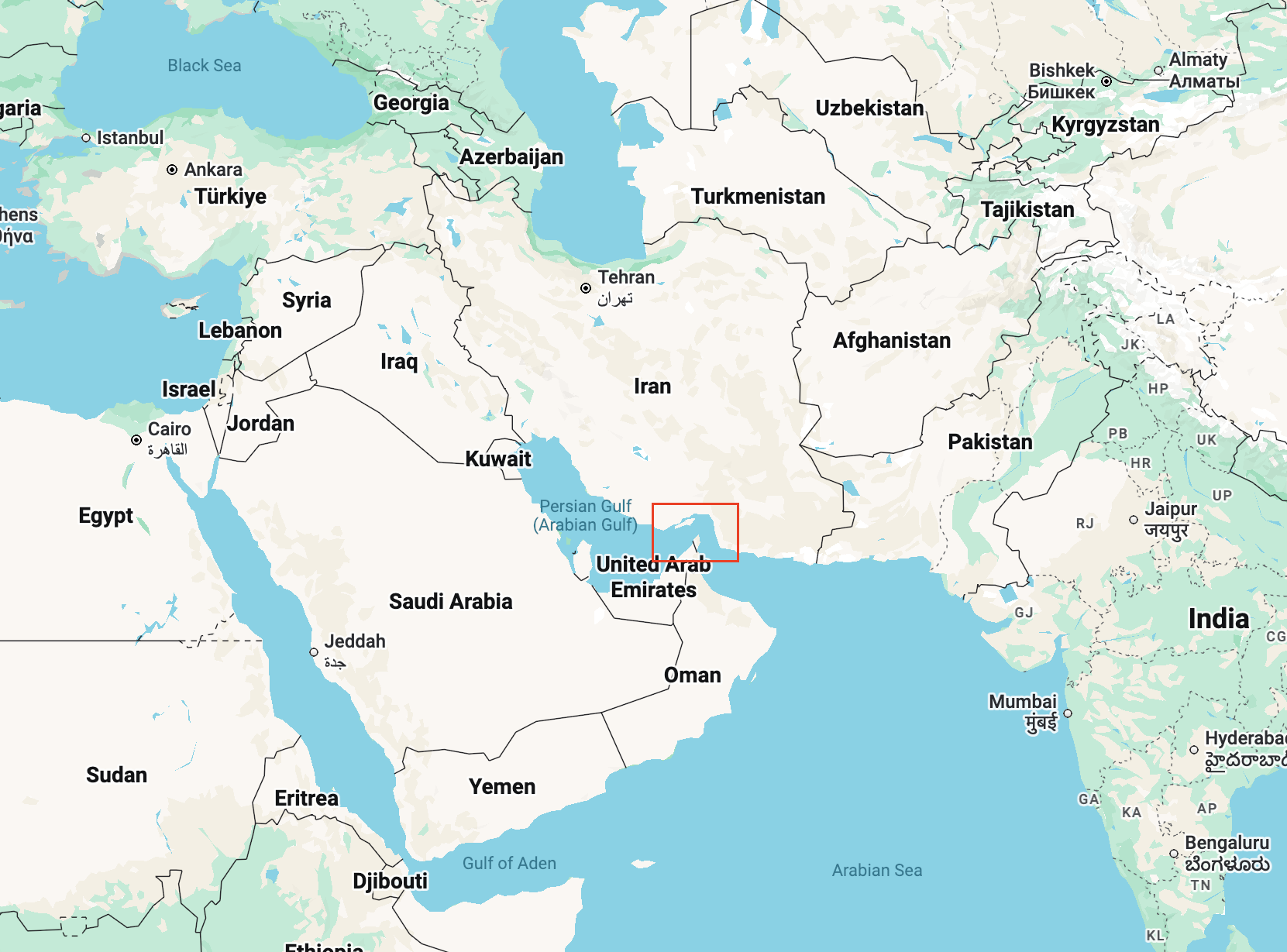
Photo: Location of the Strait of Hormuz (Google Maps screenshot)
What preceded this
Earlier reports said that due to military actions and mutual attacks involving Iran, the United States, and Israel, shipping in the region has effectively stalled, with volumes dropping by 75%. Tanker owners are reluctant to put to sea.
Although the UAE and Saudi Arabia are attempting to reroute oil via pipelines, it is not enough. As a result, fuel prices have surged sharply. India and Iran have already raised prices for their oil.