US and Israel hit Iran hard: Is this a war to destroy the regime?


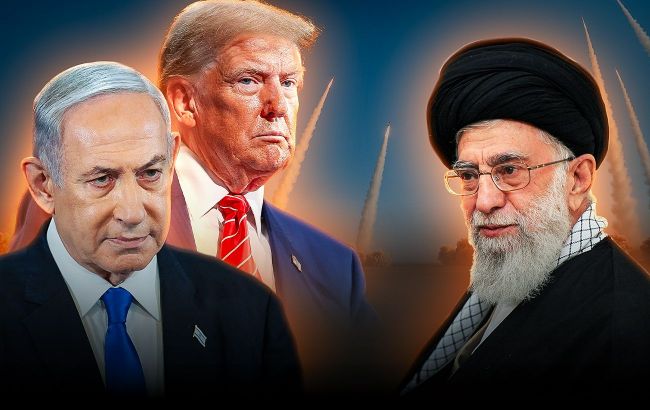 Benjamin Netanyahu, Donald Trump and Ali Khamenei (collage: RBC-Ukraine)
The United States and Israel have launched a large-scale air operation, carrying out a series of strikes on facilities in Iran. While Donald Trump says he intends to eliminate the nuclear threat, the Iranian leadership is preparing a “devastating” response.
RBC-Ukraine analyzes whether this stage of the confrontation will escalate into a major war.
Read also: Israel attacks Iran, supported by US, as tensions spike in the Middle East
Key points
- Scale of the attack. Strikes were carried out on facilities in Tehran, Qom and Isfahan, as well as on Hezbollah bases in Lebanon.
- US involvement. American aircraft are striking from bases across the Middle East and from aircraft carriers; Donald Trump confirmed US participation in the operation.
- Iran’s response. Supreme Leader Ali Khamenei was urgently evacuated from Tehran to a safe location. Iran has already begun asymmetric retaliatory strikes on US bases in the region and on Israeli territory.
- Will there be a major war? Today’s events could lead to a large-scale war and the downfall of the Tehran regime. But much depends on Trump’s willingness to go all the way.
On the morning of February 28, Israel carried out a series of strikes on facilities of the Iranian regime. The cities of Tehran, Qom, and Isfahan came under attack.
“The State of Israel has launched a preemptive strike against Iran in order to eliminate threats to the State of Israel,” said Defense Minister Israel Katz.
Facilities of the Hezbollah group in southern Lebanon, which is an ally of Iran, were also hit.
The United States also joined the attack. American aviation is carrying out dozens of strikes from bases across the Middle East, as well as from one or more aircraft carriers, The New York Times reports.
“The United States military began major combat operations in Iran. Our objective is to defend the American people by eliminating imminent threats from the Iranian regime,” US President Donald Trump said.
An American official told Al Jazeera that the joint US-Israeli airstrikes are aimed at eliminating Iran’s security system.
According to a senior Israeli security official, the operation had been planned for months together with the Americans, and the date of the attack was determined in recent weeks, Reuters reports.
The attacks have only just begun. The first stage of the operation will last four days, Israel’s Channel 12 reports, citing a source in the country’s leadership.
Culmination of the confrontation
This is not the first stage of military confrontation between Iran and Israel with US participation.
Tehran waged a proxy war against Jerusalem for years through allied groups and simultaneously developed nuclear weapons to secure an “umbrella” against a possible response.
All this led to the 12-day war between the two countries in June last year, which the United States joined at the final stage.
At that time, Israel carried out a preemptive strike on Iran’s nuclear and military facilities in order to destroy its nuclear program. It was not possible to complete this task.
Although the United States even used its most powerful non-nuclear weapon — GBU-57 bunker-buster bombs — some of the nuclear facilities are located deep underground. Iran also managed to move part of its enriched uranium to a safe location.
After the 12-day war and until today, negotiations between the United States and Iran over the nuclear program continued. The sides considered various compromise options — voluntary restrictions for Iran in the nuclear field in exchange for certain concessions by the United States.
Among other demands from the Americans were restrictions on Iran’s ballistic weapons as well as the cessation of support for terrorist groups in the region, such as Hamas, Hezbollah, and the Houthis.
However, they did not reach a result. Moreover, at the beginning of this year, mass protests against the Islamic regime broke out in Iran. The United States and other Western countries expressed support for the protesters and even considered the possibility of striking Iran to weaken the regime.
Against this backdrop, since the beginning of the year, the United States has been steadily increasing its military forces in the Middle East, while leaks in Western and Middle Eastern media predicted a strike on Iran almost a month ago.
Read also: Trump ended war? Details on resolution of Iran-Israel conflict
Will the Iranian regime fall?
The baseline scenario now is war. Likely larger in scale than the 12-day one, Serhii Danylov, deputy director of the Center for Middle Eastern Studies, told RBC-Ukraine.
“Right now, there is destruction of military infrastructure, and most importantly, command centers: ministries, the office of the rahbar (Iran’s supreme leader — ed.), top officials, senior generals. It has crossed the line. I think we are now witnessing the beginning of a war aimed at destroying the Islamic regime in Iran,” Danylov noted.
But, according to him, the fate of the regime is still far from decided.
Iran has already carried out its first strikes on Israel and US bases in response. After the 12-day war, especially over the past months, Iran was preparing for defense, but it faces objective constraints of sanctions and the power of Israeli-American forces.
“There are very different forces in the air. From our own Ukrainian experience, we know how difficult it is to build air and missile defense. The Iranians did not have such allies behind them as we do. And it took us many years. I think there will be many surprises from both sides. Both from the Israeli-American coalition and from the Iranians. The Iranians have to act in a non-standard and asymmetric way. This is their only way out in this situation. Whether they will succeed — we'll see,” Danylov said.
So far, the Iranian leadership does not intend to surrender. Reuters, citing a source in Iran, reports that Supreme Leader Ali Khamenei is not in Tehran and has been moved to a safe location.
Iran is preparing a larger response to the US-Israeli attacks, which promises to be "devastating."
Read also: Mass protests sweep Iran: Will regime fall, what it means for Russia and Ukraine?
Iran’s leadership still maintains control over the state. It is still too early to speak of a split among the elites amid the protests and possible disagreement with the supreme leader’s position. At the same time, a uniting of the population “around the flag” is also unlikely.
“I no longer believe in that. After the shootings, after the chants of ‘death to Khamenei.’ Literally this week, when the protests resumed, especially at universities, the slogans became even more radical. They use obscene language toward the regime and all its representatives. So chants with profanity are now actually sound, mostly against the leaders of the regime,” Serhii Danylov emphasized.
Much will depend on how ready Donald Trump proves to be for a prolonged operation. Whether he will prefer a targeted one-day operation "for a good picture,” as last summer, or be inclined toward more large-scale actions.
In the first hour after the start of the operation, Western media floated versions that the current strikes could be primarily Trump’s last argument of pressure on the Iranians in negotiations. This could explain why the attack was carried out in daylight and the choice of targets (such as Khamenei’s residence), whereas from a purely military point of view, nighttime strikes could have been more effective.
However, given the scale of the strikes by the American-Israeli coalition and Iran’s response, which has already affected most countries in the region, as well as the rhetoric of all parties to the confrontation, the option of a “blitz conflict” does not appear the most likely.
Quick Q&A
– What is the goal of the joint US-Israeli military operation?
– According to statements from Donald Trump and Israel’s Defense Ministry, the goal is the complete destruction of the threat from the Iranian regime and the elimination of its security system. The attacks are aimed at military infrastructure and state command centers.
– How long will the first phase of the attack on Iran last?
– According to Israel’s Channel 12, the first stage of the large-scale operation will last for four days. The operation had been prepared for several months in full coordination between Washington and Jerusalem.
– Where is Ali Khamenei now?
– According to Reuters, Iran’s supreme leader left Tehran immediately after the start of the attack. He has now been moved to a special secure location, from where he continues to lead the state while Tehran prepares its response.
– Has a major war begun in the Middle East?
– Expert Serhii Danylov notes that the current events mark the beginning of a war aimed at destroying the Islamic regime. Iran has already begun carrying out asymmetric retaliatory strikes on US bases and Israel.
Sources: Reuters, Al Jazeera, The New York Times, The Times of Israel, and comments by expert Serhii Danylov.