Ukrainians playing Russia came close to beating NATO in cyber war exercise — FT

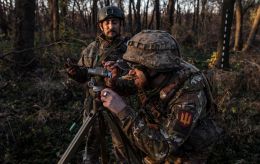
 Ukraine and NATO conduct joint cyberattack simulation exercise (photo: Raphael Minder/FT)
Ukrainian specialists assumed the role of Russia during a three-day cyberattack simulation in the Polish city of Bydgoszcz, using tactics modeled after Russian disinformation campaigns, the Financial Times reports.
How simulation unfolded
The exercise was held in Bydgoszcz, Poland, at the NATO-Ukraine Joint Analysis, Training and Education Centre (JATEC).
The scenario envisioned a fictional country called Perantsa suffering a cyberattack on its power grid by its authoritarian neighbor, Karti, which had long laid claim to Perantsa's territory.
The three-day exercise featured three crisis scenarios: a power outage, a major flood, and a cyberattack on the banking system. Ukrainian officials played the role of the "villains" from Karti, while NATO participants defended the fictional state of Perantsa.
How Ukrainians played Russians
The Karti team flooded social media with AI-generated messages. The posts accused the Perantsa government of incompetence and corruption during each crisis while simultaneously claiming that only Karti could provide "assistance."
"Perantsa can't help, but Karti does," read one message posted on a fictional government website.
The NATO team responded with calls for national unity and warnings about looting and other forms of public disorder.
According to a panel of academics and disinformation experts serving as judges, Karti lost by only a narrow margin in two of the three scenarios.
What set Ukrainians apart
According to German Lieutenant Colonel Yvonne Rötter, director of the Bundeswehr's Centre for Digitalization, the Ukrainian participants worked faster, demonstrated greater creativity, and showed stronger skills in using artificial intelligence.
"The Ukrainians have a very realistic view of how opponents work and communicate. In that regard, we can learn from them," she acknowledged.
The judges criticized the Karti team for failing to "maintain a consistent narrative anchored in a small number of core messages."
"In a real-life scenario, the core messages change every day: just look at what Russia is doing," a Ukrainian participant in the simulation responded.
About JATEC: Why it matters to Ukraine
According to Colonel Valerii Vyshnivskyi, head of the Ukrainian delegation, knowledge-sharing through JATEC "contributes to the achievement of a key goal: the fastest possible acquisition of interoperability between Ukraine and the Alliance."
Of the center's 60 staff members, one-third are seconded from Ukraine, including personnel from the Armed Forces, the Defense Ministry, and intelligence agencies. Ukrainian specialists share their experience with drone swarm attacks, electronic warfare, and decentralized command structures. In return, Ukraine gains broader access to NATO software and engineering capabilities.
The simulation was funded by the Bundeswehr, while the digital wargaming platform was provided by French IT company Atos.
Does exercise reflect reality?
Alexandru Fotescu, a cognitive warfare researcher at Helmut Schmidt University in Hamburg, acknowledged that the simulation had its limitations.
"A game is not really pushing us into the real-life conditions that the Ukrainians might be confronting. In wartime, things are very emotional, you have a dramatic and existential engagement," he said, describing the simulation as a scenario designed more for practice.
Notably, the NATO-Ukraine Joint Analysis, Training and Education Centre (JATEC) in Bydgoszcz opened in February 2025. It is the first civilian-military organization jointly managed by NATO and Ukraine.
Kyiv and the Alliance finalized the center's work plan in January 2025. In October, the Cabinet of Ministers of Ukraine approved procedures for deploying Ukrainian military personnel to Bydgoszcz, where they work on modern approaches to defense planning and the use of advanced battlefield technology.