Ukraine opens first EU accession negotiation cluster: What it means for membership


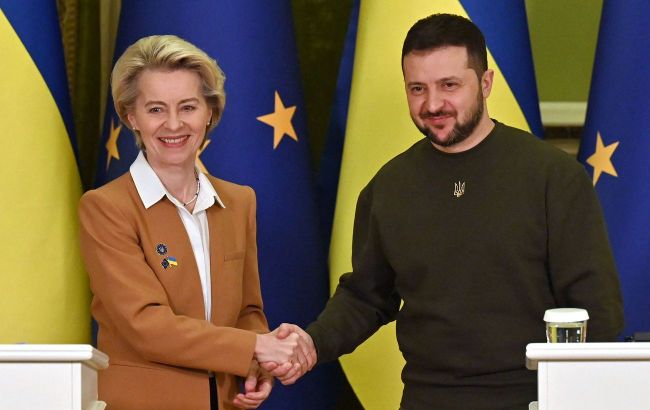 Photo: Volodymyr Zelenskyy and Ursula von der Leyen (Getty Images)
Key points:
- Six clusters: Ukraine needs to align six thematic blocks of legislation for EU accession.
- July or autumn: Optimistic and pessimistic timelines for opening the remaining five clusters after the first Fundamentals cluster.
- Poland and France: Countries that have raised their own conditions regarding Ukrainian exports and the pace of EU enlargement after Hungary’s veto was eased.
- Reform engine: The Cabinet of Ministers will develop roadmaps aligned with EU directives, while the Verkhovna Rada (Ukrainian Parliament - ed.) will pass the necessary laws.
- 2030 target: The optimistic deadline for Ukraine’s EU accession, though it may shift.
"All EU countries have now agreed to open the first accession negotiations cluster with Ukraine and Moldova. Today, we're launching talks on the backbone of the accession process, including justice, freedom, and fundamental rights," the European Commission said.
It added that Ukraine and Moldova have done enormous work.
Updated at 8:01 p.m.
EU Foreign Policy Chief Kaja Kallas confirmed that Ukraine and Moldova are taking a decisive step toward joining the bloc.
"Opening the first chapters of EU accession negotiations is a major milestone. Both countries have delivered on difficult reforms under extraordinary circumstances. Ukraine and Moldova’s future lie in the European Union. Their membership will make also Europe stronger," she said.
What are clusters?
Negotiation clusters are areas of legislation in which Ukraine must carry out reforms to join the EU. There are six clusters in total:
- Fundamentals
- Internal market
- Competitiveness and inclusive growth
- Green agenda and sustainable connectivity
- Resources, agriculture and cohesion
- External relations
Each cluster includes several chapters, and Ukraine must align its laws with EU standards. In total, there are 35 chapters. The Fundamentals cluster is always opened first.
One cluster opened — what about the other five?
The European Commission says Ukraine and the EU are technically ready to open all negotiation clusters. However, the decision is not made by the Commission but by the EU member states unanimously.
According to RBC-Ukraine, the optimistic scenario is that all six clusters could be opened by the end of July, while the pessimistic scenario puts completion closer to autumn.
Previously, Hungary under Viktor Orbán blocked significant progress in Ukraine’s EU path, although the current Hungarian government occasionally hints at new vetoes unless Kyiv cooperates on national minority rights.
Other EU countries have not publicly opposed opening all clusters. However, after Orbán’s political influence weakened, some member states reportedly began to raise additional conditions.
For a long time, Europe knew Ukraine’s EU integration was blocked by Orbán, so individual reform criteria weren't closely watched. But with Orbán no longer an obstacle, some countries suddenly came up with additional demands.
Who is against opening all clusters at once?
RBC-Ukraine sources among opponents of such a decision name Poland and France. For Warsaw, the issue of agriculture is particularly important.
Poland fears that Ukraine’s accession to the EU, with its strong agricultural sector, could negatively affect Polish farmers. At the same time, disputes over historical issues are not expected, at least for now, to influence the opening of the clusters.
As for France, its preference to initially limit the process to only the first cluster has both economic and political grounds.
On one hand, Paris is concerned about protecting its domestic economy from future Ukrainian competition. On the other hand, the French government traditionally takes a cautious approach to the rapid pace of EU enlargement.
What does the opening of clusters mean in practice?
During work on the clusters, each ministry must develop detailed roadmaps of reforms and adapt hundreds of EU directives to Ukrainian conditions — either through laws or through secondary legislation such as government decrees and ministerial orders.
Each step must be coordinated with the European Commission. At the same time, the Verkhovna Rada must quickly pass European integration-related legislation.
For ordinary Ukrainians, this means the start of big changes in everyday life. The country will begin restructuring according to EU standards even before formal accession — ranging from water supply standards to environmental regulations and consumer protection rules.
When can Ukraine close the clusters?
The clusters can be closed once the laws are fully aligned with European standards. After that, only a political decision by the European Union on Ukraine’s accession remains.
In this process, the full responsibility lies with Ukraine — the pace of reforms will depend solely on the parliament, the government, and other state institutions.
Certain challenges may already arise within the opened Fundamentals cluster. Within this framework, Ukraine must align areas such as the rule of law, anti-corruption efforts, and other sectors that have traditionally been difficult to reform.
According to RBC-Ukraine, the EU has high expectations, for example, regarding strengthening the independence of the Special Anti-Corruption Prosecutor’s Office (SAPO) and the National Anti-Corruption Bureau (NABU), reforming the State Bureau of Investigation (SBI), and changing the procedure for appointing the Prosecutor General, among others.
When could Ukraine join the EU?
At this stage, the optimistic timeline for Ukraine’s EU accession is 2030, when a new wave of EU enlargement could take place.
According to informed RBC-Ukraine sources, about 2–2.5 years from that point may be needed for ratification of Ukraine’s accession treaty in all 27 EU member states.
This means that negotiations across all six clusters must be completed in 2027–2028, along with drafting the accession treaty.
And, of course, the timeline may be affected by many factors — ranging from the end of the Russia-Ukraine war to changes in government in some European countries toward more sceptical positions on Ukraine.