Ukraine develops cheaper alternative to Patriot missiles for air defense

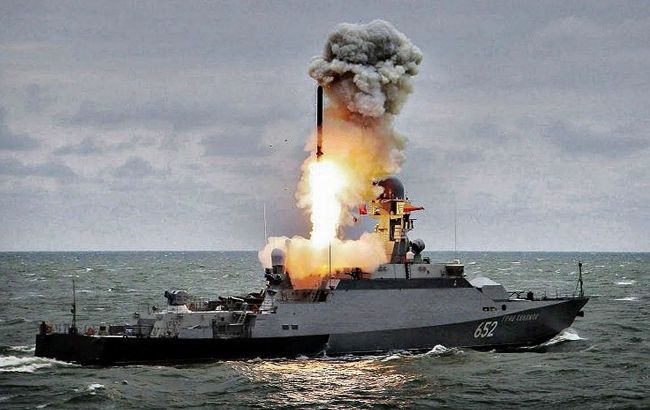 Launch of Kalibr missiles (photo: Russian media)
Ukraine is increasingly relying on next-generation electronic warfare amid a shortage of expensive Western air defense missiles, Politico reports.
The publication spoke with the developers of the Ukrainian Lima system created by defense startup Cascade Systems.
According to one of the developers with the callsign Alchemist, the system does not destroy targets but interferes with their navigation. Lima creates powerful interference fields that disrupt satellite signals.
"In addition to simply suppressing navigation, we use spoofing and the substitution of coordinates by several kilometers. We can make their missiles fall in fields instead of hitting their targets," Alchemist explained.
How Lima works
Lima imitates the satellite navigation signals used by Russian missiles and drones, transmitting false coordinates to them.
According to the developers, some past attacks were prevented because the approaching weapons were thought to be in Peru.
The system can also create a "dead zone" where a Russian drone loses its guidance signal.
"When we ... create a wide enough zone, protected by Lima stations, a missile won't even hit the city. We will send it into an open field," the Alchemist said.
Much cheaper than Patriot
Another major advantage of Lima is its price.
One installation costs about 58,000 euros. By comparison, a single Patriot PAC-3 missile costs enough to protect an entire large city with Lima systems.
Cascade has already delivered more than 400 Lima systems. They began to be used in July 2024, and since October 2025, the system has also been involved in protecting civilian infrastructure.
The company claims that over the past 18 months, Lima has jammed 20,500 Shahed drones and redirected dozens of ballistic and cruise missiles.
The system is constantly being updated
At the same time, the latest modifications of Lima are capable of suppressing long-range weapons, including ballistic missiles that use systems such as the Russian GLONASS satellite navigation system, said Maksym Skoretskyy, the head of the electronic warfare department of the land forces of Ukraine.
Developers say that after losing a satellite signal, Russian long-range weapons can continue moving using an inertial navigation system, but their accuracy drops sharply.
The system has also learned to counter glide bombs. Previously, this was more difficult due to the use of new Russian anti-jamming antennas.
"Even if the glide bomb deviates from its target for about 20 meters, it already means the target will continue to exist," Skoretskyy said.
He also stressed that relying only on electronic warfare carries risks. According to him, drones and missiles still fall after losing their signal and can cause damage.
"However, will Russian ballistic missiles hit the desired target when Lima is on? I would say unlikely," Skoretskyy added.
According to the developers, the first versions of Lima appeared in 2022 to combat cruise missiles. The company spent more than $2 million of its own funds to create the system. Cascade Systems only began receiving government contracts at the end of last year.
At the beginning of 2025, Russian forces began using upgraded Kometa antennas, causing previous versions of Ukrainian electronic warfare systems to lose effectiveness.
"That's when real life started. We were living in our lab, trying to crack the new Russian antennas," Alchemist said.
As previously reported, Ukraine has faced an acute shortage of missiles for Patriot, NASAMS, and IRIS-T air defense systems.
Launchers in military units are half-empty, and Air Force representatives are forced to ask for 5–10 missiles during international negotiations.
Russian forces also used a tactic of massive drone strikes during the attack on the night of May 24, trying to overload air defense systems. The enemy relied on the number of drones rather than technological innovations.