UK develops laser air defense to counter drone swarms after lessons from Ukraine


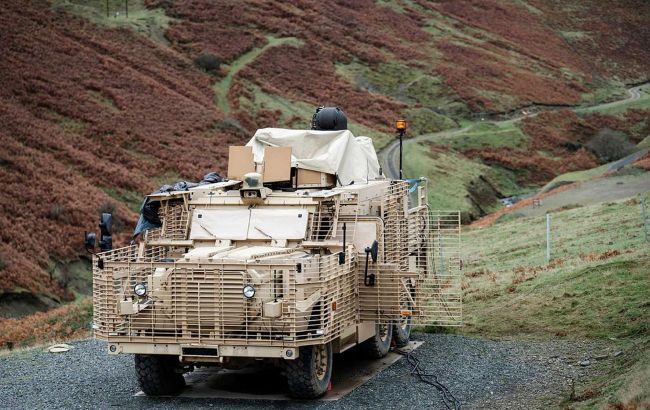 Wolfhound armored vehicle equipped with a laser system (photo: UK Ministry of Defense)
The UK Ministry of Defense has launched Project PANOPTES, an initiative to develop an autonomous laser-based air defense system mounted on armored vehicles to counter swarms of low-cost drones, the Ministry of Defense said.
What is known about Project PANOPTES
Project PANOPTES was launched on September 2, 2026, as the first stage of a multi-phase development and procurement process that could eventually evolve into a full-scale weapons program.
The UK Ministry of Defense directly links the need for such a system to lessons from the war in Ukraine, where the widespread use of low-cost drones is forcing ground forces to spread air defense resources across a much broader range of threats.
The system requirements cover the entire engagement cycle: detecting, tracking, identifying, assessing, and engaging aerial targets autonomously from a combat vehicle.
Class 1 drones have been identified as the primary target, including individual aircraft as well as simultaneous and sequential attacks designed to overwhelm local air defenses. Autonomous operation is particularly important in a drone-swarm scenario: when several threats appear at once, a human operator can become a bottleneck in rapidly prioritizing targets.
The Ministry of Defense is primarily interested in solutions based on laser-directed energy weapons, although other technologies are also being considered. One key advantage of lasers is that the number of potential engagements is limited not by ammunition stocks but by power generation, thermal management, and maintenance, allowing repeated engagements without using costly missiles.
Why Britain needs a laser to counter drones
PANOPTES builds on the earlier Land Laser Directed Energy Weapon Demonstrator program. In July 2024, a laser developed by Raytheon UK and mounted on a Wolfhound armored vehicle successfully engaged targets at the Porton Down training range at distances of more than one kilometer.
In December 2024, the Ministry of Defense confirmed that personnel from the 16th Regiment Royal Artillery had used the laser for the first time at the Rednor range in central Wales to track and destroy drones. It marked the first time the British Army had used a high-energy laser mounted on an armored vehicle against aerial targets.
Tests demonstrated a range of more than one kilometer, the ability to operate the system with a two-person crew, and a training period of less than two weeks.
Unlike the demonstrator, PANOPTES is intended to deliver an integrated system suitable for operational deployment, including potential integration with a future uncrewed ground platform. This could allow air defense systems to be positioned closer to frontline units while reducing risks to personnel.
The first phase of the program does not involve the procurement of a finished weapon. Participants must demonstrate the technological maturity of their solutions and provide credible plans for progressing to the Minimum Viable Product and Minimum Deployable Capability stages.
The Ministry of Defense aims to bring promising solutions into operational use in less than two years, subject to further approvals. Up to £5 million has been allocated for several contracts during the first phase, with work expected to begin in November or December 2026.
The Ministry of Defense stresses that lasers will not replace missiles or artillery. Weather conditions, obstacles, line-of-sight requirements, and the time needed to keep the beam on a target can limit their effectiveness, meaning the technology is intended to complement a layered air defense system. Its main advantage is the ability to repeatedly engage low-cost reconnaissance and attack drones while preserving missile stocks for more complex threats.
Cooperation between London and Kyiv in unmanned and precision-strike systems continues to expand. Ukrainian forces previously used British Nyan jet-powered drones for the first time to conduct strikes deep inside Russia. The systems, manufactured by Callen-Lenz, a subsidiary of BAE Systems, have been used for long-range strikes for more than six months.