Trump, mobilization and war: What Russia's election means for Putin's next move


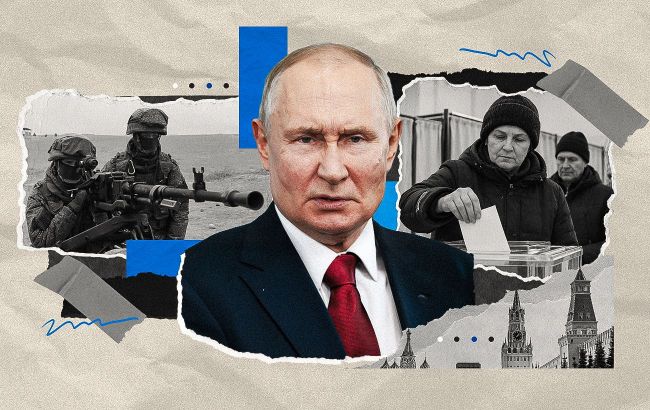 Why Putin needs Russia's "election" and what comes next (photo: RBC-Ukraine collage)
Today, September 18, Russia begins its "elections" to the State Duma (the lower house of Russia's parliament). Yet the highly staged "vote" serves merely as a facade for the Kremlin's very different objectives.
Why Putin needs the spectacle of "elections" and how it is connected to the situation on the battlefield — in RBC-Ukraine's analysis.
Key points:
-
Media smokescreen: Russia's "elections" are a political tool designed to create the appearance of broad public support for the regime and test the loyalty of regional elites.
-
The real turning point: For Putin, the vote is only a temporary constraint. Once it is over, the regime will have a freer hand to make unpopular decisions.
-
Logic of escalation: A combination of favorable weather for offensive operations and distorted battlefield reports is encouraging the Kremlin to keep up the pressure rather than enter negotiations.
-
The Washington factor: With Trump and the US elections in mind, Putin may opt for covert mobilization rather than an openly declared campaign to avoid unnecessary social tensions.
Russia's "elections" have long since turned into a farce. The outcome is known in advance. The only question is what share of the vote the Kremlin will "manufacture" for the ruling United Russia party. There is already little doubt that the party's result will fall short of a constitutional majority.
Russia's political landscape has long been shaped behind closed doors in the Presidential Administration. Kremlin-loyal parties seeking their share of corrupt patronage can, at most, negotiate outside the "electoral" process over how much representation they will receive in the State Duma. Genuine opposition forces, meanwhile, have been excluded entirely from parliament and from any role in decision-making.
The legitimacy of the "elections" is further undermined by the fact that Russia will also hold them in the occupied territories of Ukraine.
Why, then, does Russia continue to hold regular "votes"? For the Kremlin, such campaigns are more of a "public presentation tool," Iryna Pavlenko, an expert at the Institute for the Transformation of Northern Eurasia, told RBC-Ukraine.
"These 'elections' are meant to create and demonstrate the appearance of universal approval and support for the authorities and their entire agenda — domestic, economic and foreign policy alike. The main objective is to ensure, as they used to say in Soviet times, 'the unity of the party and the people,'" she said.
Anything that does not fit this scenario is barred. A clear example is the exclusion of the formally opposition Yabloko party from the current "elections." Although it de facto supports the Kremlin in most areas, at one point the party became a rallying point for those opposed to the war.
On August 10, Russia's Supreme Court revoked the registration of Yabloko's federal candidate list. The formal grounds were alleged minor violations: a small amount of foreign funding, the use of social media platforms blocked in Russia, and plagiarism.
The Kremlin also has two additional objectives for these "elections." The first is to indirectly gather information about genuine public sentiment, as Moscow remains concerned about the possibility of domestic destabilization.
"Another aspect is testing the effectiveness of local governors and regional officials — how well they can organize everything. This is their test, and they have to pass it in order to advance further within the system of government," Pavlenko added.
The State Duma "vote," therefore, serves only as a temporary constraint. For Putin and his inner circle, it represents a kind of Rubicon: once crossed, the regime will have little reason to hold back from more radical measures.
Heading toward mobilization
On August 22, Ukrainian President Volodymyr Zelenskyy, citing intelligence data, said that Russia would announce a new wave of mobilization after the State Duma "elections."
"What they want today is an additional 300,000 in 2026, and more in 2027. The target was half a million," Zelenskyy said.
As serviceman and political consultant Oleksandr Antoniuk told RBC-Ukraine, Russia has already laid the groundwork for conscription: an electronic registry of reservists is now fully operational, military registration records have been updated, and coercive measures have also been strengthened.
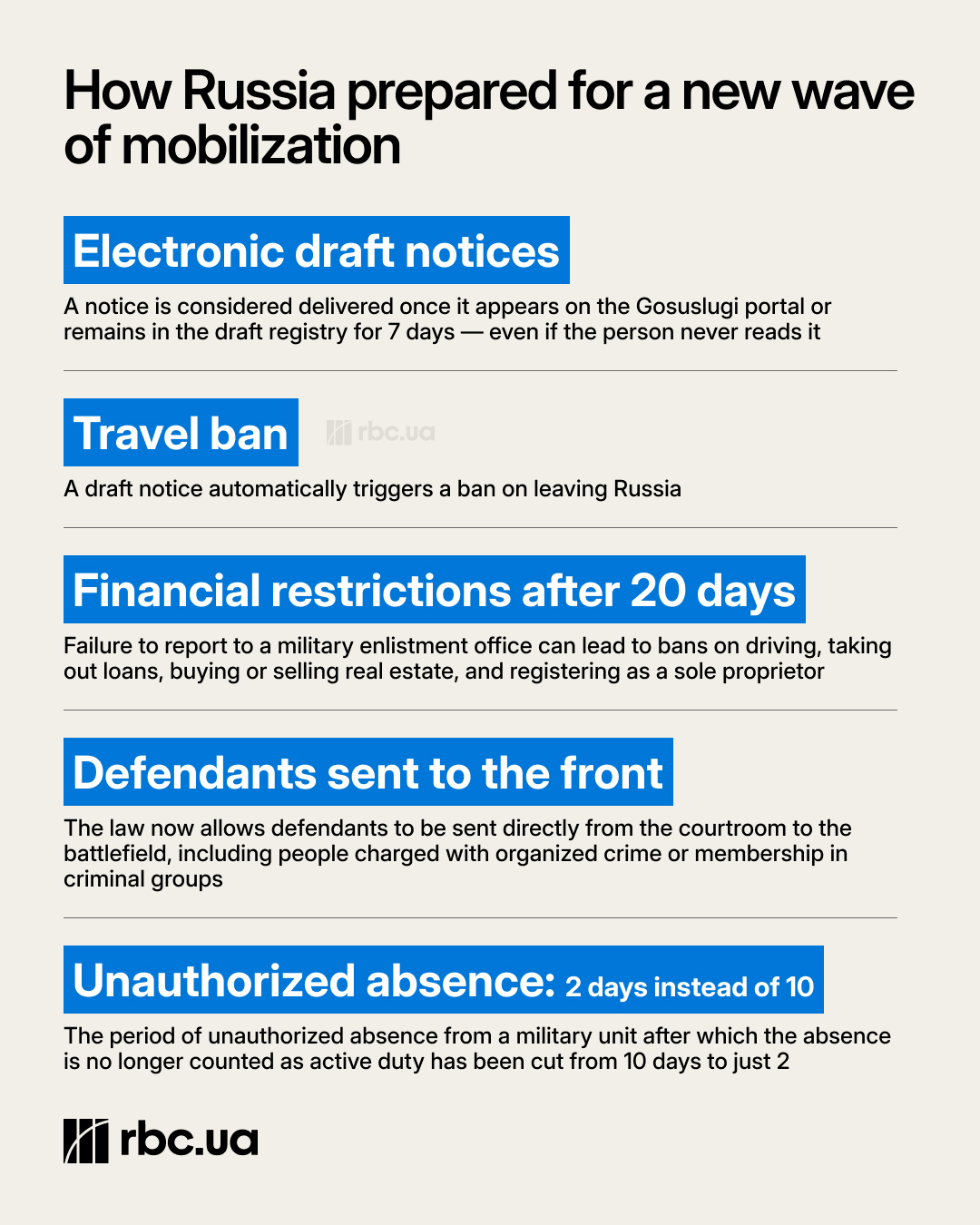 How Russia prepared for a new wave of mobilization (photo: RBC-Ukraine infographic)
On August 18, Vadym Skibitskyi, deputy head of Ukraine's Defense Intelligence (HUR), said in an interview with RBC-Ukraine that there were no signs on the battlefield suggesting that Russia was ready for a ceasefire or genuine negotiations.
"Putin wants to achieve the goals he has set for himself — primarily taking the Donetsk and Luhansk regions. Their General Staff plans to complete the capture of the Donetsk region by the end of this year," Skibitskyi said.
According to Antoniuk, several factors are currently encouraging Russia to continue escalating. As long as the weather remains favorable and the "greenery" (dense foliage that provides cover from aerial observation) remains, it is much easier to conduct offensive operations and hide from drones than during the muddy autumn season or winter. The Russian command therefore has little incentive to ease the pressure.
"The Kremlin is currently convinced that everything is going according to plan, while the Russian General Staff is reporting advances. They expect the Ukrainian front to collapse. Given that they are simultaneously using hybrid tools in Europe and the US, they see no reason to stop," Antoniuk added.
The Kremlin's long-term calculations are also reflected in the fact that civilian enterprises, including those in the Alabuga Special Economic Zone, where the notorious Shahed drones are manufactured, are signing contracts with workers that run through 2030.
Most importantly, the actual situation on the battlefield and what is being reported to Putin clearly do not match. Most recently, on September 11, the Russian leader announced the capture of Sviatohirsk in the Donetsk region, even though the city remains fully under the control of Ukraine's Defense Forces. This creates the illusion for Putin that Ukraine can still be forced into submission in the near future.
Limits of what is possible
There is another scenario — not so much an alternative as one that follows from the first. Ukrainian President Volodymyr Zelenskyy outlined it in an interview with Axios on September 7.
While acknowledging that Putin is counting on another difficult winter to weaken Ukraine, Zelenskyy said that Putin "needs Trump" and does not want to turn the US president against him ahead of the US congressional midterm elections in November. Asked whether Putin might want to hand Trump a victory before the elections, Zelenskyy replied, "Yeah."
From this perspective, the Kremlin does not need an open, publicly declared mobilization campaign that would immediately attract the attention of the US president. And although the Kremlin remains committed to continuing the war, it still takes the risk of social tensions into account.
"If mobilization does take place, it will be covert and spread out over time and across different regions. The authorities will do everything possible to avoid a large-scale announcement, relying instead on schemes that combine voluntary recruitment with coercion," Iryna Pavlenko said.
Oleksandr Antoniuk also believes that mobilization in Russia is likely to continue at roughly its current level, with somewhat greater pressure on the population.
Perhaps surprisingly, Ukrainian strikes on oil refineries — and especially on marketplaces that provided income for tens, if not hundreds, of thousands of Russians — are also contributing to this. Beyond the damage to the Russian economy, these strikes increase the number of people who may consider joining the Russian military purely for financial reasons.
"When someone has no money to repay a loan, is in debt and faces pressure from debt collectors or tax authorities, joining the war to earn money becomes the only option for many," Antoniuk explained.
According to Pavlenko, a sharp deterioration of the situation on the battlefield could alter this scenario and prompt a shift to open mobilization, as happened in the fall of 2022 following Ukraine's offensive in the Kharkiv region.
Another factor could be a decline in the number of new military contracts caused by economic difficulties in Russian regions that are unable to maintain the necessary level of payments to military personnel.
Even if Putin agrees to a temporary pause in strikes on Ukraine to accommodate Trump, there is not much time left until early November, when the US elections will take place. Moreover, previous agreements with Russia have shown that the Kremlin has learned to use such pauses to stockpile drones and missiles before launching renewed attacks on Ukraine with greater intensity.
Moreover, there is every reason to believe that once the US elections are over, Trump's interest in actively pushing negotiations between Russia and Ukraine will decline sharply.
Ultimately, the Kremlin needs this entire "election" spectacle only to provide cover for legitimizing decisions that will push Russia even deeper into a prolonged war.
Quick Q&A
– When do Russia's State Duma "elections" begin?
– Voting in Russia's State Duma "elections" begins today, September 18. All electoral procedures are taking place under conditions tightly controlled by the Kremlin and also extend to the temporarily occupied territories of Ukraine.
– Why does Putin hold "elections" if the outcome is known in advance?
– The Kremlin uses these "elections" as a media project to create the appearance of overwhelming public support for the authorities. They also provide a way to test the loyalty of regional officials and discreetly gather information about genuine public sentiment in Russia.
– When could Russia launch a new wave of mobilization?
– According to Ukrainian intelligence, Russia is preparing to announce another wave of mobilization immediately after the "elections" are over. The Russian command's main goal is to bring an additional 300,000 people into the military this year alone.
– Could Putin agree to a temporary ceasefire in Ukraine?
– A temporary pause in strikes is possible if the Kremlin decides to accommodate Donald Trump ahead of the US congressional elections in November. Yet there are no signs on the battlefield that Russia is ready for genuine negotiations, and Moscow could use any pause to stockpile missiles and drones.