Putin's energy truce trap: How he fooled Trump before and whether it can work again


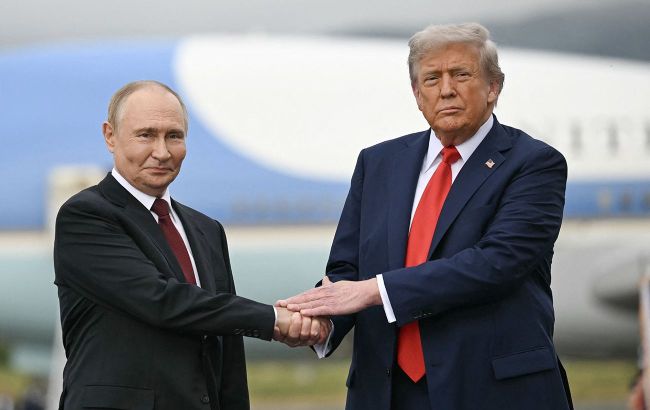 Photo: Vladimir Putin and Donald Trump (Getty Images)
US President Donald Trump said that Ukraine and Russia have allegedly agreed to refrain from mutual attacks on energy infrastructure. Such a statement is clearly premature, but it allows the negotiating process to be resumed.
Why Trump is once again pushing this idea and what chances it has of being implemented – read in the RBC-Ukraine article.
Key points
- Trump's goal: The US president needs lower fuel prices ahead of the congressional elections in November.
- Ukraine's position: Kyiv is ready for de-escalation and proposes a broader ceasefire. President Zelenskyy plans to discuss the details during a personal meeting with Trump.
- The Kremlin's dilemma: Growing losses from attacks on oil refineries are pushing Russia toward a ceasefire, but Putin's desire to use the winter factor to pressure Kyiv currently outweighs.
- Risks of the agreements: Previous experience proves that Moscow views any pause only as a tactical maneuver to stockpile missiles and restore oil refineries.
Trump's motives
According to the Financial Times, with his statement about an energy ceasefire between Russia and Ukraine, Trump seeks to demonstrate to the American public, dissatisfied with high fuel prices, that he is trying to achieve their reduction. Prices have sharply moved upward amid another escalation between the United States and Iran in the Strait of Hormuz.
This is a significant factor that could affect the results of the US congressional midterm elections, which will take place in November this year.
US Treasury Secretary Scott Bessent first, and then Trump, called on President Zelenskyy to stop strikes on diesel production facilities in Russia. According to him, Ukraine's attacks are causing a fuel shortage.
The dependence of prices in the United States on the situation in Russia is not obvious and is rather illusory, Ivan Us, an associate expert at the United Ukraine analytical center, told RBC-Ukraine. But what matters is how it affects Trump's actions.
"Ukraine certainly sent a signal: listen, if you believe this is because of our strikes, then perhaps you should also pressure Russia so that both sides agree to an energy ceasefire. And in fact, as I see it, Donald Trump wrote this statement because this issue has been promoted in the United States," Ivan Us said.
Assessing Trump's statement, an informed RBC-Ukraine source in the government suggested that it could be an attempt to present both sides with a done deal. But whatever the US president's motives may be, the main thing is their practical implementation.
Ukraine's position
The first cautious hints of a possible energy ceasefire emerged during the visit to Kyiv and Moscow by Trump's envoys – Jared Kushner and Steve Witkoff.
As an informed RBC-Ukraine source reported, Putin is now surrounded not only by "hawks" pushing him to continue the war against Ukraine. The Americans, special envoy Kirill Dmitriev and Kremlin aide Yuri Ushakov have opened up the possibility of diplomacy for Putin – and this is the main result of this round of negotiations.
Ukraine is preliminarily ready for such a step and is even ready to expand the list of targets that the sides should not strike. In his evening address, President Zelenskyy said that Ukraine had proposed an agreement with Russia that would stop the destruction of critical infrastructure.
"Food, energy and other elements of basic guarantees of life must be protected, and Russian strikes are directed primarily against that," he clarified.
Zelenskyy plans to discuss the concept of the ceasefire in more detail next week during his trip to New York for the UN General Assembly.
The Kremlin's position
The Kremlin's official comments regarding the ceasefire remain vague. Putin's spokesman Dmitry Peskov said on September 15 that Moscow "welcomes calls for Ukraine to stop strikes on Russian energy infrastructure."
At the same time, he refused to answer the question of whether Russia is ready to refrain from strikes on Ukrainian economic infrastructure if Kyiv fulfills Trump's demand.
Russian foreign minister Sergey Lavrov said that Russia is ready to hold a new round of negotiations. According to him, Moscow "has something to say" and allegedly has never refused dialogue.
A number of Financial Times sources familiar with the Kremlin's position said that Putin does not want to reach an agreement before winter. The reason is Putin's belief that Russian attacks on Ukraine's energy infrastructure could increase pressure on Kyiv to force Ukraine to make concessions in further negotiations.
But economic factors also remain important. And for the Kremlin, there are both advantages and disadvantages here.
"If high oil prices are not what Trump needs, then ironically, this is exactly what Russia needs. They make more money from it," Ivan Us notes.
On the other hand, Russia has certain motives to agree to a ceasefire. In the summer, Ukraine carried out a series of successful attacks on Russia's key marketplace, Wildberries, but even more importantly, attacks on Russian oil refineries are continuing. They, in turn, could stop in the event of an energy ceasefire.
"Russia is currently producing 70% of the fuel needed for domestic consumption. They need to find 30% somewhere. Somewhere means Kazakhstan, Belarus, China, India, Morocco, South Korea. So we have many suppliers, but if previously Russia made money from fuel, now it is spending money," Us emphasizes.
An additional, but not the main, factor for Russia is the Graham-Blumenthal bill in the US Congress, which opens up additional prospects for Washington to pressure Moscow. The document could be voted on as early as this week.
Lessons (not) learned
Any agreements with Moscow should be treated with caution. A telling example of how the Kremlin views attempts to establish a ceasefire is last winter's "energy ceasefire."
At the end of January this year, after a conversation with Putin, Trump announced a week-long pause in strikes because of severe frosts. The Kremlin confirmed this, while Kyiv expressed readiness for reciprocal actions.
However, the agreement lasted only a few days: Russia continued targeted attacks on January 30 and 31, and already on the night of February 3, it launched a new massive strike with a record number of ballistic missiles and drones.
In response, Zelenskyy directly accused Moscow of violating its promise, noting that the Russians had simply waited for the coldest days, and this forced Kyiv to adjust the work of its negotiating team.
Trump, meanwhile, claimed that "Putin kept his word." This episode clearly demonstrates not only the unreliability of Kremlin promises, but also the potential difference in how Kyiv and Washington perceive agreements.
As RBC-Ukraine wrote, the Kremlin used the pause in attacks not to seek diplomatic solutions. Disguising it as a "gesture of goodwill" at Trump's request, the Russians simply gained time to stockpile missiles and drones to launch another massive strike – thereby raising the stakes and strengthening their position ahead of another round of negotiations.
Such a scenario should not be ruled out this time either. Already this morning, contrary to Trump's statements, Moscow struck Ukrainian gas stations, while Kyiv struck the Syzran oil refinery.
Ultimately, Putin's decision depends not only on the objective state of affairs, but also on the picture he has drawn in his own imagination. And the question is how much these two realities coincide.
Quick Q&A
– Why is Donald Trump calling on Ukraine to stop strikes on Russian oil refineries?
– The US president seeks to reduce fuel costs inside the country, which have risen because of another escalation with Iran in the Strait of Hormuz. High gasoline prices create a significant negative backdrop for US government officials ahead of the congressional elections in November.
– Is Ukraine ready to agree to an energy ceasefire with Russia?
– Kyiv has expressed preliminary readiness to stop the attacks, but seeks to expand the agreement to protect all civilian and critical infrastructure. Volodymyr Zelenskyy plans to discuss the detailed parameters of the agreement during his trip to the UN General Assembly in New York.
– Has a similar ceasefire regime been implemented before, and how did it end?
– At the end of January 2026, the sides had already tried to establish a week-long pause at the initiative of the United States. However, the lull lasted only a few days. Russia used it to stockpile missiles and then launched a massive strike on Ukraine on February 3, at the peak of the cold snap.
– What risks arise for Ukraine if the agreements are repeated?
– The main concern is that the Kremlin will once again use the ceasefire as a tactical maneuver to stockpile weapons and strengthen its own position in negotiations. There also remains a large gap in how Kyiv and Washington perceive Russia's actions.