Trump blames Canada for wildfires, vows consequences

 Photo: US President Donald Trump (Getty Images)
US President Donald Trump criticized Canada over the wildfires that have blanketed much of the Midwest and the East Coast with smoke in recent days. In a post on Truth Social, the White House chief accused the northern neighbor of failing to contain the fires, even though Washington regularly asks Ottawa for assistance when US states are hit by wildfires.
Trump said he would discuss the wildfires and their negative impact on the United States with Canadian Prime Minister Mark Carney. The US president accused Canada of costing the United States "billions of dollars" because of air pollution.
"We are holding Canada responsible for the fact that they are not properly maintaining their Forests, and Brush therein, and the United States is being unnecessarily invaded by filthy, polluted, and unhealthy air, the quality of which is dangerous and totaly unacceptable," Trump wrote.
He also accused Ottawa of abandoning basic forest management and debris cleanup despite knowing that doing so would lead to exactly these consequences.
"This is Willful Negligence that has become a yearly occurwnce, costing the United States Billions of dollars, which cost of this pollution must of necessity be added to the TARIFFS Canada is currently paying," the US president said.
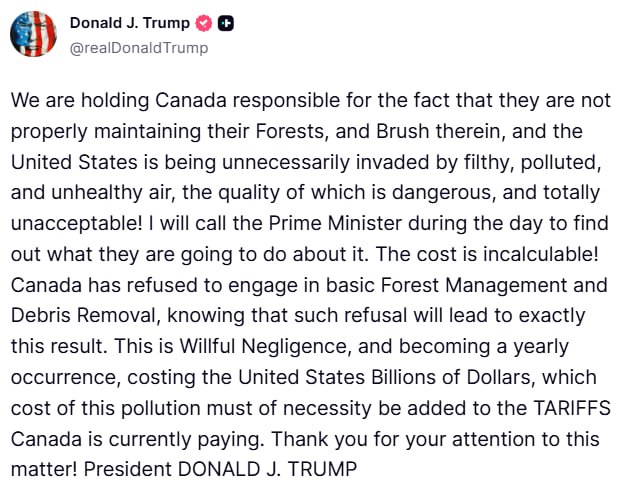
Photo: Trump, angered by the wildfires, threatens Canada with tariffs (Screenshot)
Wildfire situation in Canada
Canada is experiencing one of its most severe wildfire seasons in years due to extreme heat. More than 6 million hectares of forest have already been destroyed by the fires.
More than 450 active wildfires are burning in British Columbia and Alberta. Most of them are classified as out of control. Authorities have been forced to evacuate residents from 10 communities because of the threat of rapidly spreading flames.
The extreme heat continues, with temperatures exceeding 37°C (98.6°F) in some areas. Dry thunderstorms are sparking new fires every day. Firefighters are working at the limit of their capabilities. The Canadian government has officially requested international assistance. Fire crews from South Africa and Australia have already joined the firefighting efforts.
About 150 aircraft and helicopters have been deployed to battle the wildfires. The Canadian Armed Forces have set up mobile command centers in the disaster zone. Firefighters are creating firebreaks to protect critical energy infrastructure.
Trump's "gratitude"
Notably, before making his statement, Trump did not mention how many times Canada has helped the United States fight wildfires by providing specialized equipment and aircraft that the US does not have.
Canada has been officially assisting the United States since 1982. A mutual aid agreement allows emergency responders to cross the border under a simplified procedure.
Because wildfires occur in the United States every year, Canadian crews are regularly called in to help. Canadian wildfire specialists are widely regarded as among the best in the world.
The numbers behind Canada's support
Canada has repeatedly helped protect US states from devastating wildfires in recent years.
Here are some of the most significant examples:
- 2020: Canada sent hundreds of firefighters to California and Oregon as the US battled historic wildfires.
- 2021: More than 100 Canadian specialists helped contain fires across western states.
- 2024: Canadian crews were once again deployed to fight wildfires along the border and deeper inside the United States.
Coordination typically takes only a matter of hours. During major wildfire emergencies, more than 500 personnel are often deployed in a single response.
Canada also operates technology that is in short supply in the United States. The iconic Canadair CL-415 amphibious aircraft form the backbone of Canada's aerial firefighting fleet. They can scoop up 6,000 liters of water in just 12 seconds directly from lakes and other bodies of water.
The US states of Washington, Montana, and California regularly lease or receive this aircraft as part of Canada's assistance. Without Canadian aerial support, containing wildfires in remote areas of the United States would take roughly three times longer.