Swedish Gripen cleared to shoot down Russian missile over Poland: What stopped it

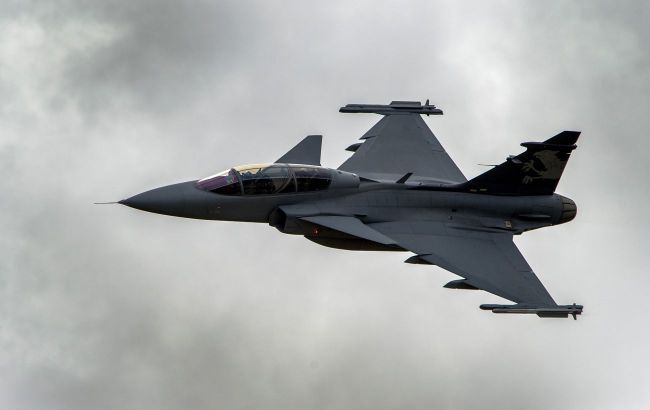 Photo: A Swedish Gripen was authorized to shoot down a Russian missile over Poland, but failed to identify it (Getty Images)
The pilot of a Swedish Gripen fighter jet, who was patrolling the skies over Poland during Friday's airspace violations, received authorization to shoot down a Russian missile but was unable to do so due to adverse weather conditions, says General Ireneusz Nowak, Commander of the Polish Armed Forces.
According to him, the pair of Swedish Gripen fighter jets operated under the command of NATO's Combined Air Operations Center (CAOC) in Uedem, Germany, which is responsible for air operations in this part of Europe.
It was the CAOC that issued a so-called condition-based order—that is, authorization allowing the pilots to make their own decisions regarding the downing of the object.
One of the Swedish pilots attempted to intercept the object, which, according to a preliminary assessment, was a Russian Kh-101 cruise missile. However, he was unable to identify it either visually or using the aircraft's onboard optoelectronic systems.
Nowak explains that extremely challenging atmospheric conditions in the interception area posed an obstacle. As a result, despite having NATO authorization to use weapons, the pilot did not shoot down the target.
Russian attack took place in two stages: first, the Russians deployed drones, specifically high-speed jet-powered unmanned aerial vehicles, and then Kalibr and Kh-101 missiles. Poland knew their launch locations, numbers, and flight paths. It also used data transmitted by Ukraine via the Virazh system.
"As for who is behind this attack, we have no doubts whatsoever at this point," Nowak concludes.
On the night of November 20, during a massive Russian attack on Ukraine, two Russian missiles and a drone fell on Polish territory—one of the munitions exploded just 96 kilometers from the site of military exercises conducted by the Coalition of the Willing.
Following the incident, the country's Prime Minister, Donald Tusk, stated that Poland did not consider the Russian missile attack to be a coincidence, but viewed it as a deliberate Russian provocation.