Successor could be worse: Why Putin's death may not change Russia

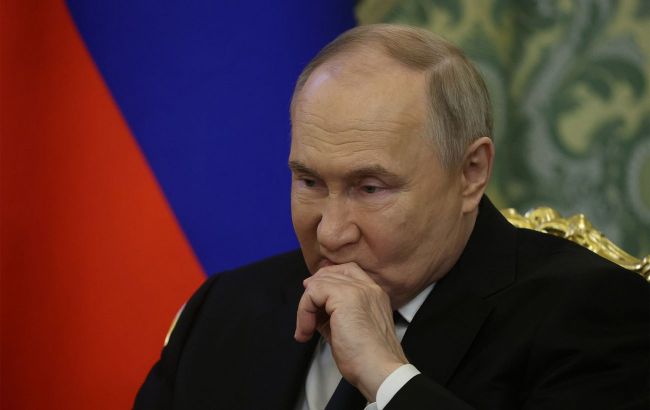 Photo: Russian President Vladimir Putin
Economic decline, anger over losses in the war against Ukraine, and mafia-style political clans will turn Putin's stability into chaos. The death of Russian President Vladimir Putin would not benefit Ukraine, but instead create additional risks, Newsweek reports.
The biggest danger for Vladimir Putin lies within the mafia-style system he created. Ambitious rivals are looking for the right moment to strike. Russia's economy is degrading, while the war in Ukraine has reached a deadlock: this creates ideal conditions for conspiracy.
US intelligence has recorded acute tensions between security services. Russia's Federal Security Service, Russia's National Guard, and Federal Protective Service, which is responsible for protecting top state officials, are competing for control over the security of senior government figures.
Special attention is being drawn to the network of Sergei Shoigu. In March 2026, his former deputy, Ruslan Tsalikov, was arrested. This indicates groundwork is being prepared for the removal of potential conspirators. Shoigu lost his position as defense minister when the successes of the Russian army on the frontline began to disappear.
Candidates for the throne: A list of contenders
After Putin's death (or retirement), a fierce struggle will begin. Some are counting on the natural course of events, while others are waiting for a successful conspiracy.
Here are the main figures who could lead Russia:
- Aleksey Dyumin — former Putin bodyguard and presidential aide.
- Sergei Kiriyenko — curator of domestic policy and master of Kremlin propaganda.
- Dmitry Patrushev — deputy prime minister and son of Nikolai Patrushev. He represents the younger generation of "siloviki."
Older associates, such as Alexander Bortnikov, may not seek power personally. They will become grey cardinals. Such figures have veto power over any candidate.
Any of the listed figures is unlikely to be ready either to quickly end the war or repent before Ukraine by returning all occupied territories.
Clan struggles in a nuclear state
According to the constitution, in the event of Putin's death, the duties of the president would initially be performed by Prime Minister Mikhail Mishustin. But he is only a temporary figure. Real power would end up in the hands of elite groups, since Russia is not a democracy — it is a military autocracy, Newsweek writes.
The success of each clan depends on closeness to security structures. Putin built this system for 25 years, and a sudden power vacuum would trigger a chain reaction. The world would witness a clash of military commanders, intelligence officers, and oligarchs.
Putinism without Putin: Why war will not stop
Most potential successors share the views of President Putin. They believe in imperial expansion. Their strategy is anti-Western antagonism, so the new leader could turn out to be even more aggressive.
Russia is currently suffering colossal human, social, and economic losses. Harvard Kennedy School estimates the number of dead and wounded at 1 million people as of February 2026. This also means several million more people who have lost a son or brother.
To this can be added increased interest rates and inflation hitting Russians. Sanctions have paralyzed production growth, while domestic resources are being directed exclusively toward supporting the war.
At such moments, material notes, authoritarian regimes resort to even greater violence. This is a way to channel public anger.
Institute for the Study of War (ISW) warns about the danger posed by veterans. Kremlin fears hundreds of thousands of angry men. They are returning from the frontline traumatized and unnecessary to civilian society.
Pardoned criminals are also joining the civilian ranks. They are already provoking the rise of organized crime. Police cannot cope with the pressure, and after the war, this wave will fully sweep across Russia.
The article emphasizes that the end of one man's rule does not mean the end of the system. Putin's death would solve one problem, but create dozens of new ones. This would be a crisis in a country with nuclear weapons and armed factions, which could become a catastrophe for the entire continent of Europe.
What else is known about Putin
EU intelligence obtained a report according to which Putin fears a possible assassination attempt using drones, particularly from representatives of the Russian elite.
It also became known which security service exactly left Russians without internet "for security reasons." It turned out that Russiaэs Federal Protective Service, which is responsible for protecting top officials and Kremlin facilities, rather than the Federal Security Service as previously believed, was behind mass internet shutdowns in Moscow.
The Institute for the Study of War also believes that Putin is stubbornly clinging to the May 9 parade out of fear. He does not want to admit that Ukraine has long since brought war onto the territory of Russia itself.