Starlink restrictions hit Ukraine: Sources explain what’s happening behind the scenes

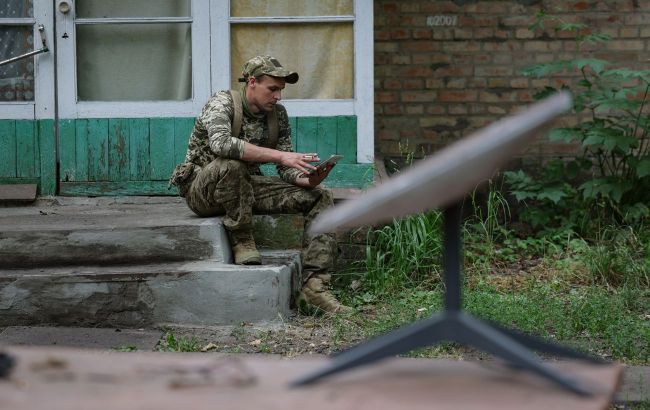 Photo: A Ukrainian soldier with a smartphone, with satellite equipment in the background (Getty Images)
After disruptions to Starshield, communications were partially restored, but the speed limit remained in place. Meanwhile, Ukraine is negotiating to restore full communications, according to an article Ultimatum with no guarantees: Trump squeezes Zelenskyy as Putin braces to make winter brutal for Ukraine.
On the night of October 14, Ukrainian units unexpectedly encountered restrictions on the operation of Starshield terminals — a military satellite communications package based on Starlink that is used on mobile platforms.
The formal limit was about 160 km/h. However, according to RBC-Ukraine's sources, in some units, communications began to disappear at speeds of just 60–80 km/h.
The Ukrainian side tried to find out why the problems had arisen. Initially, SpaceX explained them as a technical glitch, but the sources were skeptical of this version.
The situation was accompanied by contradictory public statements. According to The Telegraph, Elon Musk allegedly proposed that US President Donald Trump limit the operating speed of military Starlink terminals for Ukraine, and Trump agreed. There is no clear public confirmation of this version.
On the evening of October 14, communications were partially restored: the terminals began working again at speeds of up to approximately 160 km/h. However, the speed restriction remained in place.
On October 17, Ukrainian President Volodymyr Zelenskyy confirmed that Starlink in Ukraine disconnects once a speed of 161 km/h is reached. According to him, tests of similar terminals in EU countries showed that they could operate at higher speeds there.
RBC-Ukraine's sources in the Defense Forces also report that the limit of approximately 160 km/h remains in effect. In some cases, however, communications disappear even at lower speeds.
How the restrictions affect Ukrainian drones
According to the sources, the Starlink problems have the greatest impact on two areas of drone use.
The first is interceptor drones, which Ukraine is trying to scale up to combat Russian Geran-4 and Geran-5 jet-powered drones. Since late August, these UAVs have become one of the main means of carrying out almost round-the-clock attacks on Kyiv and the surrounding region.
The second area is middle-strikes, meaning drone strikes at medium range.
The consequences of the restrictions depend on the type of system. For some drones, the speed limit does not have a critical impact, while for others, it significantly complicates the execution of missions.
“Some missions are becoming more difficult to carry out, and some Ukrainian drones are becoming more vulnerable targets. However, we are adapting to everything,” one of RBC-Ukraine's sources said.
They also report that negotiations are currently underway to restore the full operation of Starshield, and they are optimistic about the outcome.
Will Starshield's full operation be restored?
According to the sources, negotiations are currently underway to restore the full operation of Starshield.
The sources are optimistic about the prospects for reaching an agreement, but no specific results have been reported so far.
Earlier, the Ukrainian side called the restrictions on Starlink's operation a “planned operation”. President Volodymyr Zelenskyy explained that during testing in EU countries, the terminals operated at speeds of 180 km/h, while in Ukraine, communications disappeared at around 161 km/h.
On October 18, US Treasury Secretary Scott Bessent rejected accusations against the US government. He stated that the Donald Trump administration had not restricted Starlink's operation and criticized Zelenskyy for making such claims.