Scientists update Doomsday Clock again: Humanity edges closer to catastrophe

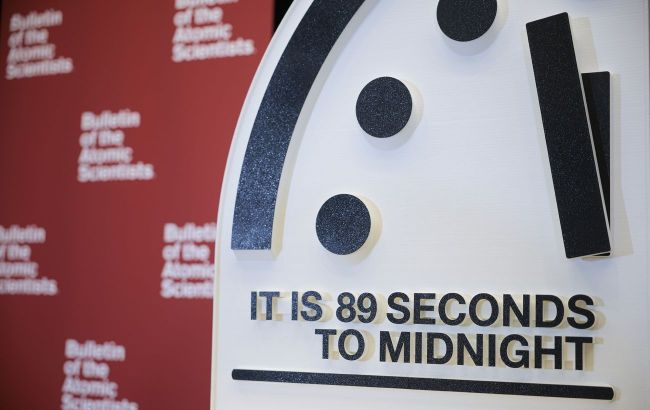 Illustrative photo: Doomsday Clock (Getty Images)
On January 27, in the United States, the Doomsday Clock was set at 85 seconds to midnight — the hypothetical point of global destruction. This is the closest to catastrophe the Clock has ever indicated, CNN informs.
In 2025, the Clock was set at 89 seconds. In 2023 and 2024, it stood at 90 seconds. In 2022, due to Russia’s invasion of Ukraine, the hands were moved forward by 10 seconds — prior to the full-scale war, the Clock had remained unchanged for some time.
The time to midnight on the Doomsday Clock symbolizes how close humanity is to being destroyed by self-created threats — such as nuclear weapons, technological risks, and climate impact — and highlights that no progress has been made in addressing these dangers.
"The risks we face from nuclear weapons, climate change and disruptive technologies are all growing. Every second counts and we are running out of time," commented Alexandra Bell, president and CEO of the Bulletin, on the Clock’s adjustment.
What the Doomsday Clock is
The Doomsday Clock is a project launched in 1947 by American scientists who had created the first atomic bomb. Among its founders and leaders were Albert Einstein and J. Robert Oppenheimer. The project is generally considered to have been established by the Bulletin of the Atomic Scientists magazine.
Since its creation, over the course of 79 years, the Clock’s hands have been adjusted annually depending on the international situation and global events. The more tense the situation and the greater the global problems, the closer the hands move to midnight, which symbolizes total catastrophe.
What the Clock measures:
-
Since 1947, it has measured the risk of a global nuclear war;
-
Since 2007, it has also accounted for the impact of climate change;
-
In recent years, scientists have added another factor — emerging technologies, including artificial intelligence.
At the same time, even the Clock’s creators have emphasized that it is not intended to provide a precise measurement of the level of global threat. Its main purpose is to spark discussion on how humanity can overcome self-created dangers.
Overall, since the project’s inception, the planet was farthest from the end of the world in 1991, shortly before the collapse of the USSR. When Washington and Moscow signed the START treaty to reduce nuclear offensive weapons, the Clock’s hands were moved to 17 minutes to midnight. However, since then, they have steadily moved closer to the mark of total catastrophe.
Nuclear tensions
Meanwhile, there is a growing number of countries worldwide seeking to expand their nuclear capabilities. For example, EU states have begun to doubt the United States’ commitment to protecting them from Russia and are therefore looking for ways to strengthen their own nuclear arsenals.
Numerous Russian nuclear tests, most of which have ended unsuccessfully, nonetheless pose a threat. Nuclear saber-rattling favored by Russian President Vladimir Putin led US President Donald Trump in October 2025 to instruct the Pentagon to immediately begin testing America’s nuclear weapons.
In addition, Iran is seeking to acquire nuclear weapons. North Korea is actively expanding its nuclear stockpile and is capable of producing up to 20 warheads per year. Meanwhile, Pyongyang’s patron, China, aims to possess at least 1,000 nuclear warheads by 2030.