Russians spark medical disaster in Lysychansk: One chance in 30,000

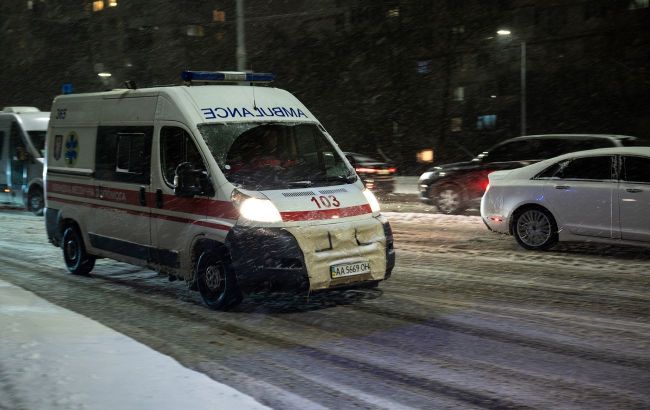 Emergency services (Illustrative photo: Getty Images)
In the occupied city of Lysychansk, only one paramedic remains for the entire population, highlighting the complete collapse of healthcare and the devaluation of human life under Russian occupation, according to a report by the Center for Countering Disinformation of Ukraine’s National Security and Defense Council.
The temporarily occupied city of Lysychansk in Luhansk, which Russians had promised to turn into a blooming region, is now on the brink of a humanitarian disaster.
It has been reported that the entire emergency medical system there has been completely destroyed. For a city of around 30,000 people, only one paramedic remains, who simultaneously performs the duties of both a medical professional and a dispatcher.
The situation in the city borders on both absurdity and tragedy:
- When the paramedic is out on a call – the station is empty. There’s no one to answer the phone, so reaching help is impossible.
- Queue for life: Assistance is provided on a first-come, first-served basis, which in emergency medicine is essentially a death sentence.
- Closed doors: Residents who try to reach the station on their own often find the doors locked. Inside, there is no one to provide even basic first aid.
Russian authorities know — and remain silent
Russian administration is well aware of the catastrophic situation. However, no real steps are being taken to resolve it. There are no personnel, no resources, and not even a basic organization.
Because this is what the so-called Russian world looks like in reality — without loud slogans or television promises. According to eyewitnesses, human life here has no value, and the care and protection spoken of by Russian propaganda have remained nothing more than words.
Why this happened
The medical system in the temporarily occupied territories is deteriorating for three main reasons:
- Staff purge: Many specialists have left, while those who remain refuse to work under pressure or fail to pass filtration.
- Priority to the military: Nearly all surviving resources and medicines are directed toward treating wounded Russian forces in hospitals, while civilians are treated on a residual basis.
- Administrative indifference: Russian authorities are aware of the critical situation but are taking no steps to attract specialists.
City that is dying
Before Russia’s full-scale invasion, more than 93,000 people lived in Lysychansk. By the end of 2025, according to the occupation administration itself, only about one-third remained — around 30,000 residents.
Such rapid depopulation has not prevented the occupiers from completely failing to provide for the basic needs of those who stayed. Even for this population size, a single medic is not a staff shortage — it is the effective absence of a healthcare system.
Lysychansk today is a vivid illustration of how liberation turns into slow extinction in isolation. Russia has brought only destruction, degradation, and complete disregard for the human right to life.
As previously reported, the occupiers are introducing new levies in the Luhansk region. Under their plans, starting in 2027, every family living in an apartment building will be required to pay monthly contributions for major repairs.
In addition, in the temporarily occupied territory of the Kherson region, the Russian administration has established a de facto information blockade, restricting local residents’ access to independent news sources and controlling the flow of information.