Russian warships near UK tracked by Protector drone for the first time: What we know

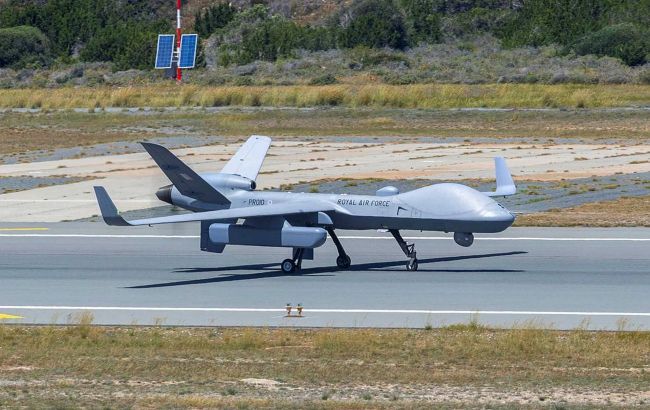 Photo: RAF Protector RG Mk1 (UK Ministry of Defense)
The UK's Royal Air Force has deployed its Protector RG Mk1 drone for the first time to conduct operational surveillance of Russian warships in British airspace. The flights took place between late September and mid-October 2026, providing more than 10 hours of surveillance, reports The Telegraph.
The drone operated alongside Royal Navy ships and helicopters monitoring the movements of Russian vessels. London announced the completed flights, rather than a mission taking place on the day of publication. According to the UK Ministry of Defence, the drone was unarmed, and there was no discussion of using weapons.
Commander of No. 13 Squadron Sam Haley said the Protector's first operational flights in British airspace had demonstrated the system's value for the country's defense. According to him, it can support maritime security while operating in both military and civilian airspace.
From October 1 to 14, the destroyer HMS Dauntless and patrol vessel HMS Tyne monitored the Russian frigate Neustrashimy and merchant vessels in the English Channel. According to the UK Ministry of Defence, the number of Royal Navy operations monitoring Russian activity increased by 25% in the first seven months of 2026 compared with the same period last year.
What we know about the Protector RG Mk1 and what remains undisclosed
The Protector RG Mk1 is the UK's designation for the American MQ-9B SkyGuardian, manufactured by General Atomics Aeronautical Systems. It is a medium-altitude, long-endurance drone.
The UK ordered 16 aircraft, and the report says 11 have already been delivered. It is based at RAF Waddington and carries out intelligence, surveillance, target acquisition, and reconnaissance missions. It can also conduct maritime surveillance, participate in search-and-rescue operations, support civilian authorities, and operate as a strike aircraft.
The RAF's list of weapons includes Brimstone 3A missiles and Paveway IV guided bombs. However, the aircraft that flew over the English Channel was unarmed.
The drone has a wingspan of 24.07 meters and is powered by a Honeywell TPE331-10T turboprop engine rated at 900 horsepower. Its crew consists of a remote pilot, a sensor operator, and a mission intelligence coordinator. The sensors listed by the RAF include a synthetic aperture radar and an AN/DAS-4 multispectral targeting system. The specific configuration and operating modes used during the maritime flights have not been disclosed.
Approval to operate in civilian airspace gives the drone operational flexibility. On June 11, 2026, the RAF announced the first flight of a Protector through European civilian airspace, from Waddington to RAF Akrotiri. It covered more than 2,000 nautical miles in approximately 13.5 hours, flying through the airspace of France, Italy, Malta, and Greece.
The report emphasizes that flights over the English Channel make it possible to supplement ships and helicopters with long-endurance surveillance. However, improvements in detection capabilities or reductions in helicopter deployments have not been quantified. The announcement also does not confirm continuous coverage, submarine detection, or new strike capabilities.
On September 22, Britain launched a torpedo from a drone.
On October 1, it imposed new sanctions against Russia, targeting, among other things, the shadow fleet.
A week later, on October 9, it was reported that Britain had invented an unusual way to protect submarines from drones.
On October 23, the British government urged citizens to stockpile three days' worth of water and food, and on October 27, the defense secretary said that Britain had just over 1,000 days to prepare for a war with Russia.