Russian oppositionist Kasparov on Putin's downfall: A bad war triggers changes


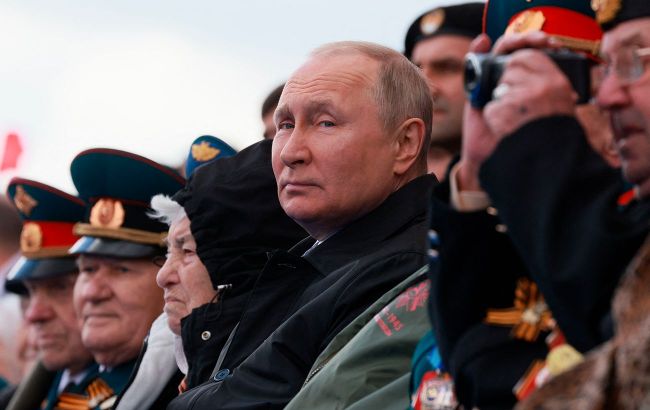 Photo: Russian president Vladimir Putin at a parade (Getty Images)
The idea of replacing Russian president Vladimir Putin is emerging over the failure of the war in Ukraine, one of the leaders of the Russian opposition, Garry Kasparov, told RBC-Ukraine.
“There is a feeling that something is happening. It is a Russian tradition that a bad war always leads to change. And now we are seeing a situation where many people, both in the elite and among ordinary citizens, are beginning to understand that Putin cannot win the war. And when a dictator starts a war he cannot win, according to the laws of history, he begins to face major problems,” he said.
There is a strong sense that a process has begun which, in the near future, if there is no turning point, could lead to catastrophic consequences, according to Kasparov.
“Obviously, something is happening. There are various signs of this: economic and military problems, but it seems to me that the main problem is psychological, and it is very important. It lies in the fact that the Russian tradition does not forgive a tsar or dictator for a lost war,” the opposition figure said.
According to him, the idea that the war is ending badly is now beginning to sink into people’s minds.
“What Remeslo writes every day about the inevitability of Putin's end — and nothing happens to him... This means that the idea that Putin must be replaced is becoming very important,” Kasparov explained.
“ Within the elite, opinion is forming that to save the regime, Putin must be removed. Remeslo reflects the imperial tradition that to save the empire, you must remove Putin,” the politician added.
He stressed that 2026 could become a defining year for the formation of a new world order. And it is thanks to Ukraine, which managed not only to withstand the pressure but also to turn the tide of the war, that these changes are becoming inevitable.
Situation in Russia
Earlier, Western media wrote that Putin is convinced of victory on the battlefield and is ready to continue fighting for up to two more years for full control over the Donetsk region.
Meanwhile, the situation in Russia’s economy looks much more complicated: due to Ukrainian drone strikes, oil and gas revenues in the first quarter of 2026 fell nearly by half compared to last year.
Sanctions are forcing Moscow to sell off gold reserves — now at the lowest level since March 2022 — and convert them into yuan.
Moreover, criticism inside Russia is growing even from pro-government bloggers and so-called Z-activists, while statements about the army’s “victories” are increasingly becoming a target for mockery.
According to intelligence estimates, while the Kremlin is trying to project an image of success, the real financial losses remain significant, although publicly this is presented as a “victory.”