Russia turns to Asia for gas sales but risks major losses, Reuters reports

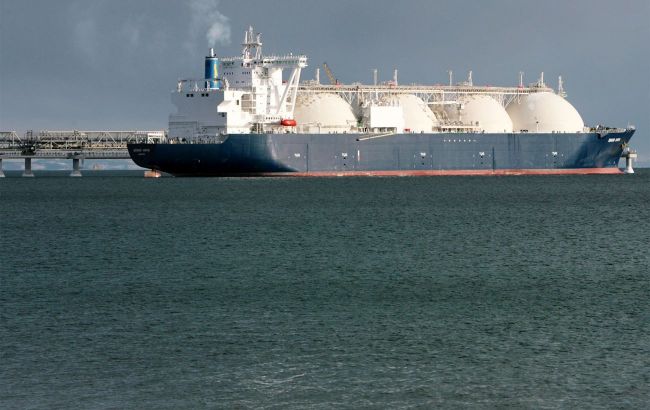 Photo: A liquefied natural gas (LNG) tanker (Getty Images)
The redirection of Russian liquefied natural gas (LNG) exports from Europe to Asia could result in a significant drop in Moscow’s revenues due to sharply rising logistics costs, Reuters reports.
The outlet noted that the European Union plans to completely phase out imports of Russian LNG from 2027 as part of its sanctions policy over Russia’s war against Ukraine.
At the beginning of March, Russian President Vladimir Putin stated that Russia was ready to stop supplying gas to Europe and instead seek long-term buyers in other regions.
However, implementing this plan has proven more difficult than the Kremlin expected.
According to industry sources, India has already refused to purchase a shipment of Russian LNG from a US-sanctioned facility.
One source explained that Russian gas may have become too expensive due to high transportation costs and sanctions risks.
LNG delivery to Asia takes much longer
The route from the Yamal LNG plant to Europe takes about 17–20 days. In contrast, delivery to Asia can take 50 to 80 days depending on the route.
Shipping via the Suez Canal takes around 50–60 days, via the Cape of Good Hope up to 80 days, and via the Northern Sea Route along Russia’s Arctic coast between 50 and 65 days.
Logistics have become more expensive
According to Alexei Belogoryev, a research director at the Institute for Energy and Finance in Moscow, transporting gas to Europe costs on average $1–1.5 per million British thermal units (mmBtu), while delivery to India can cost between $2.5 and $5.
Analysts note that the Suez Canal route is currently the cheapest option for Russia, although it carries security risks.
"For year-round deliveries to India, this is the most optimal option," Alexander Buyanov, deputy head of the Moscow-based Central Research Institute of the Maritime Fleet, noted.
Despite the active promotion of the Northern Sea Route as a strategic export corridor, experts say it remains the most expensive option for LNG deliveries to South Asia.
The situation is further complicated by a shortage of ice-class tankers.
According to estimates by the Central Research Institute, delivering gas from Yamal to India via the Northern Sea Route could exceed $187 per ton (around $3.8 per mmBtu).
Against this backdrop, experts believe that even high gas prices will not guarantee Russia the preservation of its previous energy export revenues.
After the start of Russia’s full-scale invasion of Ukraine, the European Union began actively reducing its dependence on Russian pipeline gas and increasing imports of liquefied natural gas from other countries.
The United States sharply increased LNG exports to Europe, rapidly expanding capacity along the Gulf Coast. According to estimates by the Institute for Energy Economics and Financial Analysis (IEEFA), US suppliers already account for about two-thirds of LNG imports into the EU, and their share could rise to 80% by 2028.