Russia reveals UMPB‑5 — glide bomb with 50 km more range

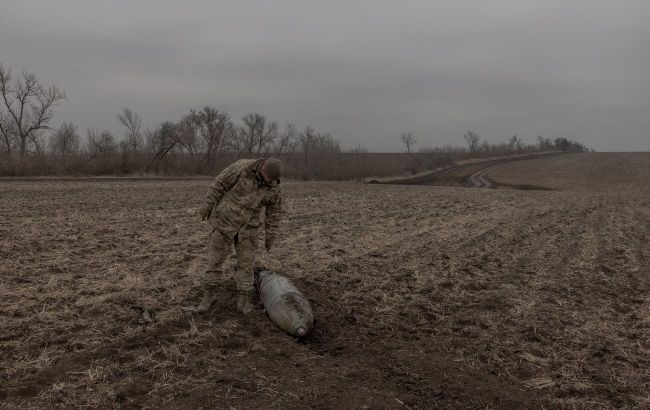 Ukrainian Armed Forces (Photo: Getty Images)
In recent days, open sources have reported on the modernization of a Russian aerial munition designed to strike targets at long distances, reports Defence Blog.
Read also: FPV drone weapons enter mass production in Russia: Here’s why it’s concerning
The updated development demonstrates an effort to expand the capabilities of glide bombs through design and flight-range changes.
Evolution of the UMPK module
Russia has presented a modernized version of a winged glide bomb designated UMPB‑5. According to published photo and video materials, the munition is a development of previously used UMPK kits that have been actively employed in the war against Ukraine.
The new version retains a modular design but features an improved airframe and a modified wing configuration to increase strike range without a radical overhaul of the guidance system.
Navigation and guidance system
According to Ukrainian sources, the UMPB‑5 uses the same correction and navigation tools as previous models. This refers to a combination of satellite and inertial systems known as SMART and Kometa‑M12.
Such an architecture enables deployment of the munition from aircraft beyond the range of certain air‑defense systems while maintaining acceptable accuracy against stationary targets.
Engine‑powered variant
A separate modification, UMPB‑5R, is also mentioned. Ukrainian sources claim it is equipped with a compact turbojet engine manufactured by SWIWIN, which would theoretically increase the maximum engagement range to 200 kilometers.
The presence of an engine enables the munition to sustain flight after release, rather than relying solely on aerodynamic glide.
Increased range without an engine
The monitoring channel Polkovnyk HSH reported that even without a power unit, improvements in aerodynamics and an increased wing area added about 40–50 kilometers to the flight range.
According to this assessment, the non‑powered version of the UMPB‑5 is capable of reaching distances of up to 160 kilometers when launched under appropriate altitude and speed parameters.
Tactics of use
The updated munitions are expected to be deployed from tactical aircraft, including the Su‑34, operating over occupied territories or from Russian airspace.
The increased range allows the carrier aircraft to remain farther from forward air‑defense systems while striking targets deep inside Ukrainian territory.
The modular approach also simplifies production and logistics, effectively turning older aerial bombs into guided weapons.
In Belgorod, the fall of a FAB‑500 aerial bomb dropped from a Russian bomber was recorded. The incident became public on January 21, when the head of the Belgorod region reported the discovery of a crater caused by a munition on Gubkina Street, without clarifying the circumstances of its appearance or the cause of the incident.
In Odesa, the counterintelligence of the Security Service of Ukraine stopped the activities of an agent group of Russian military intelligence that had been preparing to use bomber drones from within the city. According to the service, two GRU agents were detained while carrying out tasks to organize attacks on Ukrainian military personnel using a civilian quadcopter equipped with a munition‑drop mechanism.