Russia pushes propaganda on Mariupol reconstruction

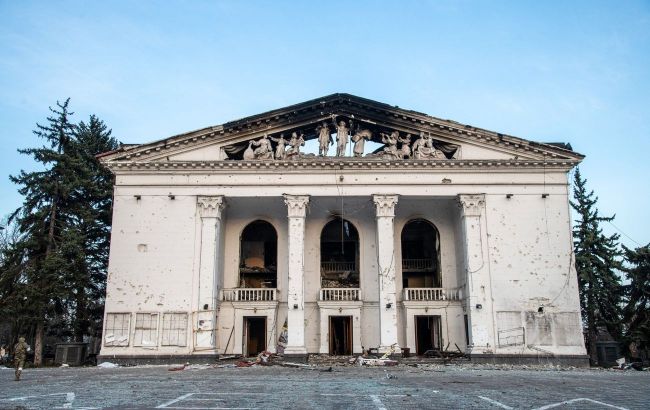 Destroyed Mariupol Drama Theater in spring 2022 (Photo: Getty Images)
Russian propaganda has launched a disinformation campaign claiming the rebuilding and prosperity of occupied Mariupol, according to the Telegram channel of Ukraine’s National Security and Defense Council’s Center for Countering Disinformation.
Pro-Kremlin media are circulating posts about supposedly restored homes, renovated parks, and sports grounds.
Particular attention is focused on the Mariupol Drama Theater, which was destroyed by a Russian airstrike in March 2022. Hundreds of civilians had been sheltering there, many of whom were killed.
Russian media are now actively spreading stories about the reconstruction of the theater, involving certain foreign journalists who, since the start of the full-scale invasion, have collaborated with Russian authorities in occupied Ukrainian territories.
“The goal of this campaign is to create the illusion, particularly in the West, that Ukrainian territories under Russian control are actively developing. By showcasing the reconstruction of the Mariupol Theater and select buildings, Russian propaganda aims to turn these locations into a showcase of the ‘Russian world,’” the Center for Countering Disinformation states.
In reality, most cities in the Donbas seized by Russia remain in ruins and are nearly deserted, with residents lacking access to basic services and living under constant terror from the occupiers.
“In Mariupol itself, despite all propaganda claims, residents are overwhelmingly reporting the loss of housing and the impossibility of receiving compensation for destroyed apartments,” the Center’s analysts note.
Living conditions in the temporarily occupied territories
As previously reported by RBC-Ukraine, residents in occupied Luhansk are suffering from severe shortages of water and heat: taps in towns remain dry for weeks, and in apartment buildings, people must rely on water drained from heating systems. Any attempts to improve living conditions can result in fines.
Amid this, Moscow announced a large-scale program for the so-called return of residents to occupied Ukrainian territories. In reality, the Kremlin’s goal is to formalize control over Donbas, Zaporizhzhia, and Kherson regions through a new migration strategy that aims to create conditions for resettlement and secure the population under Russian rule.
At the same time, large numbers of teachers from various regions of Russia continue to be sent to the temporarily occupied territories. These teachers are brought in under contracts with promises of higher pay to replace local educators who refused to work under the control of the occupation administrations.