Russia intensifies missile and drone strikes after Zelenskyy’s meeting with Trump

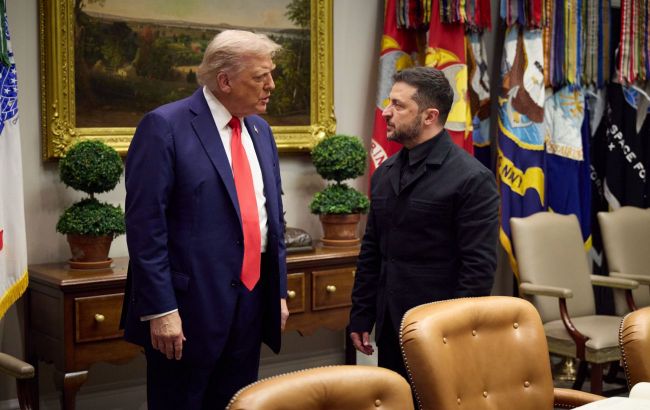 Photo: Ukrainian President Volodymyr Zelenskyy and US President Donald Trump (Office of the President of Ukraine)
Since the meeting between Ukrainian President Volodymyr Zelenskyy and US President Donald Trump at Mar-a-Lago on December 28, 2025, the Russian forces have significantly intensified their strikes on Ukraine, according to the Center for Countering Disinformation.
The Center for Countering Disinformation (TsPD) recalled that immediately after Zelenskyy met with Trump, the Kremlin spread a fake story about an alleged "Ukrainian attack" on Russian President Vladimir Putin’s residence in Valdai.
Russia used this fake story as a pretext to intensify massive strikes on Ukraine, which underscores its unwillingness to end the war.
The TsPD also shared an infographic showing the number of missiles and drones the Russian army launched at Ukraine from December 29, 2025, to January 15, 2026. In total, Russia used:
-
2,357 guided bombs (an average of 131 per day);
-
3,685 attack drones (an average of 205 per day);
-
60 cruise missiles;
-
32 ballistic missiles.
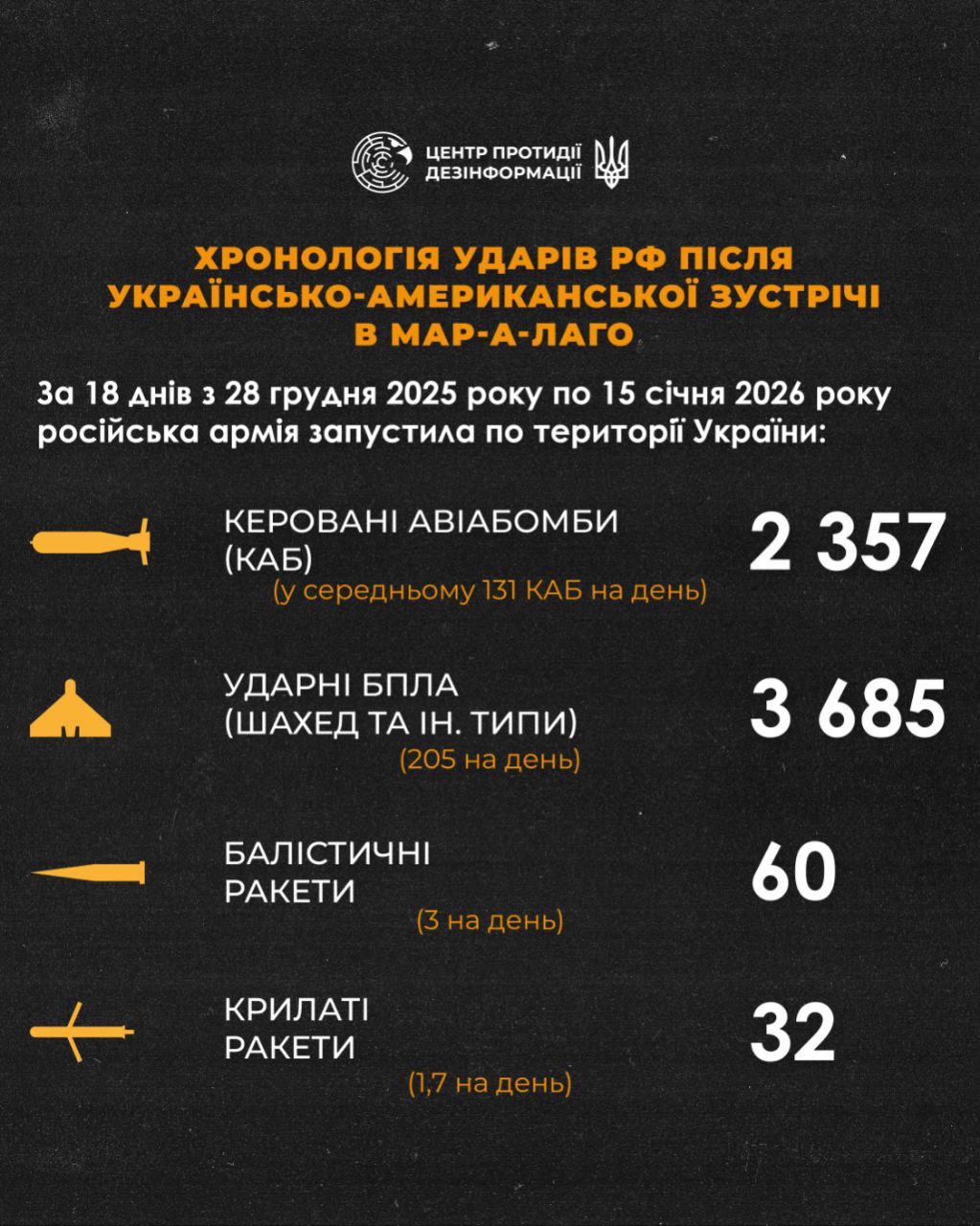
Photo: Center for Countering Disinformation
"Ukraine, meanwhile, has demonstrated that it seeks a stable and just peace with the support of its international allies," the TsPD added.
On December 28, 2025, Trump hosted Zelenskyy at his Mar-a-Lago residence in Florida. After three hours of talks, Trump said the parties were "close to peace," while Zelenskyy stated that 90% of the war cessation plan had been agreed.
Already on December 29, Russian Foreign Minister Sergey Lavrov claimed that Ukraine had allegedly attacked Putin’s state residence in the Novgorod region with drones, referring to the Valdai facility.
The Russians’ crude fake story was quickly debunked, but this did not stop Russia from intensifying aerial attacks against Ukraine. The Kremlin even resorted to using its scare tactic — the Oreshnik missile — on the night of January 9, publicly lying that it was supposedly a "response" to the "attack on Valdai."