Reparations loan for Ukraine included in draft conclusions of EU summit: Details

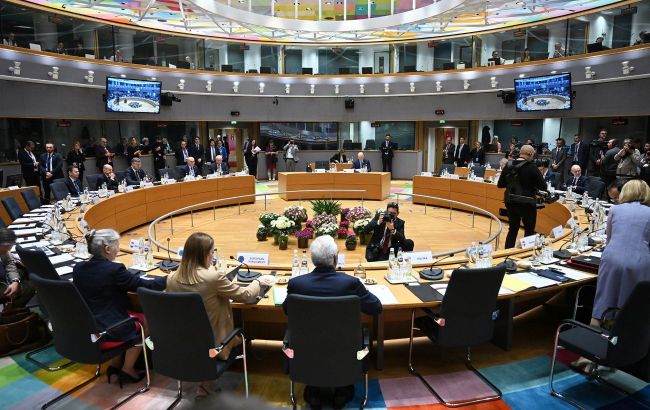 Illustrative photo: The European Council and European Parliament are urged to adopt instruments for providing a loan to Ukraine (Getty Images)
The draft conclusions of the EU summit include a detailed section on reparations credit for Ukraine from frozen Russian assets, according to Radio Svoboda.
The document available to the outlet contains a call to the European Council and the European Parliament. It concerns the adoption of instruments for providing a reparations loan to Ukraine, based on funds from frozen Russian assets.
Additionally, the section outlines the principles on which the reparations loan should be based. These include respect for the contractual obligations of financial institutions and equal treatment of all entities holding the funds.
It also refers to solidarity and risk-sharing among member states according to their share of the EU’s gross national income.
The document mentions a coordinated approach by member states regarding their bilateral investment treaties with Russia and the possibility of suspending national guarantees in the next EU budget. It also refers to coordination with the Group of Seven countries and maintaining the G7 ERA loan initiative.
Radio Svoboda notes that one of the conditions is Ukraine’s continued implementation of reforms on the rule of law and anti-corruption. The outlet also emphasizes that the draft conclusions may be subject to changes during the summit.
Reparations loan for Ukraine
The European Commission has proposed providing Ukraine with a reparations loan of €140 billion using frozen Russian assets.
In Brussels on December 18-19, the leaders of the European Union member states are expected to decide how financial support will be provided to Ukraine for 2026–2027.
If no agreement is reached, the EU will consider a Plan B — a transitional loan funded through the bloc’s borrowing to support Ukraine at the beginning of 2026.
At the same time, Germany has warned the EU that refusing to support the reparations loan for Ukraine could worsen credit ratings and increase interest rates.
It was also reported that the United States is pressuring several EU countries to prevent the bloc from using frozen Russian assets for Ukraine’s needs. If a decision is not made, Kyiv could face economic difficulties.
Bloomberg reported that the EU is considering providing Ukraine with a €90 billion loan from Russian assets, despite objections from Belgium.