Reparations loan for Ukraine: Europe divided ahead of key summit

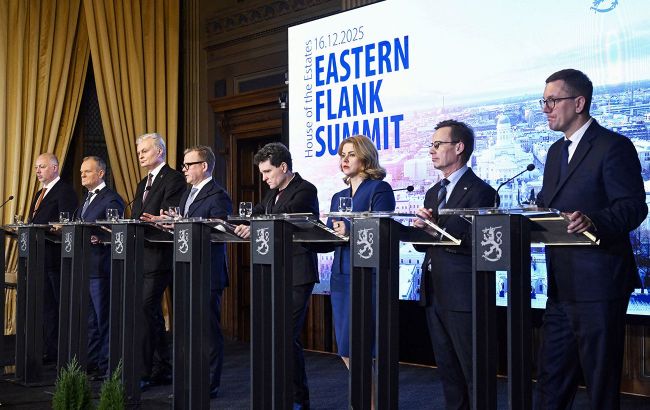 Illustrative photo: European Union leaders (Getty Images)
There is no consensus in the European Union regarding a reparations loan for Ukraine. Some leaders support funding it from Russian assets, while others insist on a joint debt mechanism, Euronews reports.
Indeed, the European Union faces a difficult choice: how to finance Ukraine’s budgetary and defense needs in 2026–2027, when US support is no longer guaranteed. The sum involved is at least €90 billion, and the time to find a solution is running short.
The main proponents of using frozen Russian assets are Germany, the Baltic states, and the Nordic countries, which consider this mechanism both financially feasible and politically fair, arguing that the aggressor’s funds should go toward Ukraine’s reconstruction.
In contrast, several countries, including Belgium, Italy, and Hungary, have expressed concerns about the legal and financial risks of such a move and suggest exploring alternative options.
Countries supporting the reparations loan
The main proponents of using Russia’s frozen assets are European Commission President Ursula von der Leyen and German Chancellor Friedrich Merz.
They proposed using the frozen assets of the Russian Central Bank as the financial basis for a loan to Ukraine. Repayment would occur only after the war ends — at Russia’s expense as the aggressor.
The plan quickly gained support from Poland, the Baltic states, the Nordic countries, and Ireland, which consider it not only financially feasible but also fundamentally fair. The Netherlands has joined them, while Spain and Portugal, though less enthusiastic, recognize that Ukraine needs stable financing now.
France is taking a cautious stance. President Emmanuel Macron avoids public statements, even though a significant portion of Russian funds is held in French banks. His silence only heightens political tension ahead of the summit.
Arguments of those opposed
Belgium is the strongest opponent of the reparations loan, as most of Russia’s frozen assets are concentrated there through Euroclear. Prime Minister Bart De Wever calls the idea legally risky and insists on a joint debt mechanism so that responsibility does not fall on a single country.
Italy, Bulgaria, and Malta have partially aligned with this position, calling for alternative solutions.
Czechia is also not ready to take on financial obligations.
Hungary stands apart, with Prime Minister Viktor Orbán fundamentally blocking any new aid to Ukraine, using pro-Russian rhetoric.
Slovakia opposes military spending but does not object to financing reconstruction.
This division leaves the EU summit with a difficult choice: whether to make a decision by qualified majority or seek a compromise to avoid undermining the union’s unity and timely funding for Ukraine.
On December 18–19 in Brussels, EU member state leaders are expected to decide on how financial support for Ukraine for 2026–2027 will be provided.
If no agreement is reached, the EU will consider a Plan B — a transitional loan funded by bloc borrowing to support Ukraine at the beginning of 2026.
Notably, Ukrainian President Volodymyr Zelenskyy will participate in the EU summit, where the reparations loan will be discussed.