Putin is angry over slump in Russian economy and missed forecasts

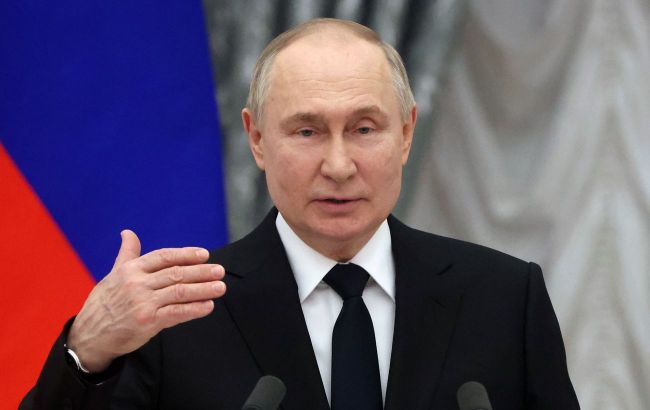 Russian President Vladimir Putin (photo: Getty Images)
The Russian economy showed a significant decline at the beginning of 2026, prompting Kremlin leader Vladimir Putin to convene a meeting and urge the government to urgently take measures to stimulate growth, Reuters reports.
Russia indicators
According to data presented at the meeting, Russia's gross domestic product declined by 1.8% in January–February. This indicates a deterioration in economic dynamics for the second consecutive month, despite the government's own growth forecasts.
To understand why the situation has become critical, it is necessary to look at the dynamics of the past two years.
- 2024: Russia's economy grew by 4.9%, largely due to military spending and artificial stimulation;
- 2025: growth sharply slowed to about 1%. The main reasons were the Central Bank's tight monetary policy (high interest rates to combat inflation) and Western sanctions limiting oil export revenues;
- Early 2026: the economy turned negative — -1.8% in the first two months.
Hope for the Middle East conflict
In March 2026, global oil prices rose due to the crisis in the Middle East. This gave the International Monetary Fund (IMF) grounds to revise its forecast for Russia upward, from 0.8% to 1.1% GDP growth for 2026.
However, Russia's Ministry of Finance forecasts growth at 1.3% in 2026, but has already warned that this figure may be revised downward at the end of April due to weak results in the first two months.
Forecasts not coming true
In light of the actual performance of the Russian economy, the Kremlin leader convened a meeting attended by key figures from Russia's economic bloc:
- Maxim Oreshkin — presidential aide for economic affairs;
- Elvira Nabiullina — head of the Central Bank of Russia;
- Anton Siluanov — Minister of Finance.
The leader made it clear to those present that explaining the decline in indicators by calendar factors, that is, referring to the specifics of early-year statistics, is insufficient.
"I hope to hear detailed reports today on the current state of the economy and why the macroeconomic indicators are still falling short of expectations," Putin said, emphasizing that the figures fall short even of officials' own forecasts.
The leader set demands
Thus, Putin set the following tasks for the economic bloc:
- To develop "additional measures aimed at reviving growth";
- To create conditions for the development of business initiatives;
- To redirect skilled personnel to sectors with higher growth potential — where there is real demand and return, rather than into bloated state structures.
The Kremlin leader also mentioned that the government had prepared a set of measures to reduce the budget's dependence on revenues from volatile commodity markets: oil and gas, whose prices fluctuate depending on global conditions. He did not disclose details.
Russia's budget is dependent on oil and gas
The dependence of the budget on commodity markets is something observed in the Russian economy and is its chronic problem. When oil is expensive, the treasury is replenished, and when it is cheap, a deficit arises. Russia has been trying to reduce this dependence for several decades, but so far unsuccessfully.
As Reuters writes, the economic contraction in Russia at the beginning of the year is not just a figure in a report. It means fewer investments, fewer jobs in civilian sectors, and persistently high borrowing rates.
While the economy is fighting inflation, consumer loans and mortgages in Russia remain extremely expensive. At the same time, military spending continues to absorb a significant part of the budget, leaving fewer and fewer resources for the development of the peacetime economy.
As is known, the Defense Forces of Ukraine are making efforts to ensure that the Russian economy is under strain and unable to sustain Putin's war machine. One of the measures used by Ukrainian forces is strikes on oil facilities in Russia, causing Moscow to lose a significant share of its revenue.
For example, exports of Russian oil and liquefied natural gas (LNG) through the ports of Ust-Luga and Primorsk in the Baltic Sea were halted on April 1 due to Ukrainian attacks. Russia loses tens of millions of dollars every day.