Poland demands Germany pay 10,000 zlotys per year for each Nazi victim

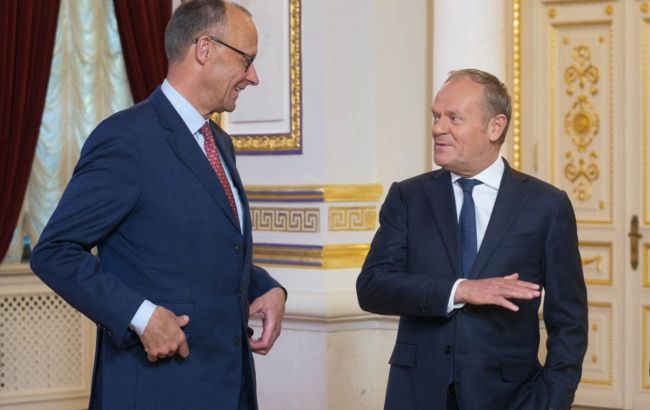 German Chancellor Friedrich Merz and Polish Prime Minister Donald Tusk (Photo: Vitalii Nosach, RBC-Ukraine)
Warsaw has prepared and submitted to Berlin a detailed plan for financial compensation for tens of thousands of Polish citizens who suffered during the Nazi occupation, according to Süddeutsche Zeitung.
Amount of payments and total cost of compensation
According to the new plan, the Polish side demands that the German government pay each living victim of the Nazi regime an amount of 10,000 zlotys (approximately 2,333 euros) annually.
The payments are proposed to be made through the Foundation for Polish-German Reconciliation. Since this is not a one-time payment but ongoing annual support, the total compensation amount will not have a fixed limit, and expenditures will decrease each year due to the natural decline in the number of survivors.
According to very conservative estimates, the total cost of implementing this project could reach about 300 million euros. If Berlin agrees to these conditions, the first 100 million euros will have to be allocated from the German budget as early as 2027 to cover the needs of all registered victims.
Polish Prime Minister Donald Tusk is demanding that Germany approve the plan clearly by the end of 2026, warning that otherwise, Warsaw will begin financing the payments independently from its own budget.
Rejection of 200 million
The demands for a specific amount of annual payments are dictated by the acute domestic political situation in Poland. Donald Tusk's government is trying to avoid accusations from the opposition Law and Justice party (PiS), which, while in power, presented Germany with an official bill for classical reparations amounting to a staggering 1.3 trillion euros.
Precisely because of the colossal gap between the trillion-euro demands of his predecessors and Berlin's capabilities, Warsaw seeks to achieve a financial humanitarian gesture in a form that would not be perceived by society as humiliating charity.
For this reason, back in 2024, Donald Tusk rejected the proposal from then-German Chancellor Olaf Scholz for a one-time compensation of 200 million euros, deeming it insufficient.
The German government's attempts to settle the payment issue are taking place against the backdrop of an active dialogue on the historical past and common security. In particular, during a recent visit to Gdańsk, German Chancellor Friedrich Merz drew a parallel between post-war German-Polish reconciliation and Ukraine's future in Europe.
He publicly expressed deep gratitude to the Polish people for the fact that, after the horrific crimes committed by the Germans in Poland between 1939 and 1945, the two states managed to achieve peace, good neighbourliness, and friendship, which now serves as an example for supporting Ukraine in its resistance to Russian aggression.