Plans call for up to 1,000 satellites: Ukraine's Intel reveals details of Russia's Rassvet system

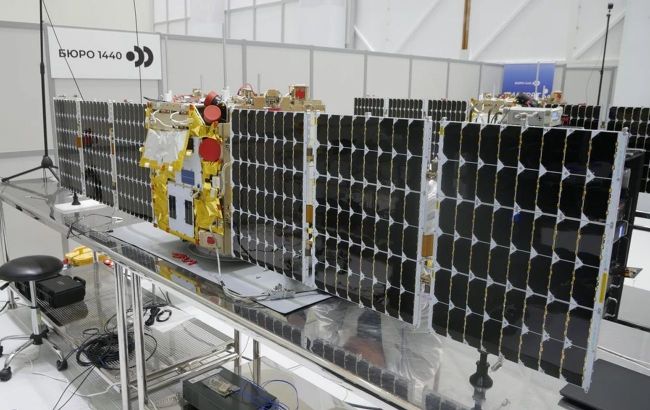 Photo: Ukraine's Defense Intelligence reveals details of Russia's Rassvet system (Russian media)
Russia is trying to accelerate the deployment of its Rassvet low-Earth orbit satellite communications system, which it presents as an equivalent of Starlink, but the project is facing difficulties, according to Ukraine's Defense Intelligence.
According to the Defense Intelligence of Ukraine, the key problems include dependence on foreign components, difficulties in placing satellites into their target orbit, and the development of compact subscriber terminals. The third satellite launch, planned for 2026, was reportedly canceled or postponed, according to preliminary data.
How many satellites does Russia have in orbit?
So far, Russia has launched 30 satellites into orbit in two batches – on March 23 and July 19, 2026. Two spacecraft have already deorbited.
Of the 30 satellites, 26 have settled into stable positions at an altitude of approximately 500–520 km. None has reached the planned altitude of 800 km. The remaining spacecraft are continuing maneuvers to reach their target orbit.
Each satellite weighs approximately 280 kg. One of the system's key technologies is inter-satellite laser communication, which makes it possible to transmit data directly between spacecraft without constantly relying on ground infrastructure.
By the end of 2026, Russia planned to expand its constellation to 47–48 satellites. In 2027, it aims to launch another 240 spacecraft to provide coverage of 94% of Russian territory with data transfer speeds of up to 150 Mbps. By 2031, the constellation is expected to grow to 408 satellites, and by 2035 – to 924.
The ground segment is based on a main control center in Moscow. It is responsible for satellite control, laser link operations, and traffic routing. A network of ground stations is also planned.
In September 2026, Russia completed testing of the Ultra terminal. Its claimed download speed is up to 650 Mbps, and it is designed to operate even when the carrier is moving at speeds of up to 250 km/h. Around 1,000 devices are planned to be delivered to customers by the end of the year.
In 2027, Russian forces plan to develop four more terminal modifications, and in 2028 they are expected to unveil the Vozdukh aviation terminal.
The project's main contractor is Bureau 1440 LLC, which is part of IX Holding. At least 46 Russian and three Belarusian companies are involved in the production process.
Earlier reports indicated that Russia's Rassvet project was facing serious technical problems. On October 30, one of the system's satellites, Rassvet-3 No. 17, deorbited and burned up in the atmosphere after spending less than three months in space.
According to Defense Express, the spacecraft likely failed to activate its engine to correct its orbit.