OSCE unveils plan to monitor peace in post-war Ukraine

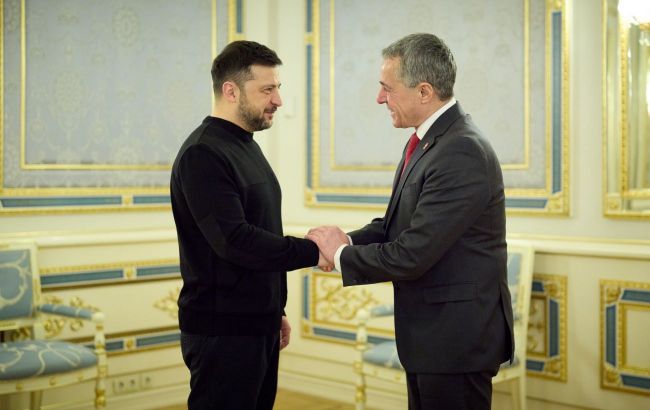 Photo: President of Ukraine Volodymyr Zelenskyy and OSCE Chairman-in-Office Ignazio Cassis (president.gov.ua)
The Organization for Security and Co-operation in Europe (OSCE) presented "concrete tools" in Kyiv to monitor and support the maintenance of peace in Ukraine after the war with Russia, according to the OSCE press service.
The current OSCE Chairman-in-Office, Swiss Federal Councillor and Head of the Federal Department of Foreign Affairs, Ignazio Cassis, and the organization’s Secretary-General Feridun Sinirlioğlu concluded their visit to Ukraine.
The delegation met with Ukrainian President Volodymyr Zelenskyy and Foreign Minister Andrii Sybiha. The main topic of discussion was the OSCE’s role in achieving a just and lasting peace based on international law.
"The OSCE must be prepared, once conditions allow, to contribute to monitoring a ceasefire and to supporting the implementation of a peace arrangement. This visit was an opportunity to present clearly the concrete tools the OSCE can bring to such a process," Cassis said.
Sinirlioğlu added that the OSCE has the necessary experience and instruments to promote stability in Ukraine, should the parties request support within the framework of negotiations.
The OSCE leadership also expressed deep concern over ongoing Russian attacks on civilians and critical infrastructure in Ukraine.
OSCE monitoring
Before Russia’s full-scale invasion, the OSCE Special Monitoring Mission observed the ceasefire in Donbas.
More than 700 observers recorded violations of the truce using cameras and drones. However, Russia and its proxy forces systematically obstructed the mission’s work: they jammed drones with electronic warfare systems, blocked access to the border, and threatened personnel.
The most tragic incident occurred in 2017, when a Special Monitoring Mission vehicle hit an anti-tank mine in the Russian-occupied part of the Luhansk region, killing American medic Joseph Stone.
Russia also repeatedly used escalations on the front line as a tool of diplomatic pressure, ignoring the Minsk agreements and using prohibited heavy artillery.
Finnish Foreign Minister Elina Valtonen previously stated that the OSCE mission could be deployed in Ukraine once security conditions allow.