A square meter of labradorite costs less than a punnet of strawberries: Ukraine moves to tax raw stone exports
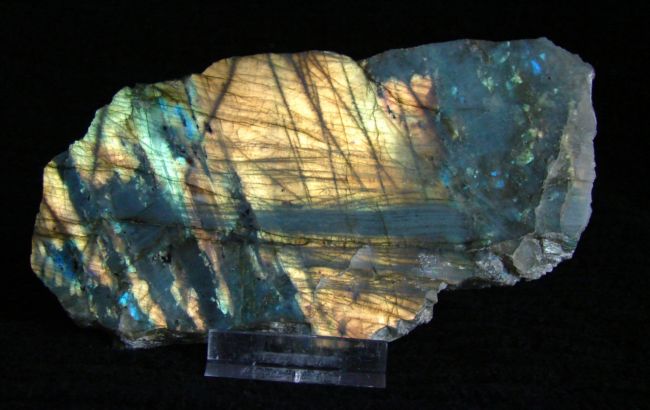 Ukraine's Parliament introduces export duty on Ukrainian decorative stone of labradorite (photo: wikimedia.org)
Parliament passed Law No. 15111-d, introducing an export duty on unprocessed decorative stones, namely granite and labradorite. The decision is expected to halt the long-standing export of unique Ukrainian raw materials at undervalued prices, according to the National Association of the Extractive Industry of Ukraine.
One cubic metre of Ukrainian labradorite block, weighing around 2,600 kilograms, leaves the country for roughly $415. After cutting and polishing, that cubic metre yields about 27 square metres of finished slab. Each square metre sells for $80 to $150 on European wholesale markets, and for $650 to $970 as an installed product in the US. The raw stone embedded in each square metre of finished slab earns Ukraine about fifteen dollars at the quarry gate. For decades, that difference accrued to processors in other countries.
To put the number in everyday terms: fifteen dollars, which is Ukraine’s return on the raw stone that goes into a square metre of finished slab from rock that is over a billion years old, is roughly the price of a kilogram of early-season strawberries. On 9 June, the Ukrainian Parliament, Verkhovna Rada, passed the law intended to change that model.
What the law does
The law introduces an export duty of €0.30 per kilogram on stone falling under commodity group 2516 of Ukraine's customs classification, covering granite, gabbro, labradorite, basalt, and related rock. The duty applies to unprocessed blocks only. Cut slabs, polished stone, and finished products fall under different codes and are not affected.
The logic is straightforward: exporting raw blocks becomes unprofitable, while shifting to processed output does not.
Where the fifteen-dollar figure comes from
According to customs data, Ukraine’s average export price for decorative stone has hovered around $0.16 per kilogram. Wholesale blocks are traded by weight or by cubic metre: one cubic metre of labradorite weighs roughly 2,600 kg and leaves the country for around $415. Once cut into standard three-centimetre slabs, that cubic metre yields approximately 27 square metres of finished surface, accounting for cutting losses. The raw material cost embedded in each square metre of finished slab works out to about fifteen dollars.
Up to 80% of this material was shipped to China. Chinese plants bought the blocks, cut and polished them, and sold the slabs for $150 to $200 per square meter. Finished facade panels, staircases, and architectural elements commanded several times more. The entire spread between the $415 Ukraine receives per cubic metre of raw block and the several thousand dollars that the same volume commands as finished product on international markets was captured abroad.
What the industry association says
The National Association of Extractive Industries of Ukraine (NADPU) has pushed for years for stronger domestic processing and supports the new law. The association also points to royalty revenues: seven key companies in the sector paid a combined total of around six million hryvnias in royalties over 2024 and 2025, because royalties are calculated on declared export value rather than real market price.
A scientific opinion from Ukraine's State Gemological Center notes that Ukrainian labradorites of the Holovinskyi type combine mineralogical and decorative characteristics rarely found in foreign equivalents. NADPU argues that treating such a resource as an ordinary bulk commodity is a losing proposition for the state.
Critics of the duty
Some exporters and business associations have opposed the measure. Their calculations suggest the total duty burden is roughly twice the sector's entire declared export revenue, making shipments unviable. Critics also cite Article 31 of the EU Association Agreement, which restricts the use of export duties.
NADPU counters that the duty exceeds declared revenue precisely because that revenue has been understated at $0.16 per kilogram. Companies that declare stone at real market prices, or that switch to exporting processed goods, will not feel the impact. The duty is prohibitive only for those who ship maximum volumes of raw stone at minimum declared prices, and that, the association says, is the model the law is designed to end.
Background
Other resource-rich countries have faced the same choice. In 2022, Zimbabwe effectively banned exports of unprocessed granite after establishing that it was selling the stone at around $117 per tonne while losing an estimated $15 million a year in potential revenue.
Türkiye built one of the world's leading stone-processing industries on exports of finished products: processed marble generates roughly one billion dollars in export revenue in nine months alone, compared with a price roughly three times lower for raw stone.
Ukraine holds an estimated 5% of global decorative stone reserves, with proven anorthosite deposits alone exceeding 15 billion cubic meters.