Oil blockade and Israel tensions: Why Trump can't claim 'victory' over Iran


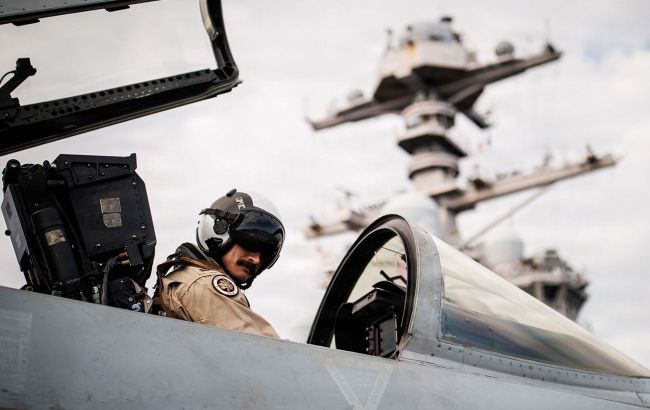 US Air Force pilot before strike on Iran (photo: US Central Command)
Today marks the start of the fourth week of the US and Israel's war against Iran. Both sides continue to methodically attack each other while gradually expanding the conflict zone. RBC-Ukraine outlines the key developments in the war over recent days and how it may unfold next.
Key points:
- Damage to Iran: Israel has disabled 80% of Iran's air defense systems and 70% of its missile launchers.
- Regional retaliation: Iran is targeting civilian oil and gas infrastructure across the region.
- Strait blockade: Tehran has halted the transit of 20% of the world's oil through the Strait of Hormuz, allowing passage only to ships bound for China and India.
- Europe's position: Most countries have refused military involvement, relying instead on diplomacy and drone-based mine clearance.
- Allied disagreements: Trump opposed new attacks on Iran’s energy sector, contradicting Israel’s strategy to neutralize the regime.
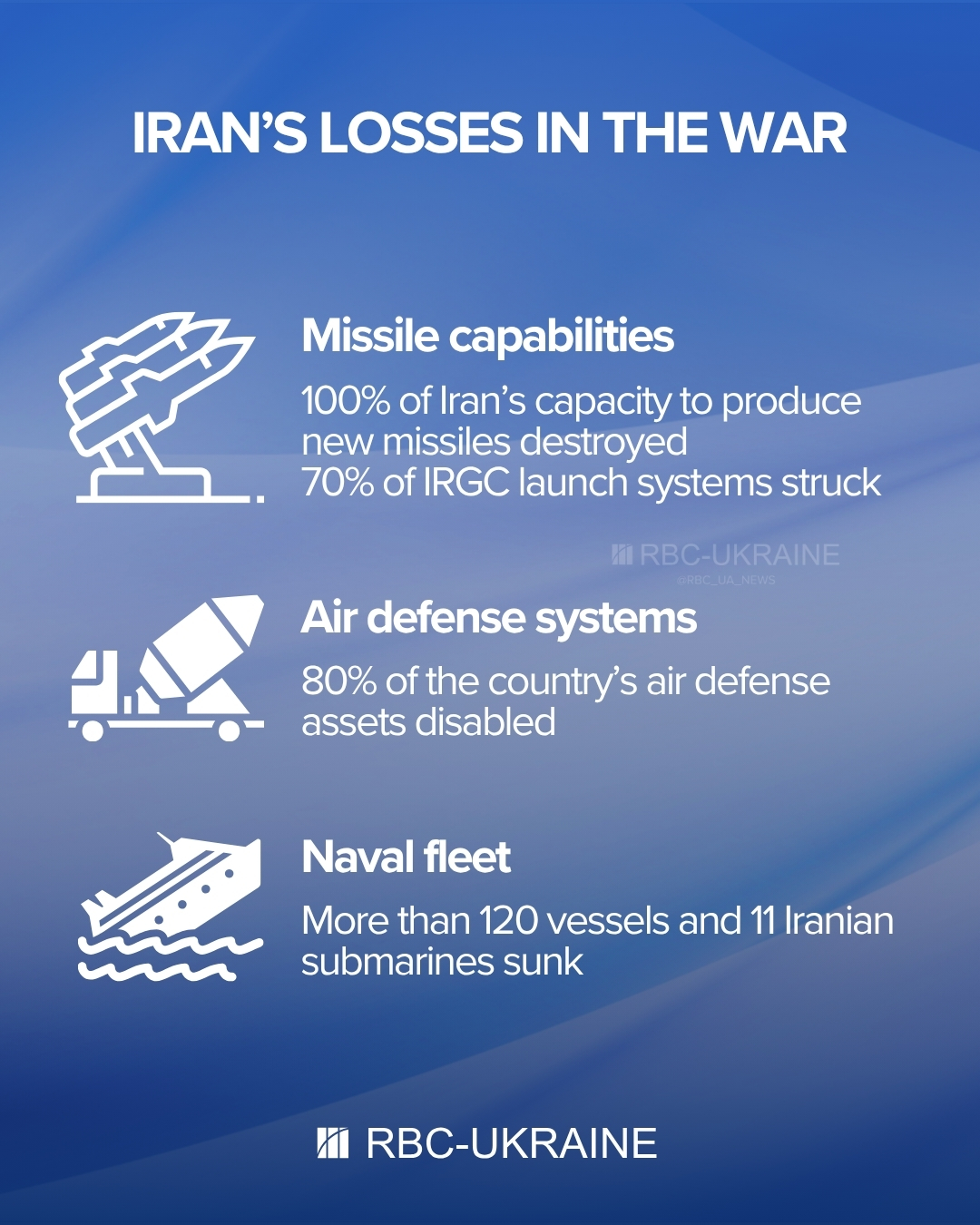 Iran's military capabilities have been significantly weakened (infographic: RBC-Ukraine)
Expansion of the war
Israel and the US continue methodically destroying Iran's military infrastructure.
"Our best pilots are taking part in the operation — both men and women. Over 4,400 sorties have already been carried out, striking more than 7,400 targets. Operations have also included targeted eliminations of regime leaders and top commanders," Major (res.) Anna Ukolova, spokesperson for the Israel Defense Forces (IDF), told RBC-Ukraine.
She specifically highlighted the strike on Iran’s missile production capabilities. As a result of IDF actions, Iran currently lacks the ability to produce new missiles.
"Among the key targets of our strikes are Iran’s air defense systems, 80% of which have already been disabled, as well as missile launchers. More than 70% of these launchers have been put out of action, significantly affecting the IRGC’s ability to launch missiles at our cities," Ukolova added.
Additionally, US Defense Secretary Pete Hegset reported that over 120 ships of the Iranian navy were sunk and 11 Iranian submarines were neutralized.
On Tuesday night, the Israeli military struck Iran, eliminating a number of commanders of security forces. Basij commander Gholamreza Soleimani and National Security Council secretary Ali Larijani were killed. Also eliminated were Intelligence Minister Esmail Khatib and Quds Force spokesperson Ali Mohammad Naini, who oversaw propaganda and played a significant role in suppressing protests in Iran.
In response, Iran continues to target US military sites, Israeli territory, and civilian infrastructure in other countries across the region. One of the most significant attacks hit the city of Ras Laffan, home to one of the world’s largest liquefied natural gas complexes.
On Monday, Iran used drones to strike the UAE's largest oil port — Fujairah. Located on the coast of the Gulf of Oman, it allows oil exports that bypass the Strait of Hormuz. The attack was aimed at blocking this alternative route.
For the same purpose, Saudi Arabia’s SAMREF refinery at the port of Yanbu on the Red Sea was targeted. This is the only Saudi refinery capable of exporting its products to other markets while bypassing the Strait of Hormuz.
Problem of the Strait of Hormuz
Iran has imposed a partial blockade of the Strait of Hormuz, through which 20% of the world’s oil consumption, over 30% of gas, and 30% of nitrogen fertilizers are shipped to global markets.
Most vessels in the Persian Gulf are blocked. At the same time, Iran allows passage for ships headed to China, India, and Pakistan, mostly tankers carrying Iranian oil.
Throughout the week, Trump has been working to build a coalition of countries to reopen the Strait of Hormuz. On Sunday, he told reporters that he "demands" NATO countries and other oil importers, including China, assist the US in this effort.
The United Arab Emirates have expressed willingness to join. Other countries ignored the invitation.
For the operation, American ships with Marines, helicopters, and additional F-35 aircraft are heading to the strait area. In addition, the US successfully struck fortified Iranian missile sites along the coast near the Strait of Hormuz.
Trump is also considering seizing a critical Iranian oil terminal on Kharg Island.
Europe observes
European leaders so far are limiting themselves to statements. French President Emmanuel Macron on Monday called on Tehran to immediately cease attacks on Middle Eastern countries.
The German government also stated that it would provide no military support to reopen the Strait of Hormuz. However, it may send drones for mine detection.
EU High Representative for Foreign Affairs, Kaia Kallas, said Europe's participation in the operation is possible but would most likely be diplomatic rather than military.
Later, Trump said most NATO allies informed him that they do not want to take part in a military operation against Iran. He added that the US no longer needs Alliance assistance.
"Without the USA, NATO is a paper tiger! They didn't want to join the fight to stop a nuclear-powered Iran. Now that fight is militarily won, with very little danger for them, they complain about the high oil prices they are forced to pay, but don't want to help open the Strait of Hormuz," he emphasized.
Disagreements with Israel
Meanwhile, tensions are growing between the US and Israel. US Director of National Intelligence Tulsi Gabbard said Washington and Tel Aviv are pursuing different goals in the war against Iran.
According to her, the actions of the two sides already show different approaches to the operation. The Israeli government focuses on neutralizing Iranian leadership, while the US president’s goals are to destroy Iran’s ballistic missile launch and production capabilities, as well as its navy.
This became evident during Israel’s attack on the South Pars gas infrastructure. According to sources cited by The Wall Street Journal, Trump initially supported Israel’s actions as a signal to Iran regarding the blockade of the Strait of Hormuz. However, he later changed his position, believing Tehran understood the message. Trump now opposes new attacks on Iran’s energy infrastructure.
At the same time, three of Trump's advisors told Axios anonymously that, in their view, he may seek to end the operation sooner than Israeli Prime Minister Benjamin Netanyahu.
Prospects of the war
According to Trump’s advisors and aides, the intensive military operation is expected to conclude in early April — 4–6 weeks after it began, Axios reports. However, officials in Washington and allied countries are preparing for a much longer crisis. Three sources in the Trump administration and NATO countries believe instability in the Middle East could last until September.
To understand when the war will end, it is necessary to know the ultimate goals of Israel and the US, Alexander Leonov, executive director of the Center for Applied Political Studies Penta, told RBC-Ukraine. However, not only do their goals differ, but Trump's rhetoric on the issue keeps changing.
According to Leonov, it is still too early to speak of a failed "blitzkrieg." In a comparable operation, widely regarded as a successful example of a rapid victory — the 1991 "Desert Storm" against Iraq — active combat lasted five weeks.
At present, Trump cannot simply declare victory because Iran is blocking the Strait of Hormuz.
"Without at least a localized ground operation, it is impossible to move the issue forward. Trump cannot even declare victory. From this perspective, the US would need to take control of Kharg Island and several other islands near the Strait of Hormuz, and possibly parts of the coastline, to prevent Iran from striking tankers," Leonov said.
At the same time, several factors make this scenario unlikely. First, the US is operating in the Persian Gulf without active support from allies, except Israel. Second, in Iran — at least for the duration of the war — power has consolidated in the hands of the most radical segment of the establishment.
"As I understand it, the American administration is not even attempting to engage with part of the Iranian elite about ending the war. Trump's dismissive statements are more likely to push those willing to talk away from negotiations, even though there is a split among the Iranian elite," Leonov emphasized.
Even if the US undertakes a limited ground operation, there is no guarantee it will succeed. Over the past three weeks, Iran has shown it can surprise and is clearly preparing to resist American forces on its own territory.
FAQ
– What targets in Iran have the US and Israel already destroyed?
– Coalition forces have disabled 80% of Iran’s air defense systems and over 70% of its missile launchers. The destruction of 120 Iranian ships, 11 submarines, and the country’s full capability to produce new ballistic missiles has also been confirmed.
– Which Iranian leaders were killed in the recent strikes?
– Targeted operations eliminated Basij militia commander Gholamreza Soleimani and National Security Council secretary Ali Larijani. In addition, Intelligence Minister Esmail Khatib and Quds Force chief propagandist Ali Mohammad Naini were killed.
– How does the blockade of the Strait of Hormuz affect global energy supplies?
– The blockade has cut off the transit of 20% of global oil consumption and over 30% of natural gas. Iran selectively allows only tankers headed for China, India, and Pakistan, creating shortages for other countries.
– Why have the US and Israel diverged in their war strategies?
– Washington aims solely to destroy Iran's missile capabilities and navy to restore shipping, while Tel Aviv insists on completely removing the ruling regime. Donald Trump has begun opposing attacks on energy infrastructure that he previously supported.