No planet is safe? Black holes could destroy atmospheres across vast distances

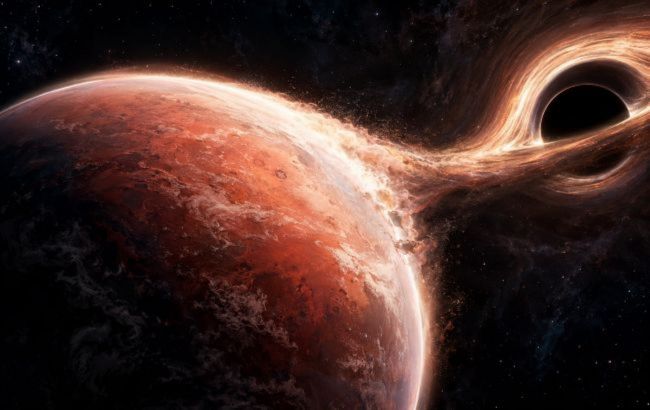 Scientists model the destructive effects of black holes on planets (photo: RBC-Ukraine)
Supermassive black holes may destroy exoplanet atmospheres thousands of light-years away. Astronomers have found that powerful galactic winds and bursts of radiation released during periods of intense matter absorption can completely destroy planets' ozone layers, according to Futura.
Trap at galaxy's center: Why watery 'paradise' may be illusion
When searching for potentially habitable planets, scientists typically focus on the so-called habitable zone, the distance from a star where liquid water can exist on a planet's surface. However, a new study shows that a planet's location within its galaxy also matters.
Near galactic centers, stars are more densely packed, and dangerous cosmic events occur more frequently.
When a supermassive black hole actively consumes gas and dust, it forms an extremely hot accretion disk, turning the galaxy's central region into an active galactic nucleus that can emit powerful streams of energy.
The main hazards posed by an active galactic nucleus include:
-
Intense radiation in the hard ultraviolet and X-ray ranges
-
Galactic winds of high-energy particles that travel enormous distances
-
Intense heating of the upper atmospheric layers of nearby and distant exoplanets.
Stripped atmospheres, depleted ozone: What galactic winds do to exoplanets
Scientists ran computer simulations of scenarios involving black holes of different masses and activity levels. The simulations showed that streams of high-energy particles accelerate the loss of atmospheric gases into space and can completely destroy an exoplanet's ozone layer.
Without an ozone shield, a planet's surface is exposed to harmful ultraviolet radiation, making it impossible for complex life forms to survive.
The most powerful galactic winds can travel thousands of light-years from a galaxy's center. As a result, large areas of the central bulge, a dense concentration of stars surrounding the nucleus, may become uninhabitable.
Milky Way's sleeping 'monster': Does our galaxy face a threat?
The supermassive black hole at the center of our galaxy, Sagittarius A*, is currently relatively quiet.
However, astronomers believe it went through periods of intense activity in the past, when powerful radiation exposed surrounding regions of the Milky Way.
The researchers note that current models are somewhat simplified and do not account for additional factors, such as how quickly volcanic activity might replenish a planet's atmosphere.
Nevertheless, the scientists' main conclusion remains clear: assessing a planet's habitability requires analyzing not only its host star but also the state of the entire galaxy and the activity of the black hole at its center.