No alternative to Odesa ports: Ukraine warns of global hunger risk


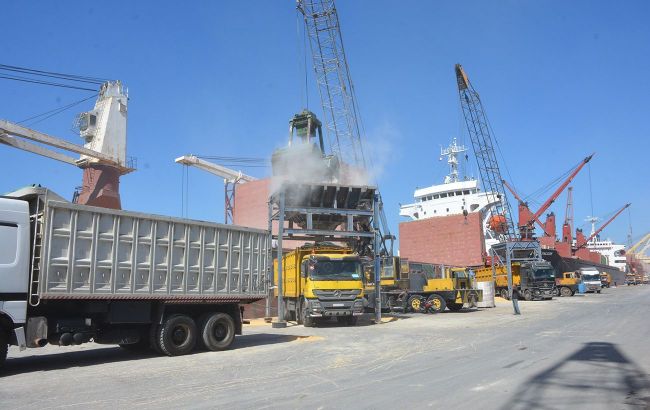 Photo: A port in Ukraine's Odesa region (Getty Images)
There is no alternative to the ports in Ukraine's Odesa region, which Russia terrorizes daily. Their shutdown would lead to global consequences, states Taras Vysotskyi, Ukraine's Minister of Agrarian Policy and Food, while speaking to journalists on the sidelines of a meeting of Ukrainian ambassadors.
Russian attacks on Odesa ports could trigger global food shortages
Vysotskyi said there is no substitute for the ports of Greater Odesa. If exports through them are not fully restored, the world could face food shortages. He added that disruptions at these ports could also drive global food prices up by 25%, similar to what happened in 2022.
The second major threat, according to Vysotskyi, is that importing countries could simply be left without sufficient supplies.
"About 30% of the world's wheat exports come from the Black Sea region. The main destinations are North Africa, the Middle East, and Southeast Asia," he said.
What can compensate for the loss?
According to Vysotskyi, Danube ports and rail transport can replace only up to 30% of the export capacity of Greater Odesa's ports.
He noted that these alternative routes would still be used to help mitigate the impact on global food security, but they cannot fully replace maritime exports.
Ukraine's export routes and capacities:
- Up to 5.5 million metric tons of goods per month can be shipped through the ports of Greater Odesa;
- A maximum of 1 million metric tons can be exported by rail;
- Up to 500,000 metric tons can be transported by road;
- Up to 1.5 million metric tons can be shipped through Danube ports under the best-case scenario.
Support for farmers
Responding to a question from an RBC-Ukraine journalist, Vysotskyi said the government's main task is to provide farmers with financial liquidity.
"The key objective is to provide farmers with liquidity, meaning access to funds. They already have an asset — the harvested crop. The harvest is at last year's level, or even slightly better, so volumes are normal," he said.
According to the minister, financing must be secured against this asset so that farmers can continue operating and have access to working capital.
"A model has already been developed together with the agricultural sector and other stakeholders," he added.
Measures being considered
- Allowing farmers to extend existing loans and obtain new ones under the government's 5-7-9 affordable lending program, using agricultural products as collateral;
- The National Bank of Ukraine is actively working to adjust relevant regulations to support these measures.
Impact of a port shutdown on Ukraine
Earlier, RBC-Ukraine reported in an exclusive material that Russia's targeted attacks on the ports of Greater Odesa have effectively halted shipping operations. More than 60% of Ukraine's exports and key import supply chains are now under threat.
A pivotal incident was the July 19 attack on the Guinea-Bissau-flagged bulk carrier Golden Leo. Nine foreign sailors and a Ukrainian pilot were killed, and the vessel later sank.
The main challenge is that the disruption to maritime trade has come at the peak of the harvest season, when a significant share of the new grain crop was expected to be contracted and shipped abroad.
On July 22, it also emerged that one of the world's largest container shipping companies, Maersk, had temporarily suspended services through the Chornomorsk Fishing Port due to the current security situation in the Black Sea.
In addition, on July 25, Russia launched another attack targeting Ukraine's civilian shipping and port infrastructure. Among the targets was a vessel in the Odesa region, which was struck twice.