NASA loses crucial Mars spacecraft after 11 years of service

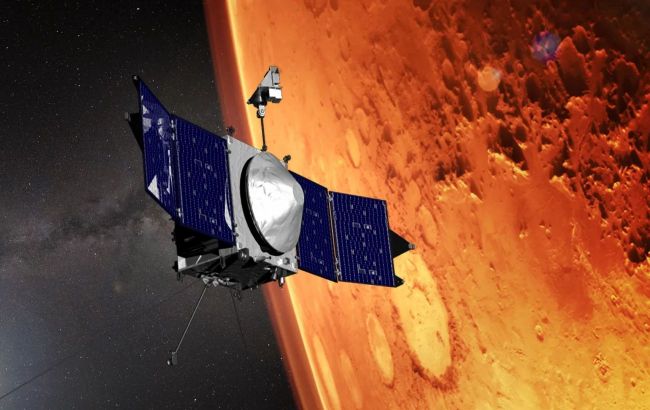 NASA seeks replacement for the lost MAVEN spacecraft (photo: NASA)
How did the MAVEN satellite fail?
Decoded fragments of delayed telemetry showed that the spacecraft began rotating around its axis, lost sunlight, and completely exhausted its batteries.
Analysis of the recovered technical data revealed that the satellite began spinning uncontrollably at approximately 2.7 rotations per minute. This is significantly faster than normal operating mode, so the system was unable to stabilize.
As a result, MAVEN failed to orient its solar panels toward the Sun and fully discharged its batteries within a few hours.
The spacecraft will remain in orbit around Mars for another 50 to 100 years before eventually burning up in the Martian atmosphere.
What did the sensors record before contact was lost?
The research spacecraft, which arrived in Mars orbit in 2014, stopped communicating during a scheduled pass behind the planet’s disk.
Engineers at the Jet Propulsion Laboratory (JPL) were unable to restore stable contact, but they managed to record and analyze fragments of delayed telemetry and Doppler shift data received after the probe emerged from the planet’s shadow.
“NASA has ceased efforts to search for the MAVEN spacecraft and are beginning activities to decommission the mission,” said project manager Mike Moreau of NASA’s Goddard Space Flight Center.
Main discoveries of the probe over 11 years of operation
The satellite was designed to determine how Mars turned into a cold desert and where its ancient lakes and rivers disappeared. Based on the collected data, scientists proved for the first time that the main reason for the disappearance of the Red Planet’s atmosphere is the solar wind, which literally “knocks” gas molecules into outer space.
“One of our most exciting discoveries used 11 years of MAVEN data to observe, for the first time at any planet, an atmospheric escape process called sputtering. This is where charged particles crash into the upper atmosphere and splash out into the neutral atmosphere, much like doing a cannonball in a pool. Our team used noble gas isotopes to confirm that this process has been a dominant escape mechanism for billions of years,” explained Shannon Curry, the mission’s principal investigator at the University of Colorado Boulder.
“We confirmed that this process was the dominant escape mechanism over billions of years,” the scientist added.
For the research team, the mission’s conclusion was a heavy blow. Mike Moreau shared that people experience it “like the loss of a close family member,” while Shannon Curry emphasized that MAVEN left behind the most detailed understanding of atmospheric processes among all planets in the Solar System, including Earth.
Communication issues with Mars rovers
In addition to pure scientific research, MAVEN also functioned as a powerful relay satellite — it collected signals from the Perseverance and Curiosity rovers on the surface and transmitted large volumes of photos and other data back to Earth. This spacecraft accounted for nearly 18% of all data sent from the surface of Mars.
Tiffany Morgan, Director of NASA’s Mars Exploration Program, reassured that four other orbiters can support the mission, although three of them are older than MAVEN.
To fully solve future communication challenges, NASA is already involving private companies in building a new commercial infrastructure called the Mars Telecommunications Network. The new network is planned for deployment in the 2030s.