Is Bulgaria getting its own 'Orbán'? What it means for Ukraine


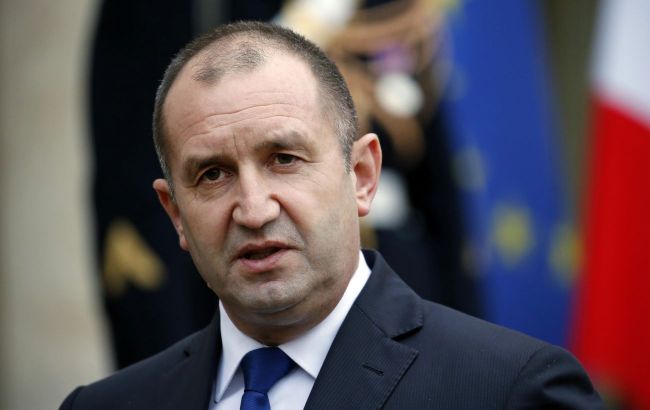 Rumen Radev (photo: Getty Images)
Today, April 19, parliamentary elections are being held in Bulgaria. The pro-Russian former president Rumen Radev has strong chances of winning.
RBC-Ukraine explains how this could affect the country's foreign policy and whether it may create new problems for Ukraine.
Key points:
-
Race frontrunner: the new party of former president Rumen Radev, "Progressive Bulgaria," is leading with a rating of 29–31%.
-
Political record: the current elections on April 19 are the eighth in the past five years, indicating a deep crisis and division in society.
-
Risks for Ukraine: Radev opposes military aid to Kyiv and criticizes the security agreement, although he has previously shown a willingness to compromise.
-
Threat of a coalition deadlock: even with 30% of the vote, Radev has no allies for a majority, which could lead to yet another round of elections.
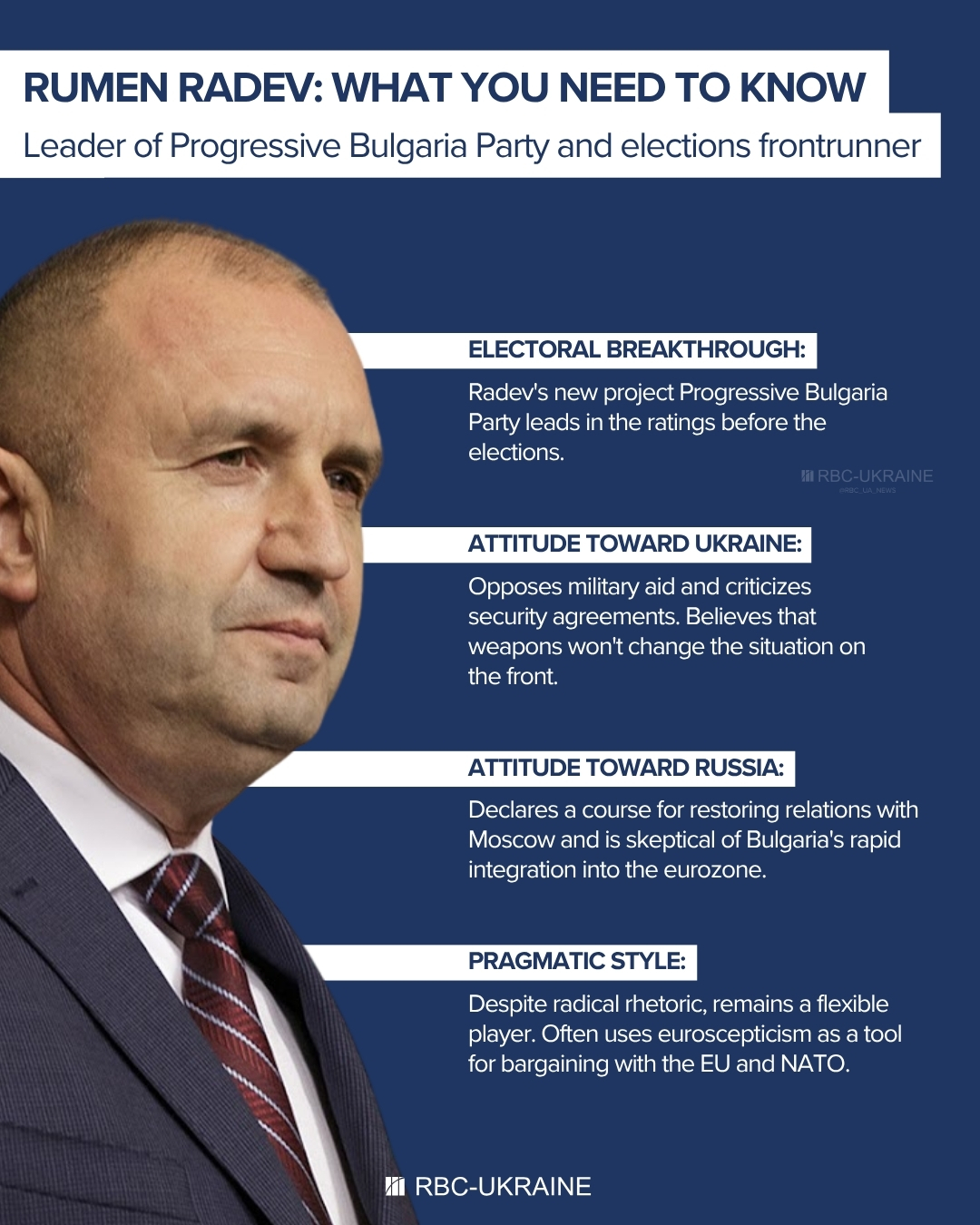
Key facts about Rumen Radev (infographic: RBC-Ukraine)
At the end of last year, Bulgaria's president Rumen Radev dissolved parliament and called early elections. Soon after, he himself resigned, but did not leave politics. Radev is now running for parliament with a new political project — Progressive Bulgaria.
It includes three left-leaning parties: the Movement of Political Social Democrats, the Social Democratic Party, and the Our People Movement. According to polls, Progressive Bulgaria has 29–31%.
Radev's main rival is the right-wing bloc Citizens for European Development of Bulgaria – Union of Democratic Forces (GERB-UDF), led by former Prime Minister Boyko Borisov, with 20%.
Other key players include the pro-European bloc We Continue the Change – Democratic Bulgaria (PP-DB), which positions itself as an alternative to the old elites — 10%.
The Movement for Rights and Freedoms – New Beginning, linked to oligarch Delyan Peevski, the pro-Russian party Revival, and the Bulgarian Socialist Party may also enter parliament.
Familiar face with a new role
Bulgaria has long been in a latent political crisis. The current elections are the eighth in the past five years. The country's population is politically divided. The parties representing it are not ready for compromise and do not trust each other, making parliamentary coalitions very fragile. All of this creates a favorable environment for populists.
For Bulgaria, Radev is both an established politician and a figure of some novelty. He served as president from 2017 to 2026, during the political crisis. However, Bulgaria is a parliamentary republic where the government holds the greatest powers.
Thus, on the one hand, Radev did not have significant authority to end the crisis, and on the other — he formally remained "above the fray."
As a result, he is one of the few Bulgarian politicians with a positive trust rating. In January this year, he left the presidency early and founded a new party.
Progressive Bulgaria draws support from left-leaning rural voters, who often feel nostalgic about Russia and the socialist past. At the same time, Radev's party has gained backing from those disillusioned with other parties during the years of crisis.
Could Radev become a new "Orbán"?
While serving as president, Radev opposed military aid to Ukraine, arguing that supplying Bulgarian weapons would not change the situation on the battlefield. He also criticized the recently signed security agreement with Ukraine, concluded by Bulgaria’s interim government.
In addition, Radev criticizes Bulgaria's integration into the eurozone and declares a desire to restore relations with Moscow.
However, as president, Radev showed he can be a fairly flexible politician and is not ready to sharply oppose the positions of the EU and NATO. He has rather used his Euroskeptic views as leverage for bargaining and gaining political points, often opting for compromise.
For example, in October 2022, during a meeting of the Bucharest Nine, Radev refused to sign the full declaration in support of Ukraine because he disagreed with the wording about its future NATO membership. At the same time, his administration officially stated that the president supports all other provisions of the document, including Ukraine’s sovereignty and territorial integrity.
During the European Council summit in December 2022, Radev threatened to veto a new package of sanctions against Russia if it included restrictions on nuclear fuel exports, and called for focusing on ceasefire negotiations. However, he ultimately supported the document.
Future coalition
It is not certain that Radev will be able to convert his mandates into political influence. Even if he secures 30% of the vote, as polls suggest, this is not enough to form a government alone. Under these conditions, Radev will have to take into account the positions of potential coalition partners.
GERB-UDF and PP-DB have so far stated that they will not form a coalition with Progressive Bulgaria. However, if this eventually happens, Radev will likely avoid the topic of Ukraine to prevent deepening divisions with partners.
Radev may also cooperate with Revival and the socialists if they enter parliament. However, this scenario also appears unlikely due to the overt toxicity of Revival.
At the same time, pro-European parties have been unable to reach agreement among themselves due to a series of conflicts in previous parliaments. Therefore, the most likely scenario remains that the president will give Radev the mandate to form a coalition, but he will fail. As a result, another interim technical government will be appointed — until the next snap elections.
Quick Q&A:
– Who has the best chances of winning the elections in Bulgaria?
– The main frontrunner is the newly created left-wing project of former president Rumen Radev, Progressive Bulgaria, currently supported by around 30% of voters. His main opponent is the right-wing bloc GERB-UDF, led by Boyko Borisov, whose rating stands at about 20%.
– How will a victory by Rumen Radev affect support for Ukraine?
– Radev has repeatedly spoken out against supplying weapons to the Armed Forces of Ukraine and has criticized security agreements, arguing that they will not change the situation on the front line. If he forms a government, Bulgaria could shift toward a more neutral or skeptical stance on Euro-Atlantic initiatives supporting Ukraine.
– Will Radev be able to form a government on his own after the elections?
– Even in the event of victory, Radev will not have enough mandates to govern alone, and key pro-European parties (GERB-UDF and PP-DB) have already refused to cooperate with him. The most likely outcome is another political deadlock and the appointment of an interim technical government.
Read also:
- Hungary's Magyar party heading for historic parliamentary majority
- Slovakia issues statement on Druzhba and Ukraine loan after Orbán defeat