Iran's chaos strategy: Why Tehran is attacking its neighbors and whether they'll join the US-Israel operation

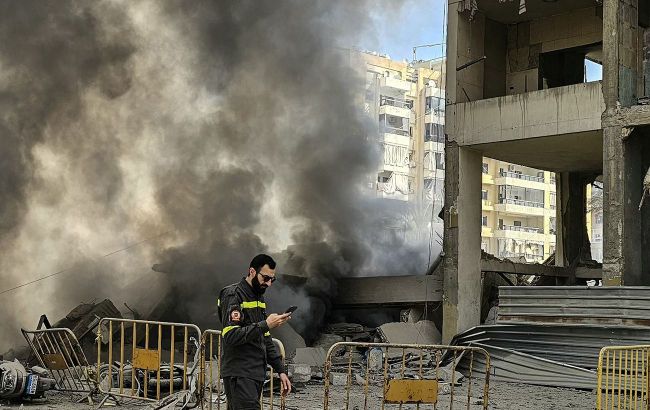 A man stands in front of a building destroyed by an explosion in Beirut (photo: Getty Images)
In response to attacks from Israel and the United States, Iran is launching large-scale strikes against its neighboring countries.
RBC-Ukraine explains Iran’s strategy and whether the affected countries will join the operation against Tehran.
Key points
- Scale of attacks. In less than a week of war, Iran has launched more than 800 missiles and 2,000 drones, attacking not only US bases but also the Persian Gulf countries, Türkiye, Azerbaijan and Cyprus.
- Hybrid approach. Iran avoids directly acknowledging strikes on civilian facilities in Arab countries, officially stating only that it is attacking American targets and using its proxy terrorists.
- Strategy of chaos. Tehran is deliberately striking its neighbors and oil infrastructure to provoke a global energy crisis and force the West to make concessions.
- Coalition in question. Despite the threat, potential US allies (Türkiye, the UAE, Azerbaijan) are currently cautious due to internal contradictions and fear of escalation. However, the situation may change.
The US-Israeli operation against Iran is affecting an ever-wider circle of countries. Iran is carrying out its “retaliatory strikes” against almost everyone along its perimeter borders, and even distant Cyprus has come under the crosshairs. Iran has already launched more than 800 missiles and 2,000 drones.
Among Iran’s many neighbors, Armenia, Pakistan, Afghanistan and Turkmenistan remain unattacked for now. Yet, the chaotic nature of Iranian strikes means no guarantee that these countries will not become new targets of the Islamists.
Besides direct missile and drone attacks, Iran is also trying to use its proxy forces, such as Lebanon’s Hezbollah and the Yemeni Houthis.
Iran’s strategy
According to Israeli military expert David Sharp, Iran deliberately chose the tactic of chaotic attacks on its neighbors. The idea is to inflame regional instability that would force Israel and the United States to seek reconciliation.
The main element of this strategy can be pressure on the fuel market: strikes on oil-producing Arab countries and a blockade of the Strait of Hormuz. This situation affects not only the Middle East but nearly the entire world, causing a rise in energy prices. It could potentially serve as an additional lever of pressure on the United States and Israel, as it makes them responsible for a global energy crisis.
David Sharp notes that Tehran is also trying to avoid excessive escalation. “Iran works quietly. For example, they do not say that they strike Qatari facilities, they officially say they strike American ones,” he told RBC-Ukraine.
This strategy relies on large stockpiles of strike weapons that Iran and its proxies accumulated over years of preparation for confrontation. Despite a significant blow to its missile forces and air defense units, Iran will continue to pose a threat for a long time. Especially to its closest neighbors and their oil infrastructure.
At the same time, Tehran is deliberately escalating even with countries that initially expressed skepticism about the American operation. Iran has already turned the Arab monarchies against itself.
Facilities of European countries have also come under Iranian attacks, despite Europe’s obvious lack of support for the operation. Further expansion of strikes risks increasing hostility and rallying the affected countries with the United States and Israel.
Possible response
Possible responses from the attacked countries remain in question. Extremely complicated relations between the states of the region may hinder a coordinated response to Iranian actions.
Victims of Iranian attacks include Saudi Arabia and the UAE — two countries that seriously compete with each other for influence in the region and beyond, for example, in Africa.
Azerbaijan, which recently became a new target of attacks, has excellent relations with Türkiye and very good ones with Israel. But at the same time, Türkiye and Israel are in extremely strained, if not hostile, relations. It remains open whether the countries affected by Iran will be able to put their old contradictions aside to address more urgent problems.
David Sharp believes these factors will not prevent unification, since Iran’s actions threaten everyone collectively. Among possible arguments in favor of joining, the expert also names political motives.
“This is a purely Eastern story. If you allow yourself to be beaten, both your enemies and your citizens see it. It hits internal support and can also strengthen the confidence of your enemies,” Sharp said.
According to the expert, some countries could unofficially join the US–Israeli operation against Iran without publicizing it. As an example, Sharp cites Azerbaijan.
President of Azerbaijan Ilham Aliyev has already declared that his country is not participating in the operation against Iran, but reserves the right to self-defense.
“In my opinion, the main factor is, first, these countries’ understanding that the United States and Israel are doing the main work,” Sharp said.
“And second, these countries realize their vulnerability in the event of a serious escalation.”
Meanwhile, militarily powerful Pakistan, which borders Iran, for example, sent Tehran a “friendly warning,” emphasizing that it has an agreement and security obligations to Saudi Arabia. But as long as Pakistani territory itself does not become a target of Iranian attacks, it is obviously not worth expecting Islamabad to join the anti-Iran coalition.
Indecision of the affected countries
The United States is obviously interested in bringing additional participants into the anti-Iran coalition. Despite an extremely successful air campaign, Iran currently does not demonstrate readiness to make concessions to the United States. So, they need more pressure.
One element of this could be a ground operation against Iran. In recent days, there has been an active discussion about involving Kurdish armed groups from Iraq, which could launch an offensive into Iranian Kurdistan. The BBC reports that the Kurds are ready, but no concrete decisions have yet been made.
Meanwhile, other countries are also in no hurry to act. Azerbaijan is demanding explanations from Iran regarding the drone attack. The UAE had previously spoken about a possible joining of strikes, but no official decisions have yet been made. Türkiye is extremely irritated by Iranian attacks but is also “closely monitoring” the actions of Kurdish militias.
For now, the latest iteration of the US–Iran conflict is tending toward significant expansion, turning into a real regional war. This is a conscious bet of the Iranian leadership, which primarily seeks to preserve itself and the Islamist regime as such in this confrontation.
To this end, they are attacking almost all countries within their reach, while simultaneously destabilizing global oil trade.
David Sharp believes the most correct decision would be a joint coordinated response to Iranian attacks. But there is a probability that indecision and old grievances will prevent even a situational alliance against a common enemy from forming.
Quick Q&A
– Which countries have already become targets of Iranian attacks?
– Apart from the US military bases in the Persian Gulf area, attacks have been carried out against Türkiye, Azerbaijan and Cyprus. Oil infrastructure in the region has also been attacked. For now, among all its neighbors, Iran is leaving Armenia, Pakistan, Afghanistan and Turkmenistan untouched.
– What is Iran’s strategy?
– According to expert David Sharp, Iran is deliberately fueling regional instability and striking the fuel market (in particular through a blockade of the Strait of Hormuz). The goal is to create a global energy crisis to blame the United States and Israel for it and force them to seek reconciliation.
– Is the international coalition ready for a joint response?
– Despite the common threat, the situation is complicated by internal conflicts. For example, competition between Saudi Arabia and the UAE or strained relations between Türkiye and Israel. Most countries are currently limiting themselves to monitoring or demanding explanations from Tehran.
Sources: statements from representatives of Pakistan, the UAE, Türkiye and Azerbaijan, articles from BBC, Reuters, and comments by David Sharp.