'Imperial tumor in head': Ukraine’s MFA strongly reacts to transcript of Putin-Bush conversation

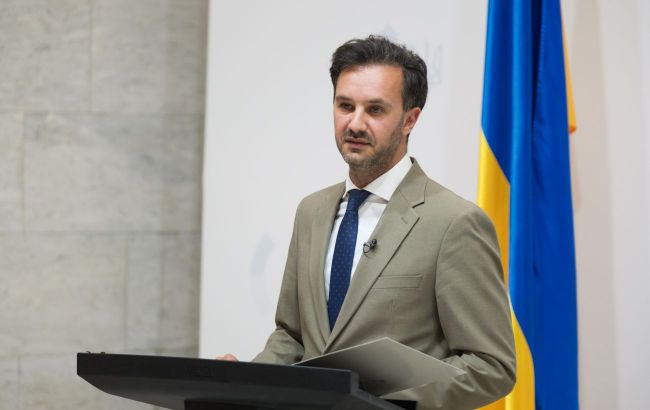 Photo: Heorhii Tykhii, spokesperson for Ukraine’s Ministry of Foreign Affairs (Vitalii Nosach/RBC-Ukraine)
The United States has published verbatim transcripts of talks between Russian President Vladimir Putin and US President George W. Bush held in 2001 and 2008. The documents demonstrate the Kremlin’s imperial vision toward Ukraine, according to a statement by Heorhii Tykhyi, spokesperson for Ukraine’s Ministry of Foreign Affairs.
"Putin denied Ukraine’s right to exist in 2001. 21 years before full-scale invasion and 13 years before the Revolution of Dignity, which he often blames as the 'root cause' for the war. The root cause has always been and remains the imperial tumor in his and other Russian heads," the Foreign Ministry spokesperson wrote on Twitter (X).
During the 2001 conversation, Putin said that Ukraine’s accession to NATO would inevitably create a conflict between Russia and the US. When Bush asked "why," he replied that Ukraine was an "artificially created complex state" that was allegedly not a fully formed nation.
According to Putin, Ukraine was "formed" from the territories of other states:
-
Western regions, he claimed, were taken from Poland, Romania, and Hungary after World War II;
-
Eastern regions were allegedly transferred from Russia in the 1920s–1930s;
-
Crimea, he said, was transferred to Ukraine in 1956.
In addition, Putin insisted that one-third of Ukraine’s population was Russian and that a significant share of citizens allegedly viewed NATO as a hostile alliance.
In 2008, during another meeting with Bush, the Kremlin’s rhetoric remained the same. Putin again called Ukraine an "artificial state," predicted the country’s fragmentation, and openly threatened to create problems in response to NATO’s expansion.
"Russia will work to prevent NATO from expanding. Russia will create problems here all the time," the Russian President said at the time, questioning the very rationale of Ukraine’s potential membership in the Alliance.
The published documents once again refute the Kremlin’s narrative that the war against Ukraine was a reaction to the 2014 Revolution of Dignity or to the West’s "mistakes."
In reality, as the transcripts show, the denial of Ukrainian statehood has been part of Putin’s worldview at least since the early 2000s.
These same theses — about an "artificial state," the "fragmentation of Ukraine," and the "threat from NATO" — later formed the basis of the Kremlin’s ultimatums to the West, the annexation of Crimea in 2014, the war in Donbas, and the full-scale invasion in 2022.
Peace negotiations
Recently, Ukrainian President Volodymyr Zelenskyy, speaking with media representatives, unveiled a draft peace agreement that had been developed over the past weeks by the US, Ukraine, and European allies.
The document stipulates that Russia must withdraw its troops from the territories of Dnipropetrovsk, Mykolaiv, Sumy, and Kharkiv regions. At the same time, the issue of Donetsk remains unresolved, as the parties have not yet reached an agreement.
Kyiv is also considering holding elections as soon as possible after the signing of the peace agreement. Regarding the Zaporizhzhia Nuclear Power Plant, no compromise solution has been found so far.
The peace initiative to resolve the situation in Ukraine is currently under consideration. The further course of events directly depends on the decisions of Russian President Putin.