How Macron blocked an EU loan plan and reshaped funding for Ukraine

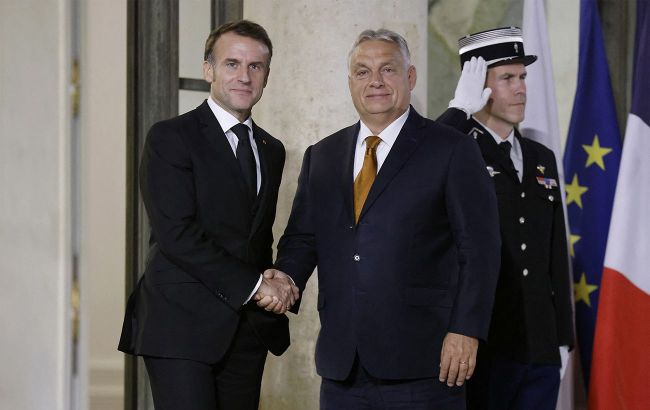 Photo: Emmanuel Macron and Viktor Orbán (Getty Images)
French President Emmanuel Macron played a decisive role in derailing a plan to provide a loan for compensation of damages and in steering the European Union toward an alternative mechanism for financing Ukraine, according to Politico.
According to sources quoted by the media outlet, the turning point came around 10:00 p.m. on Thursday, December 18, after EU leaders received a revised legal draft of the Ukraine aid proposal. At the same time, Italian Prime Minister Giorgia Meloni sharply criticized the plan.
While some leaders were caught off guard by the developments, France was simultaneously working on a Plan B that envisaged a different financing format. According to POLITICO’s sources, Paris believed it was essential to have a backup option even before the European Council summit began.
Macron’s aides held talks with the Hungarian side to ensure that, if the reparations loan collapsed, Hungarian Prime Minister Viktor Orbán would not veto the alternative option — the use of joint borrowing or the EU budget reserve. Other countries, including Belgium, were also involved in contacts with Budapest.
In addition, Macron personally spoke with Orbán during the summit when concerns over a potential Hungarian veto intensified. The key signal was Orbán’s statement that he was ready not to block the use of the EU budget reserve to continue financing Ukraine.
Slovakia and Czechia were also prepared to support this option, provided they did not have to participate in the loan mechanism for Ukraine. As a result, the so-called Plan B, previously seen as unlikely, effectively became the only acceptable solution.
Although some participants in the talks felt “misled,” diplomats acknowledge that Macron played a central role in implementing the alternative scenario. One EU official described it as a “masterclass” by the French president.
Politico also notes that Macron’s influence within the EU had weakened for some time due to domestic political problems in France, allowing German Chancellor Friedrich Merz to strengthen his position as one of Europe’s leading voices. Nevertheless, thanks to his experience and behind-the-scenes diplomacy, Macron demonstrated that he remains one of the EU’s most influential leaders.
Financial support for Ukraine
Earlier, the European Union discussed the possibility of directing frozen Russian assets toward financing aid for Ukraine, but this idea encountered significant resistance from several countries.
In particular, Belgium opposed such a mechanism, as a large share of the assets is held at the Brussels-based depository Euroclear. The decisive factor was the position of the Belgian government and Prime Minister Bart De Wever, who insisted on unlimited guarantees against potential financial and legal risks. This forced European leaders to look for another option — joint borrowing.
The decision was made against the backdrop of statements by Russian leader Vladimir Putin about his intention to continue the war, making financial support for Ukraine critically important for its resilience in the fifth year of Russia’s full-scale aggression.
In effect, the EU acknowledged that assistance to Ukraine is a long-term financial commitment that must be secured already now.
At the summit, EU member state leaders agreed to allocate €90 billion in support for Ukraine in 2026–2027. This concerns a concessional loan that was considered a fallback scenario in case the mechanism for using frozen Russian assets is never implemented.
Ukrainian Finance Minister Serhii Marchenko noted that for Kyiv these funds are effectively interest-free and conditionally non-repayable: repayment would only be possible after Russia compensates Ukraine for the damages caused by the full-scale war.
Earlier, European Commission President Ursula von der Leyen emphasized that the summit would continue until participants reached an agreed decision on financial support for Ukraine.
At the same time, Germany warned its EU partners that abandoning the reparations loan could negatively affect credit ratings and lead to higher interest rates across Europe.