Half a million take to the streets in France as riots erupt in cities

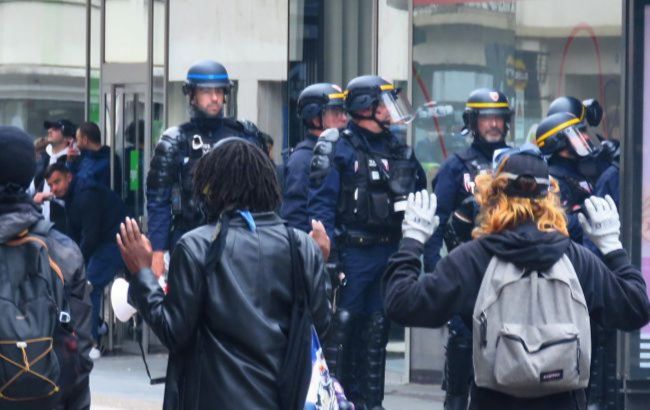 Protests in France escalate into riots across the country (photo: molaire2/Flickr)
At least 550,000 people took to the streets across France on October 17 to protest the rising cost of living. Riots broke out in cities amid the demonstrations: a 19th-century city hall burned down in Limoges, and around 400 people were detained, according to Le Monde.
French Interior Ministry said 550,000 people took part in the demonstrations, including 110,000 in Paris. Organizers put the figure at 800,000. Schoolchildren and university students led the protests, joined by the Yellow Vests (Gilets jaunes), trade unions, and political activists.
Peaceful marches turned into riots in the evening. Interior Minister Laurent Nuñez said far-left groups were behind the destruction, along with "opportunistic criminals" who took advantage of the chaos.
Mass #protests in #France over the rising cost of living have escalated into riots.
— RBC-Ukraine (@NewsUkraineRBC) October 17, 2026
The protests have been going on for several weeks. They began with school and university blockades, before trade unions and the Yellow Vests (Gilets jaunes) joined schoolchildren and students.… pic.twitter.com/e1Mwzjt4Mu
What was destroyed
-
Limoges: Protesters smashed the city hall windows, broke into the building, and set it on fire. The 1883 building, modeled on Paris City Hall, has been largely destroyed: its roof collapsed, and two-thirds of its facade was lost. The prefect called it a disaster for the heritage.
-
Bordeaux: Rioters stormed the prefect's residence, set fire to the courtyard, and vandalized the premises. The RAID police tactical unit was called in. On the city's main shopping street, a Decathlon store was looted and set on fire, with the flames spreading to a residential building.
-
Marseille, Lille, Calais, and Angers: Protesters attempted to break into city halls.
-
Lyon: Protesters burned down a tourist office.
-
Paris: Mayor Emmanuel Grégoire said entire streets had been "systematically ransacked."
Stores were also looted in Strasbourg, Rouen, Nantes, Rennes, Toulouse, and other cities.
Mass #protests in #France
— RBC-Ukraine (@NewsUkraineRBC) October 17, 2026
In #Limoges, protesters set fire to the historic 19th-century city hall, which has been largely destroyed. In #Bordeaux, protesters vandalized the prefect's residence, while stores were looted in #Paris, #Lyon, #Nice, and #Rennes. #Macron promised to… pic.twitter.com/5iyu9s9BlW
Injuries
Interior Ministry reported that 60 security personnel were injured, two of whom were taken to the hospital unconscious. In Saint-Étienne, a police grenade tore off the hand of a 17-year-old protester who had picked it up from the ground. The police inspectorate is investigating.
Government response
"Those who have broken, attacked the prefectures as well as businesses, looted even our town halls, will be prosecuted and punished," French President Emmanuel Macron said.
Prime Minister Sébastien Lecornu convened a crisis response meeting. Justice Minister Gérald Darmanin instructed prosecutors to seek detention for those involved in the riots. However, the government does not plan to declare a state of emergency.
The opposition parties have traded blame. Jean-Luc Mélenchon, leader of La France Insoumise, accused the police of having orchestrated the disorder, while Marine Le Pen blamed La France Insoumise for pushing the country into chaos.
Trade unions are calling for the protests to continue. The next nationwide strike action is scheduled for November 5.
The protests in France began in mid-September at a high school in Créteil, a suburb of Paris. Teachers and students there protested underfunding and a shortage of educators. Within weeks, the movement spread to hundreds of schools nationwide, and university students joined in by blocking campuses.
Young protesters are demanding €10 billion in funding for high schools and the abolition of Parcoursup, the government's university admissions platform. At the peak of the protests on October 6, protesters disrupted around 800 high schools, and on October 13, 480,000 people took to the streets. Heavy-handed police action against schoolchildren further fueled the anger.
Meanwhile, a call to protest the rising cost of living and fuel prices spread on TikTok on October 17 and gained support among the Yellow Vests movement. As a result, schoolchildren, university students, and trade unions all took to the streets that day.